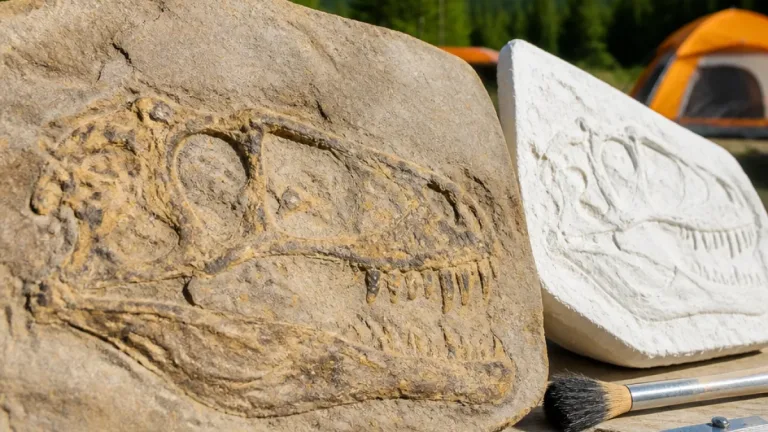

A series of enormous footprints found in the badlands of North Dakota is believed to be the first known trackway made by an adult Tyrannosaurus rex, a discovery that could provide new evidence about how the giant predator moved more than 66.5 million years ago.
The prints were discovered by Kent Hups, a science teacher at Northglenn High School in Colorado, while he was exploring the Hell Creek Formation in 2025. What began as a search connected to a lifelong interest in tyrannosaur fossils instead led to a much rarer type of evidence: a sequence of footprints preserved in rock.
“It’s been unbelievable. It’s a dream come true,” Hups told CBC’s As It Happens.
Footprints can answer different questions
Fossil bones can reveal the size, shape and anatomy of an extinct animal. A trackway, by contrast, records an animal in motion. The spacing and arrangement of individual prints may help researchers examine how a dinosaur carried its body and moved across the landscape, although footprints do not preserve every detail of that movement.
That makes the discovery notable even though T. rex fossils are relatively common. Dinosaur paleobiologist Jordan Mallon, who was not involved in the research, said the tracks of the species are unusually scarce compared with its bones. A single footprint can establish that an animal passed through an area; a connected series offers a broader record of its behaviour at one moment in the distant past.
The newly identified prints are now the subject of a study co-authored by Hups and published in September in the Journal of Vertebrate Paleontology. The findings were also presented to the public last week, when the excavated footprints were unveiled at the Denver Museum of Nature & Science.
Why the discovery matters
The trackway adds to the evidence available to scientists studying tyrannosaurs, but it does not by itself resolve every question about how adult animals travelled. Its value lies in preserving a physical trace of movement rather than another isolated part of the skeleton. Researchers can compare the prints with known T. rex anatomy and with other dinosaur tracks as they continue assessing what the sequence can show.
- Location: the Hell Creek Formation in North Dakota.
- Discoverer: Kent Hups, a Colorado high school science teacher.
- Scientific status: the subject of a study published in the Journal of Vertebrate Paleontology.
- Public unveiling: the Denver Museum of Nature & Science.
Hups had hoped since childhood to find a tyrannosaur bone. Instead, the discovery may offer a different kind of connection to the animal: not simply evidence that a T. rex existed, but a preserved indication that one moved across the ancient landscape. Further study will determine how much information the trackway can yield about the habits and locomotion of adult tyrannosaurs.