Prince Edward Island’s elected members are drawing salaries well above those of most American state representatives, according to a new study from the Canadian Taxpayers Federation (CTF). The report also highlights the province’s comparatively high tax rates and relatively low economic output per person.
How Island pay compares
The CTF found the median salary for Canadian provincial politicians was $113,637, nearly three times the median for American state house members, which the report places at $45,002. On Prince Edward Island, MLAs receive a base salary of $84,598, described in the report as “nearly double” the U.S. median.
“Prince Edward Island MLAs are paid significantly more than their American peers yet they’re not delivering better results,” said Devin Drover, CTF Atlantic director.
Alongside pay, the report draws attention to tax and economic indicators. It states P.E.I. has a higher combined top marginal tax rate than any U.S. state and ranks among the lowest jurisdictions in North America for GDP per capita.
Local context and recent change
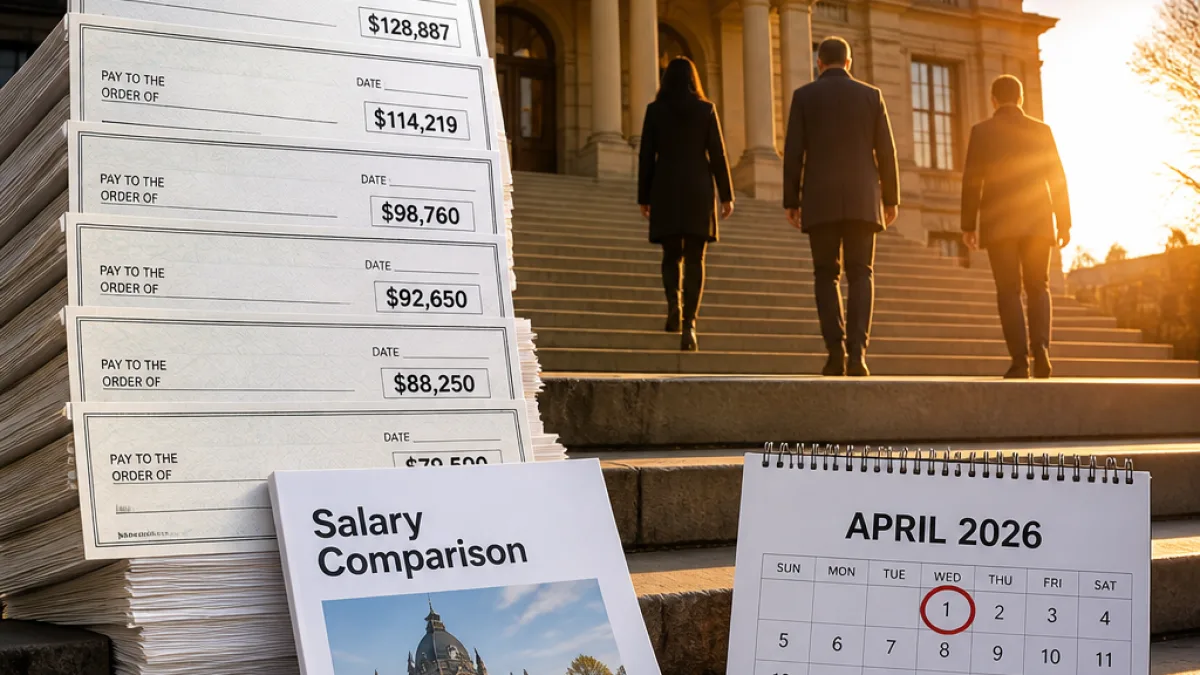
The report notes a further development for Island politicians: MLAs received an automatic increase of 2.75 per cent, taking base pay to $86,924, effective April 1, 2026. That raise was applied without a vote in the legislature, the report says.
The CTF frames these facts as a concern for taxpayers, arguing larger paycheques have not translated into better outcomes for residents. The report quotes the Atlantic director saying higher salaries and high taxes present a poor combination for families on the Island.
- Median Canadian provincial politician salary: $113,637
- Median American state representative salary: $45,002
- P.E.I. MLA base salary (pre-raise): $84,598
- P.E.I. MLA base salary (after 2.75% raise): $86,924 (effective April 1, 2026)
| Measure | Reported figure |
|---|---|
| Median Canadian provincial salary | $113,637 |
| Median U.S. state representative salary | $45,002 |
| P.E.I. MLA base salary (before April 1, 2026) | $84,598 |
The report also points out that despite higher pay levels for politicians, P.E.I. has the third-lowest GDP per capita among provinces and U.S. states, and a combined top marginal tax rate higher than any U.S. state, according to the CTF’s analysis.
What this means for Islanders
For residents watching household budgets, the CTF’s presentation ties elected officials’ remuneration to broader questions about tax burdens and provincial economic performance. The organisation urges politicians to prioritise reducing costs for families rather than increasing their own compensation.
The CTF’s full Subnational Politician Pay Report contains the complete dataset and methodology used for these comparisons. The federation’s statements and the figures above reflect the conclusions published in that report.
As Islanders debate public spending and priorities, the report is likely to prompt further public and political scrutiny of MLA pay, tax levels and measures aimed at strengthening the province’s economy.