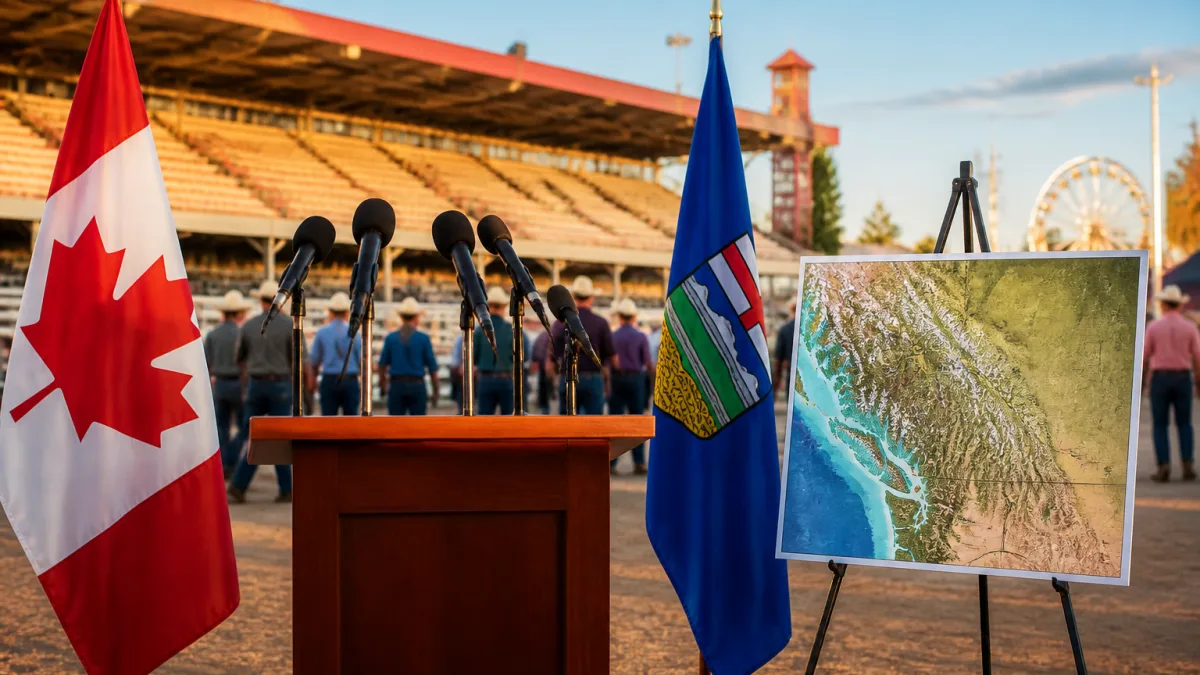
Carney presses unity message in Calgary, flags risks of separation talk
At the close of the Calgary Stampede, Prime Minister Mark Carney used a high-profile stop in Alberta to argue the province and the country are better off together, while cautioning that the current push to test support for independence amounts to a high-risk political wager. In a sit-down with CTV News Calgary, Carney said both Canada and Alberta would face losses if the province moved toward secession.
“Canada works,” Carney said. “It can work better and it works better when people are engaged.”
Carney framed the recent revival of separatist debate as a “dangerous game” that could backfire on Albertans, pointing to his own experience as governor of the Bank of England during the 2016 Brexit referendum. He referenced the economic blowback that followed a narrow Leave win in the United Kingdom and argued an Alberta exit from Confederation would unravel benefits that come from national and international accords.
- He warned that secession could “rip up” free trade agreements Canada currently enjoys.
- He said Alberta and Canada both have a lot to lose if a vote on independence proceeds.
“We’re fighting Canada and building up the country,” he said. “My job is to make Alberta stronger, to make Canada stronger. We’re making real progress on that.”
Referendum question floated as separatist movement draws attention
His remarks come as Alberta’s secessionist movement has dominated the national conversation in recent months. Premier Danielle Smith has moved to place a question before voters on whether the province should hold a referendum asking if Alberta ought to remain within Canada. No vote has been scheduled, but the premier’s intent to consult Albertans on the matter has kept the unity issue near the forefront of provincial politics.
Carney suggested that even airing the question invites uncertainty, saying Canada is “stronger when we’re together” and that outcomes from sovereignty referendums can reverberate far beyond the ballot box. His comments emphasized process and engagement over confrontation, with an appeal to keep national and provincial interests aligned.
Pipeline proposal: Alberta-to-Delta route filed without private backer
The unity message came alongside a renewed pitch for a major energy corridor. Carney noted that his last visit to Calgary included a joint appearance with Smith to confirm a pipeline proposal has been filed with the federal major projects office. The line would originate in Bruderheim, northeast of Edmonton, run largely along the existing Trans Mountain route, and terminate at a coastal terminal in Delta, B.C.
According to the leaders’ earlier outline, the system is conceived to move up to one million barrels per day to tidewater, positioning Alberta crude for export to Asian markets. The submission, however, went in without a private investor attached, and the projected capital cost presented publicly sits in a wide band.
| Aspect | Details |
|---|---|
| Proposed capacity | ~1,000,000 barrels/day |
| Route | Bruderheim, AB to Delta, B.C. (largely alongside Trans Mountain) |
| Estimated cost | $35.2B–$43.7B |
| Private investor | No (proposal submitted without one) |
The Alberta government has said it has already put $18.3 million into planning work tied to the concept. While project timelines, regulatory pathways and financing remain to be clarified, the plan has been presented by both leaders as part of a broader effort to expand market access for the province’s energy sector.
Economic stakes and parallels to Brexit
Carney’s intervention merges two themes that resonate in Alberta: the desire for greater prosperity through infrastructure that links resources to global buyers, and unease about the economic volatility that can follow constitutional rupture. Drawing from the Brexit experience, he underscored how a close referendum result can trigger sustained uncertainty, policy churn and investor caution.
His argument focused on preserving advantages that flow from Canada’s trading architecture. In that frame, the pitch for a new pipeline is presented as a way to strengthen Alberta within a functioning federation, not apart from it.
What to watch next
Alberta residents can expect continued debate over the scope and wording of any question related to a potential independence referendum, as well as scrutiny of the pipeline proposal’s feasibility. Key issues include:
- Whether the province proceeds with asking voters to authorize a future referendum on remaining in Canada.
- How the pipeline plan advances through regulatory review and whether private capital steps forward.
- The balance provincial leaders seek between asserting autonomy and securing national-level approvals needed for energy exports.
For now, Carney’s message in Calgary attempted to cool separatist momentum while keeping attention on projects he contends would make both Alberta and Canada more competitive. His comments situate the unity debate alongside practical economic choices facing the province in the months ahead.