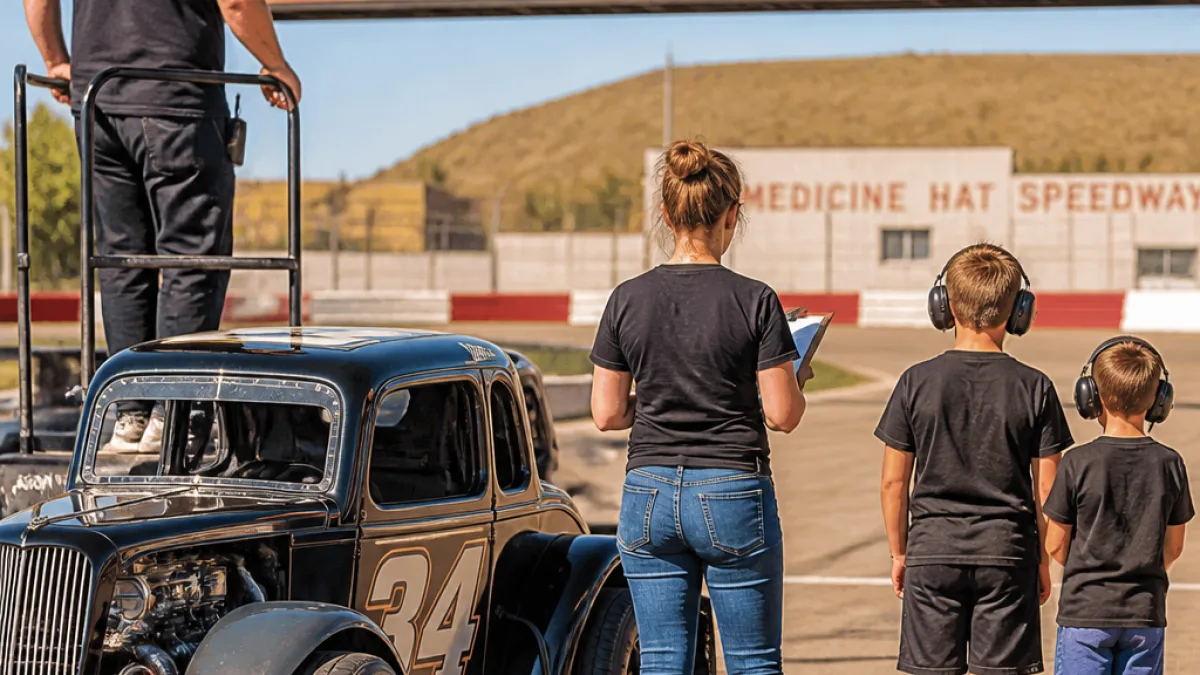
A Medicine Hat racer will make his first appearance in a Legend Car event in Idaho this summer as his family pursues the longer-term goal of returning the class to Medicine Hat Speedway.
New car, new environment
The driver, Rhett Pearce, will compete in a 1937 Chevrolet–style Legend Car powered by a Yamaha engine. The car is capable of speeds approaching 200 kilometres an hour and represents a marked change from the Mini Cup cars he currently races in Alberta.
The move also means adapting to different race-day procedures. Events in Idaho require drivers to use a spotter for communication during the race, a practice not common at most Alberta races. Rhett’s father, Roy Pearce, will take on the spotter role for the first time.
“I’m feeling really excited,” Pearce said.
Family hopes and local consequences
Rhett’s mother, Michelle Pearce, described the Idaho weekend as more than a single event. The family views it as an early step in a possible transition: Rhett has considered finishing Mini Cup racing by the end of the summer and moving toward Legend Cars on a full‑time basis in the United States.
Beyond personal ambition, the family is using the opportunity to connect with other Legend Car competitors and organisers with the explicit aim of bringing the class back to Medicine Hat. The speedway hosted Legend Cars during the COVID‑19 pandemic, but many drivers subsequently moved to dirt racing. That migration left too few competitors to sustain an asphalt Legend Car division in Medicine Hat.
Practical differences and challenges
The transition involves several practical differences for the team and driver:
- Vehicle performance: Legend Cars are faster and mechanically different from Mini Cups.
- Race communication: Use of spotters in U.S. events requires new in‑race coordination between driver and spotter.
- Competitive field: Racing in the U.S. will expose the driver to new competitors and varied track conditions.
Roy Pearce said the family is proud but apprehensive about the added responsibility of serving as spotter. He acknowledged the team’s confidence in Rhett’s abilities while noting the pressure that comes with adapting to new procedures in a higher‑speed car.
What this means for Medicine Hat Speedway
Reviving Legend Cars at Medicine Hat Speedway would require rebuilding a sufficient roster of drivers interested in asphalt competition. The Pearce family hopes that connections made at events like the Idaho race will help drum up interest and recruit drivers back to asphalt racing in the city.
| Aspect | Mini Cup (Alberta) | Legend Car (Idaho event) |
|---|---|---|
| Styling | Small, current regional class | 1937 Chevrolet–style body |
| Engine | Different specification (regional) | Yamaha |
| Top speed | Lower than Legend Cars | Approaching 200 km/h |
| Spotter use | Generally not used in Alberta events | Required at the Idaho event |
If successful in building relationships and interest, the family’s efforts could restore a once‑present class to local asphalt racing, expanding the weekly offerings at Medicine Hat Speedway and giving local fans a return of the small‑block, vintage‑styled wheel‑to‑wheel competition they saw during the pandemic years.
For now, the immediate test for Pearce and his crew will be whether they can translate current Mini Cup success into competitiveness in a faster, mechanically different car and whether new communication routines with a spotter can be established under race conditions.