British Columbia and the Simpcw First Nation have formalized how the proposed Yellowhead Copper project will be evaluated, signing an agreement that requires the nation’s consent in addition to any provincial environmental approval.
Consent and parallel assessments
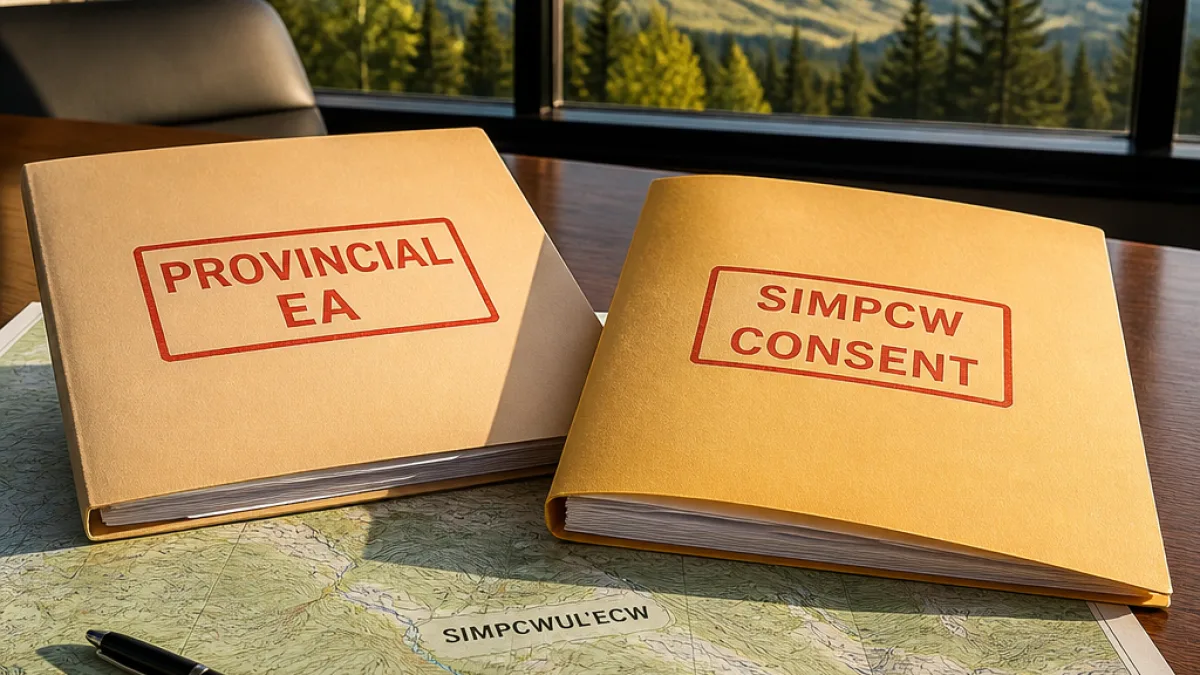
The accord, announced by the province on July 16, aligns the Environmental Assessment Office’s (EAO) process with Simpcw’s own review. Under the terms, both the EAO’s environmental assessment certificate and explicit Simpcw consent are prerequisites for the Trektor Metals Limited-linked proposal to advance.
The mine is proposed within Simpcwul’ecw, roughly 150 kilometres northeast of Kamloops. The agreement is intended to provide regulatory clarity by allowing the two governments to carry out their assessments cooperatively while making separate, independent decisions.
Local governance and community involvement
Simpcw Ku̓kwpi7 (Chief) George Lampreau described the move as a milestone for the nation, noting it is the first time Simpcw has applied their consent process to a major project. He said the community helped shape the process so it reflects Simpcw values, laws and decision-making priorities.
“We worked closely with our community to develop this process, ensuring it reflects our values, our laws and our vision for how decisions should be made in Simpcwul’ecw,”
According to the province, the arrangement aims for an "efficient, timely, collaborative and consent-based approach" that allows both parties to gather information needed to inform their respective decisions.
Who signed the agreement
The document was signed by leaders and ministers from both governments. Signatories listed by the province include:
- George Lampreau, Simpcw Ku̓kwpi7 (Chief)
- Tamara Davidson, Minister of Environment and Parks
- Spencer Chandra Herbert, Minister of Indigenous Relations and Reconciliation
- Jagrup Brar, Minister of Mining and Critical Minerals
| Signatory | Role |
|---|---|
| George Lampreau | Simpcw Ku̓kwpi7 (Chief) |
| Tamara Davidson | Minister of Environment and Parks |
| Spencer Chandra Herbert | Minister of Indigenous Relations and Reconciliation |
| Jagrup Brar | Minister of Mining and Critical Minerals |
Provincial officials framed the agreement as supporting regulatory certainty while acknowledging the sovereign decision-making rights of the Simpcw Nation.
What this means locally
For residents and stakeholders in and around Kamloops and Simpcw territory, the pact means the project cannot proceed on the basis of a provincial approval alone. It also signals an emerging model in B.C. for how Indigenous consent processes and provincial reviews might be coordinated for major resource developments.
Details remain to be developed about timelines, specific information-sharing protocols and how community engagement will be carried out at each stage. The agreement nonetheless marks a formal step toward integrating Indigenous governance into the assessment phase for a potentially large mining development on unceded territory.
InfoRadar will continue to monitor subsequent filings and notices from the Environmental Assessment Office, Simpcw leadership and project proponents as the review unfolds.