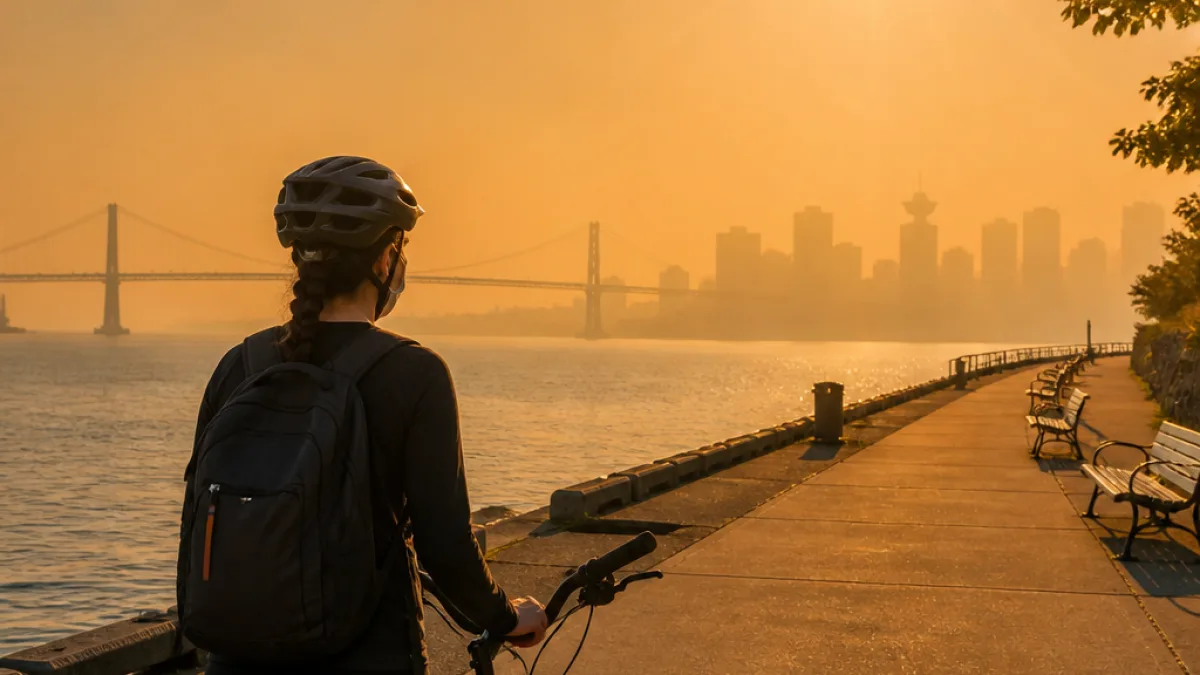
Metro Vancouver woke to thick wildfire smoke on Wednesday as air-quality readings climbed to the upper end of Environment Canada’s scale across large parts of the region. The haze is coming from multiple southern Interior fires, including the Brunswick Creek and Big Bar Complex incidents that have been sending smoke into the Lower Mainland.
Health risk and alerts for residents
Environment Canada and regional health authorities have flagged areas north of the Fraser River — including Vancouver, Burnaby, the North Shore, Coquitlam and Maple Ridge — as exposed to high-risk smoke conditions. Several reports put local air quality at Level 9 on the 10-point scale; the Eastern Fraser Valley has been described as reaching Level 10+, a classification that denotes very high risk.
Public-health guidance for those readings is clear: people should reduce or reschedule strenuous outdoor activity, and those who are at greater risk — the elderly, young children and people with respiratory or cardiac conditions — should avoid outdoor exertion.
- Air-quality warnings: Yellow and Orange advisories are in effect across Metro Vancouver and parts of the Fraser Valley.
- Smoke sources: Plumes from the Brunswick Creek and Big Bar Complex fires are being carried into the Lower Mainland.
- Vulnerable groups: Residents with pre-existing health conditions should take immediate precautions.
Officials have also reiterated standard protective steps: keep windows and doors closed, run air conditioners on recirculate where possible, and use properly fitted masks when outdoors if necessary.
Fires, damage and the wider provincial picture
The smoke arrives amid a severe fire season in British Columbia. Provincial authorities report roughly 115 wildfires burning across the province, with five described as fires of note near communities such as Boston Bar, Clinton, Vernon and Kimberley. The Okanagan region has seen some of the worst property losses: local reports indicate about 230 homes were confirmed destroyed on the Okanagan Indian Band reserve near Okanagan Lake.
Emergency Management Minister Kelly Greene said that about 8,000 people have been forced from their homes across B.C. because of wildfires. The human toll and disruption have prompted calls from Indigenous leaders for stronger provincial action, including questions over whether a provincial state of emergency should be declared.
“Thousands of British Columbians have been forced from their homes,” said Spuzzum First Nation Chief Janice Kuester, urging a provincial emergency declaration.
Weather-driven risks and response capacity
BC Wildfire Service officials warn that the situation could worsen. Cliff Chapman noted forecasts of rising temperatures into the mid-30s Celsius and the possibility of dry lightning, conditions that increase the likelihood of new fire starts. The service has helicopters and fixed-wing aircraft on standby to respond to emergent blazes.
| Metric | Reported figure |
|---|---|
| Homes destroyed (Okanagan reserve) | ~230 |
| People evacuated provincewide | ~8,000 |
| Active wildfires (approx.) | 115 |
| Local air-quality level | 9–10+ |
For Vancouver residents, the immediate concern is health and those secondary impacts that accompany thick smoke: reduced outdoor recreation capacity, potential stress on health-care services and complications for people who must work outdoors. With hot, dry weather and lightning in the forecast, officials say crews are preparing for another demanding period.
City and regional authorities will continue to update air-quality advisories and evacuation notices as conditions evolve. Residents should monitor official channels for the latest warnings and follow health guidance to limit smoke exposure.