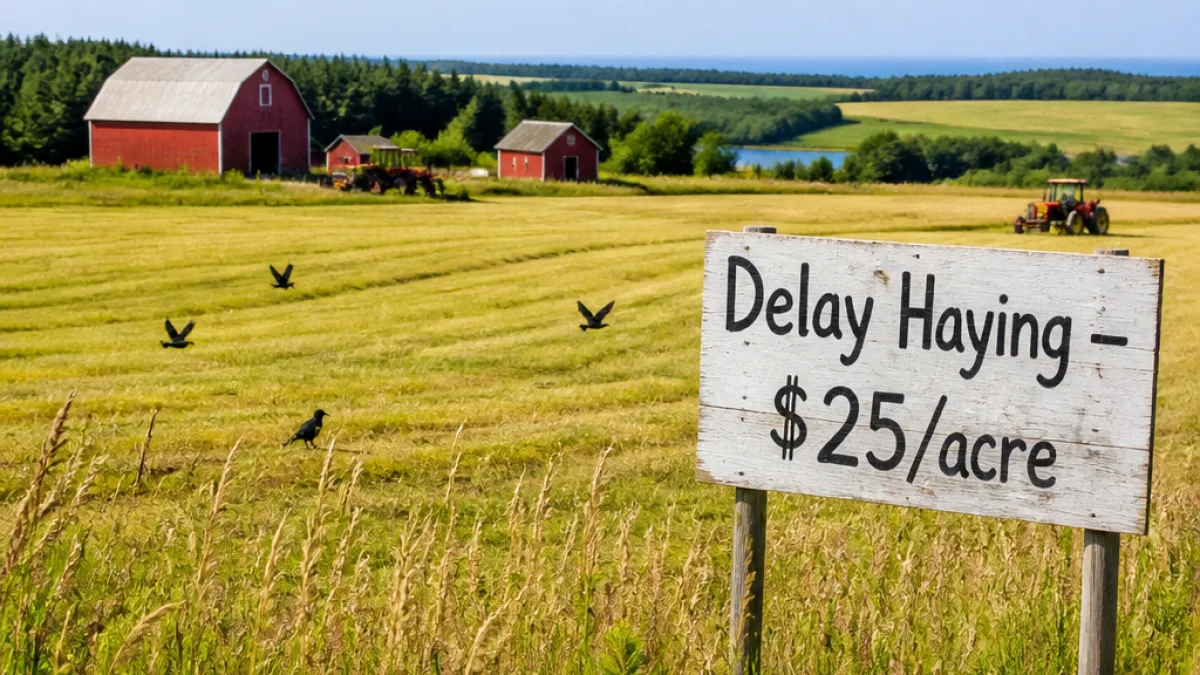
Across Prince Edward Island, some farmers are shifting the calendar for their first hay cut to help a small grassland songbird that nests in hay fields. Under an incentive through the province’s Alternative Land Use Services (ALUS) program, growers who delay harvest are paid to reduce the risk that young birds will be killed or injured by machinery.
Why the delay matters
The target species is the bobolink, a migratory grassland bird listed as threatened under federal law. The timing of a later cut is intended to allow nestlings to leave the nest and avoid haying equipment. This year, fields enrolled in the program were to be left uncut until after July 15.
“That is the point in time that the young will have fledged, and so they will be able to escape from any hay harvesting equipment,” said Erica MacDonald, agriculture climate action specialist with the P.E.I. Department of Agriculture. “It just gives them a leg up on things.”
How the incentive works
Farmers who take part receive a payment intended to offset income lost by postponing the first cut. Under the program the rate is $25 per acre. Program staff acknowledge the amount does not fully replace potential earnings from an earlier harvest, but many participants say conservation and stewardship are motivating factors.
- Program: ALUS (Alternative Land Use Services)
- Species helped: bobolink (threatened)
- Delay target date: after July 15
- Payment: $25 per acre
Local context and choices for farmers
On the Island, hay fields provide nesting habitat for several grassland species. Farmers who enrol make a managed trade-off: later cutting can reduce the quantity or quality of a first cut but aids biodiversity. Officials say many participants value the recognition and the environmental benefits the initiative fosters.
| Item | Detail |
|---|---|
| Program name | ALUS (P.E.I.) |
| Target species | Bobolink |
| Cutting date advised | After July 15 |
| Payment rate | $25 per acre |
For farmers weighing the decision, officials stress that the program sits within a broader suite of stewardship options that aim to balance agricultural production and wildlife habitat. Supporters say maintaining biodiversity can provide long‑term benefits to farmland resilience.
Island residents looking for more information on eligibility or how to enrol should contact the P.E.I. Department of Agriculture or the local ALUS coordinator to learn about timelines and any additional practices that may be available through the program.
The delayed-harvest measure is one of several conservation tools in use across the province to protect species at risk while keeping working landscapes productive.