
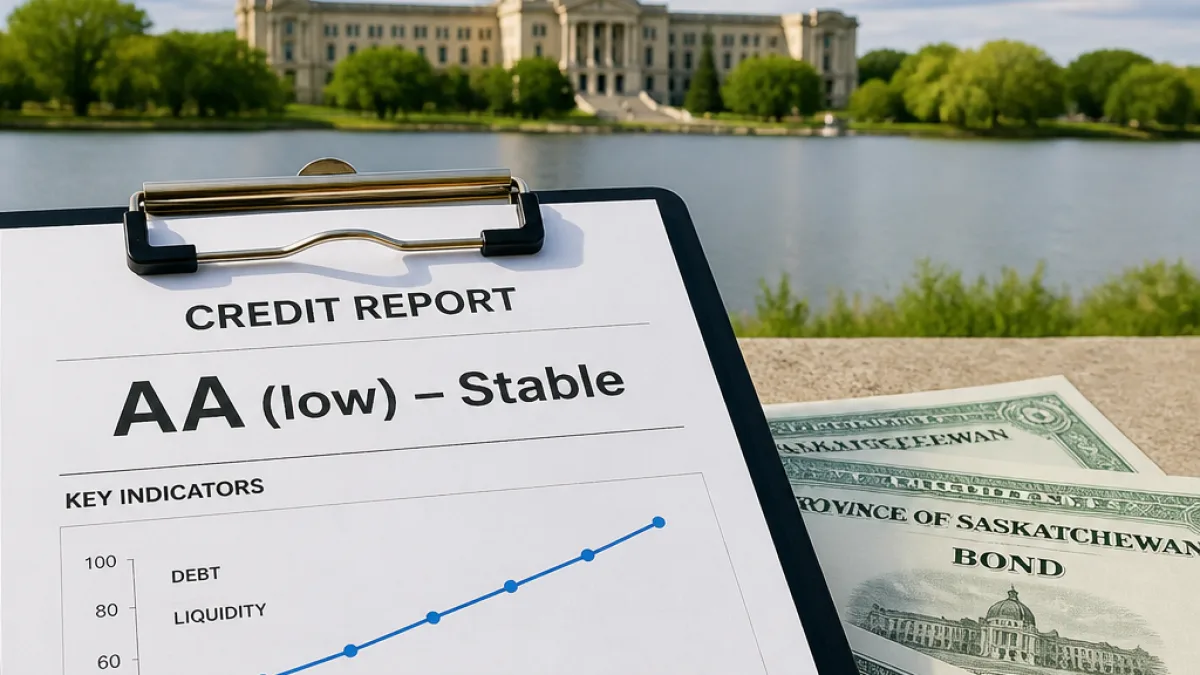
DBRS Morningstar reaffirms Saskatchewan’s standing
REGINA — Saskatchewan’s credit standing has been reaffirmed at AA (low) for long-term obligations and R-1 (middle) for short-term borrowing by DBRS Morningstar, with the agency maintaining a stable outlook on both ratings. The confirmation, unchanged from six months ago, underscores the province’s continued access to relatively low-cost financing despite a projected deficit and a growing debt load.
In its assessment, the agency linked provincial credit strength to Saskatchewan’s relationship with the federal government — which carries a AAA rating with a stable trend — and pointed to fundamentals such as prudent debt management, ample liquidity, a rising population and recent years of above-average economic growth. The stable trend signals DBRS Morningstar’s view that Saskatchewan can weather short-term economic softness or swings in commodity prices without a material deterioration in its credit profile.
“[Saskatchewan] remains well positioned to withstand any temporary weakness in the macroeconomic backdrop and/or commodity price volatility without materially eroding its credit profile.”
At the same time, analysts flagged fiscal headwinds. The province is forecasting an $819.4 million deficit, with a gradual return to balance anticipated by 2030–31. DBRS Morningstar estimates the operating deficit-to-operating-revenues ratio at 3.8% in 2026–27, with improvement expected thereafter. The combination of ongoing deficits and significant capital spending requirements is pushing up the overall debt burden; however, the report notes that the increase remains manageable and that Saskatchewan’s liquidity position is strong.
What the ratings mean for residents and communities
Credit ratings help determine how much a government pays to borrow for day-to-day cash needs and for long-lived assets such as transportation links and public facilities. By holding at AA (low), Saskatchewan preserves investor confidence and keeps a lid on interest costs across the public sector — a consideration that can influence everything from provincial budget room to the costs passed through to Crown agencies and, indirectly, ratepayers and taxpayers.
DBRS Morningstar’s short-term designation of R-1 (middle) indicates solid capacity to meet near-term obligations, an important factor for cash management and routine market access. The stable outlook, in turn, reduces the likelihood of abrupt borrowing cost changes for municipalities, school divisions and health authorities that align their planning with provincial fiscal conditions.
| Instrument | DBRS Morningstar rating | Outlook |
|---|---|---|
| Issuer/Long-term debt | AA (low) | Stable |
| Short-term debt | R-1 (middle) | Stable |
Fiscal context: balancing investment and restraint
DBRS Morningstar’s analysis highlights a tension familiar to resource economies: revenue sensitivity to commodities on one side and sustained funding pressures on the other. The agency notes that high spending needs, coupled with softer revenue growth, are weighing on finances. Even so, Saskatchewan’s balance sheet, aided by risk management and liquidity reserves, is assessed as resilient enough to navigate near-term volatility.
The projected return to balance by 2030–31 offers a fiscal anchor for medium-term planning. While the report anticipates higher debt tied to capital requirements, it stops short of flagging a near-term threat to the rating, citing the province’s ability to finance projects while maintaining market access. For households and businesses, this translates to a reduced risk of sudden fiscal retrenchment or spikes in borrowing costs that could ripple through the broader economy.
Why the outlook matters now
Global investors have kept a close watch on regional governments as interest rates and growth prospects evolve. DBRS Morningstar’s stable trend suggests Saskatchewan’s credit story remains intact even as the province contends with a deficit path and an expanding capital plan. The rating also reflects confidence that budget measures and economic performance — supported by population growth — can incrementally narrow the gap between revenues and expenditures over the forecast horizon.
- Ratings affirmed: AA (low) long-term; R-1 (middle) short-term, both with a stable trend.
- Deficit signal: Province projects a $819.4M shortfall, aiming for balance by 2030–31.
- Debt outlook: Borrowing needs are rising with capital investments, but liquidity remains robust.
For residents, the takeaway is straightforward: holding the line on the province’s credit rating helps contain financing costs and supports continuity in public services, even as fiscal room tightens. DBRS Morningstar’s message is that Saskatchewan retains the capacity to navigate cyclical bumps without undermining its core credit standing.