National farm policy lands in Halifax spotlight
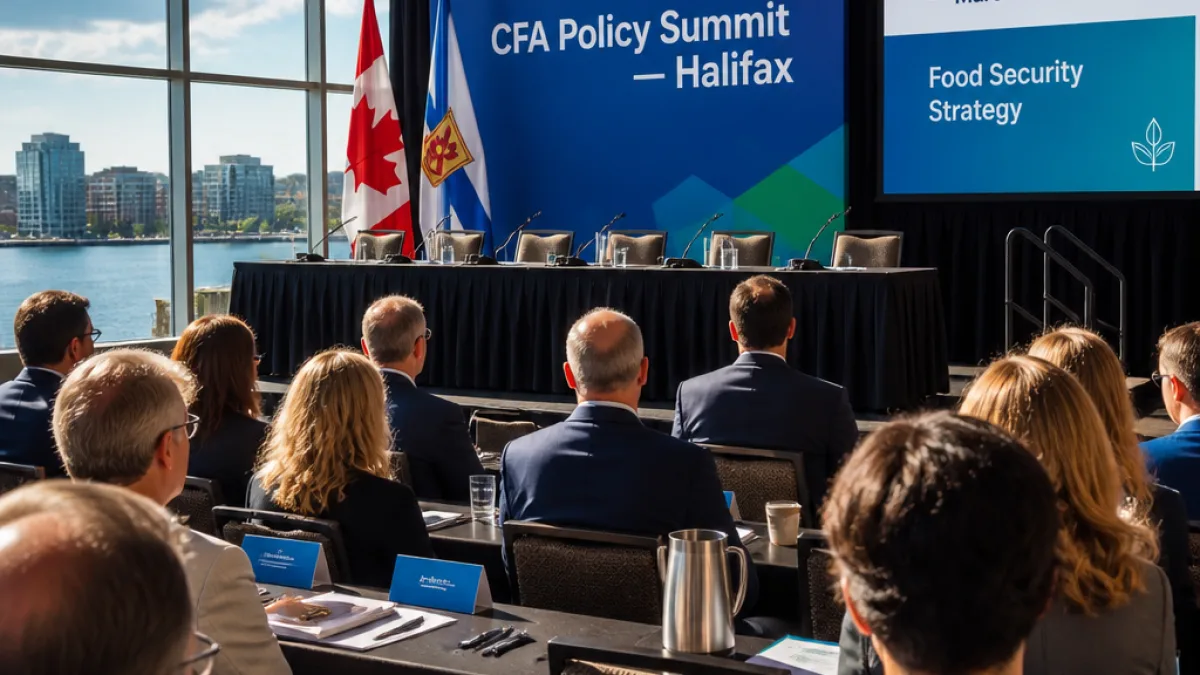
Halifax served as a national policy hub over the weekend as the Canadian Federation of Agriculture (CFA) convened a policy summit alongside the federal, provincial and territorial agriculture ministers’ meeting. With more than 260 participants in the room, farm leaders, officials and stakeholders used the gathering to digest Ottawa’s new food security strategy and to start shaping the next policy framework for Canadian agriculture. The current framework is scheduled to expire in March 2028.
CFA president Keith Currie said the summit was structured to build momentum across a series of conversations.
“The policy summit had five different panels on it, and the panels all built off each other,”he said, adding that the day ended with a reception that gave participants a chance to talk directly with ministers and their staff. Organizers described the Halifax sessions as a productive step in aligning farm-sector priorities with government planning cycles.
What was on the table
According to the federation, the Halifax discussions centred on two main tracks: unpacking the federal food security plan and organizing early input for whatever succeeds the current framework in 2028. That meant stress-testing ideas across supply chains, finance, innovation and trade—all areas the sector says must move in concert if farmers are to manage costs, volatility and climate pressures.
- Food security: Participants examined how the federal strategy could translate into practical support for producers and resilient supply chains.
- Next framework: With the present agreement ending in 2028, stakeholders sought to define principles and gaps the next iteration should address.
- Cross-government alignment: Leaders argued that agriculture policy cannot rely on a single department to deliver results.
Call for broader federal involvement
Currie emphasized that advancing farm policy requires coordination beyond Agriculture and Agri-Food Canada. He pointed to the need for infrastructure investment, market access, transportation reliability, financing tools and technology adoption. The conversation reflected a view that agricultural competitiveness is shaped by multiple portfolios and that early collaboration could prevent bottlenecks later.
| Federal portfolio named |
|---|
| Infrastructure |
| Innovation, Science and Economic Development |
| Global Affairs (trade) |
| Finance |
| Transportation |
Technology is also on the agenda. Currie noted that
“AI will play a big part.”That focus on digital tools dovetailed with conversations about productivity, data and risk management, while raising questions about adoption costs and training that stakeholders say must be addressed in any future program design.
Why it matters to Nova Scotia
By hosting the meetings, Halifax placed Nova Scotia producers and agri-businesses closer to national decision-making at an early, formative stage. The province’s farms and processors operate within national frameworks that shape income supports, research funding, climate resilience, transportation and export access. Input gathered in Halifax could influence how the next federal-provincial agreement balances on-farm needs with supply chain and market realities across Atlantic Canada.
Organizers highlighted the value of face time between industry and government. The summit’s closing reception gave producers and association representatives a chance to meet one-on-one with ministers and staff—an avenue stakeholders often say is critical for translating broad strategies into measurable, on-the-ground programs.
Next steps
With the current policy framework set to run until March 2028, deliberations are still in the early stages. The CFA signalled that ongoing consultation with producers will be essential as governments and industry refine priorities. Halifax’s role as host underlines the importance of Atlantic perspectives in what will become a multi-year negotiation, touching everything from market development to transportation logistics. As the federal food security strategy rolls out, Nova Scotia stakeholders will be watching for details on program design, timelines and how multiple departments coordinate to deliver changes that matter on the farm.