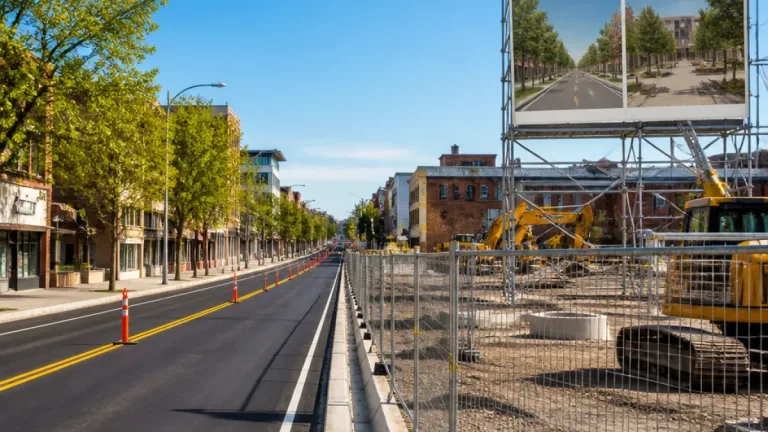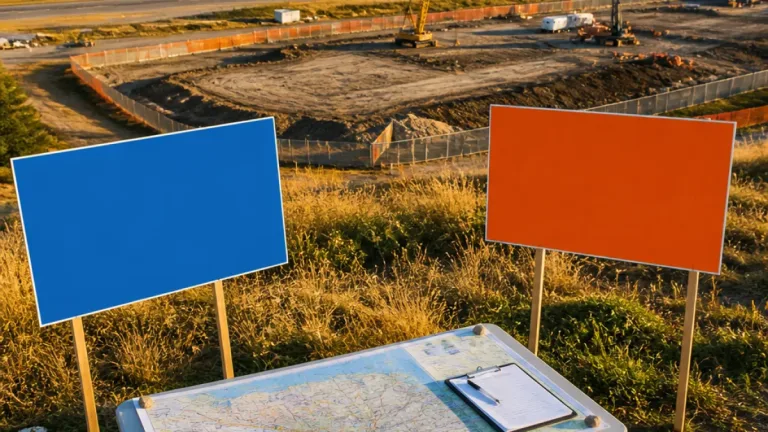
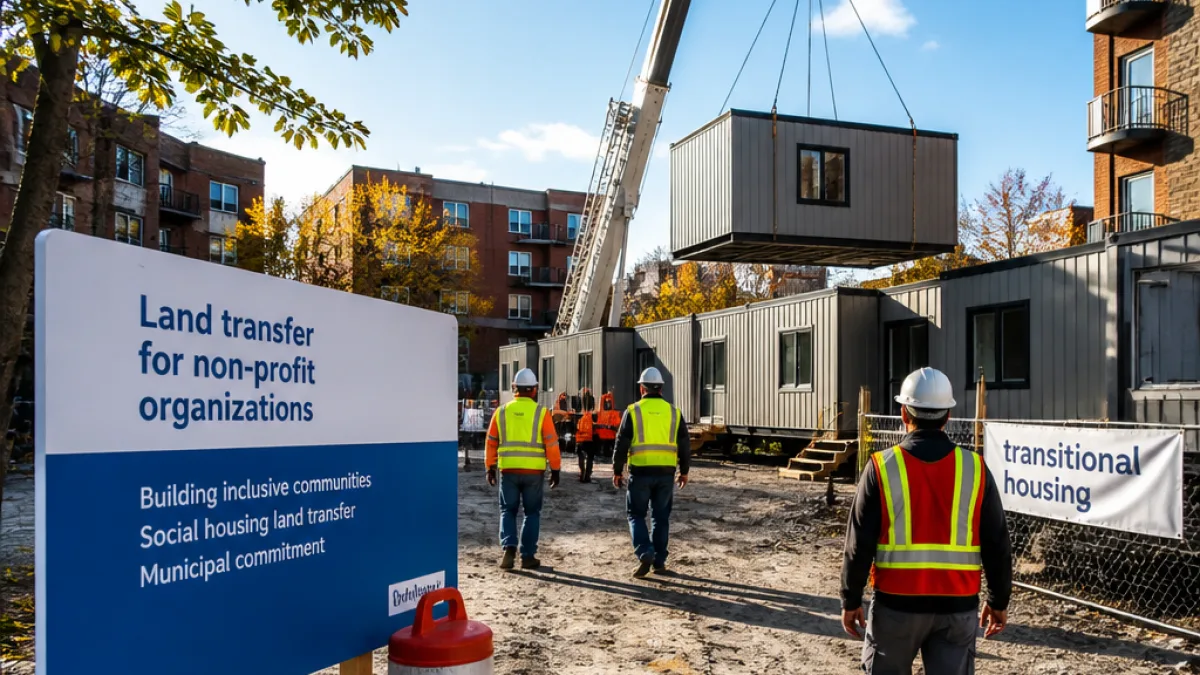
The City of Montreal announced plans on Wednesday to construct 54 prefabricated transitional housing units on Elmhurst Avenue in the Côte‑des‑Neiges–Notre‑Dame‑de‑Grâce (NDG) borough to serve women who are experiencing homelessness or at risk of losing housing.
Project partners, funding and supports
The parcel of land has been transferred from the Société d’habitation du Québec (SHQ) to the nonprofit organisation Communia, a partner of the Office municipal d’habitation de Montréal, which will develop the project. The construction will be fully funded by the City of Montreal.
- Number of units: 54
- Location: Elmhurst Avenue, Côte‑des‑Neiges–Notre‑Dame‑de‑Grâce
- Developer/owner partner: Communia
- Land transferred by: Société d’habitation du Québec (SHQ)
- On‑site support: Old Brewery Mission
All eligible women who move into the units will receive rent supplements administered through the Ministry of Health and Social Services. The supplements will ensure that tenants’ rent contribution equals 25 per cent of their income. The additional assistance will be financed with 90 per cent from the SHQ and 10 per cent from the City of Montreal.
| Item | Source | Share |
|---|---|---|
| Rent supplement funding | SHQ | 90% |
| Rent supplement funding | City of Montreal | 10% |
| Tenant rent contribution | Tenants | 25% of income |
Government comments and rationale
Provincial ministers framed the project as part of wider efforts to reduce homelessness. In a statement, Karine Boivin Roy, the minister of housing, said the recent increase in announcements shows the new government’s determination to address homelessness and applauded cooperation between the City and the Office municipal d’habitation de Montréal.
“Our announcements to set up living environments and measures to fight homelessness have been multiplying in recent months. This shows that the new government in place is firmly determined to tackle this social scourge. I applaud the cooperation of the City of Montreal and the Office municipal d’habitation de Montréal on this issue.”
Lionel Carmant, minister of social services and the fight against homelessness, said stable, safe housing adapted to needs is the first step to getting people out of homelessness and that the new units will provide the stability required to begin a new trajectory.
“To get a person out of homelessness in the long term, we must first offer them a stable, safe living environment that is adapted to their needs. With these 54 new affordable housing units, we are quickly adding spaces that will allow some of the most vulnerable people to find a roof over their heads and the stability they need to embark on a new journey.”
Local context and implications
Montreal has seen a series of housing and homelessness initiatives in recent months, and this project follows a pattern of municipal–provincial cooperation. The use of prefabricated units is intended to accelerate delivery; the Old Brewery Mission’s involvement indicates on‑site or connected social supports for residents, although operational details such as timing, intake criteria and supports schedule were not specified in the city’s announcement.
The transfer of the Elmhurst site from the SHQ to a nonprofit partner signals a model combining municipal capital funding with provincial operating subsidies. For NDG residents and social service providers, the new housing will mean additional capacity targeted specifically at women, a population that faces particular barriers and risks in homelessness.
Further information on timelines, selection processes and the precise role of partners is expected as the city and agencies move from announcement to implementation.