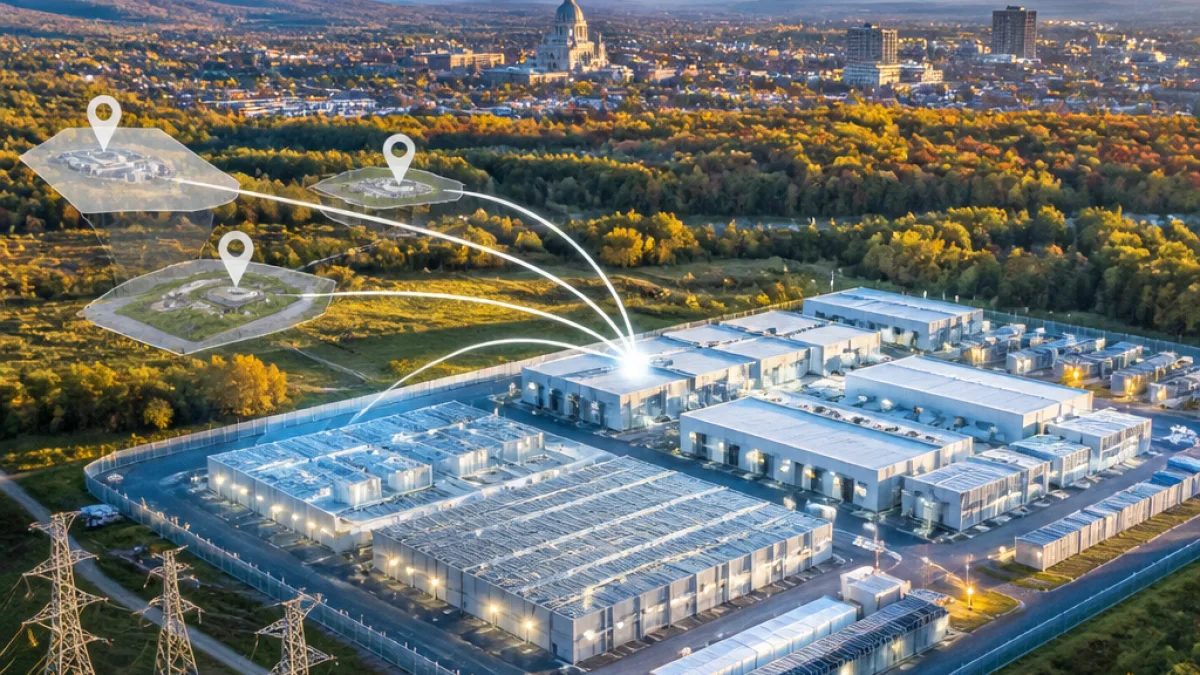
The City of Sherbrooke has approved an agreement allowing Keel Infrastructure Corp. to consolidate an existing 96 megawatts (MW) of electrical capacity — currently used across three bitcoin mining facilities — into a proposed high‑performance computing (HPC) and artificial intelligence (AI) data centre campus.
Local approval preserves existing power allocation
The municipal vote authorizes Keel to enter into an agreement with the local utility, Hydro‑Sherbrooke, to transfer and operate the capacity at a new site. Under the approval, Keel will recategorize the capacity from bitcoin mining to HPC and AI use. Company filings indicate no additional electricity is being requested; instead, Keel plans to relocate capacity already claimed by its operations and combine it at a single campus.
- Purpose: Convert capacity used for bitcoin mining to HPC/AI data centre use.
- Capacity involved: 96 MW consolidated from three local sites.
- Next steps: Transfer remains subject to review and approval by Québec’s Ministry of Economy, Innovation and Energy.
Which sites are affected
The 96 MW total is currently allocated across three Keel facilities in Sherbrooke. Company disclosures list the capacity as follows:
| Site | Capacity (MW) |
|---|---|
| The Bunker | 48 |
| Leger | 30 |
| Garlock | 18 |
All three properties were leased and operating as bitcoin mining facilities as of late March, according to Keel’s annual filing. Consolidation would allow Keel to maintain its existing power entitlement while replacing smaller, purpose‑built mining operations with a campus configured for denser computing workloads.
Project status and limitations
The municipal approval is a significant local milestone but does not complete the regulatory process. The transfer and change of use still require provincial sign‑off from the Québec Ministry of Economy, Innovation and Energy. Keel has not disclosed a purchase price for the site it has agreed to buy, nor has it released expected development costs, a construction timetable or any confirmed customers for the proposed campus. Those omissions leave the project at an early stage despite the municipal green light.
"Keel said it did not request any additional electricity for the project, potentially making the development easier to accommodate within Québec’s constrained power system."
Keel also entered into an agreement to purchase a parcel of land located about 100 miles east of Montréal; the company expects the acquisition to close in the first quarter of 2027, subject to site inspections, feasibility work, municipal approvals and other customary conditions.
Local and provincial context
The distinction between transferring existing capacity and requesting new power is material in Québec. Provincial authorities have become more selective in recent years about allocating electricity to large industrial users. By seeking to preserve an existing entitlement rather than obtain new supply, Keel aims to navigate that constrained environment while converting an energy allocation historically tied to cryptocurrency mining into infrastructure intended for AI and HPC workloads.
For Sherbrooke residents, the project represents a potential shift in local industrial activity from cryptocurrency mining toward data‑centre operations. Final outcomes will depend on provincial approvals and any further details Keel discloses about land purchase, development costs, timelines and tenancy for the campus.