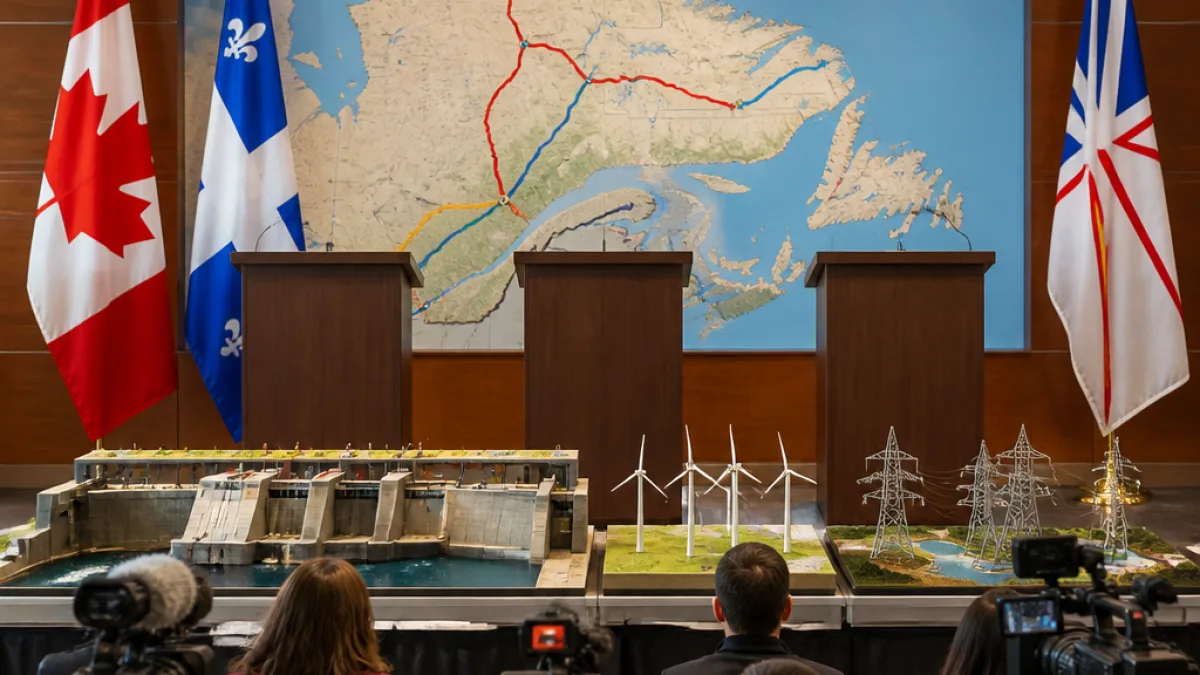
Federal, Quebec and Newfoundland and Labrador officials unveiled a tentative, non-binding agreement Monday to share hydroelectricity from Labrador and pursue new energy projects valued at more than $50 billion.
What the framework proposes
The outline presented in St. John’s brings together Hydro-Québec and Newfoundland and Labrador Hydro, with federal facilitation. It sketches how power from the Churchill Falls generating station and future Labrador developments would be divided and how transmission corridors could channel electricity through Quebec to markets in the United States.
- Potential export capacity: negotiators say up to 985 megawatts could be sent through Quebec to the U.S.
- Investment scope: more than $50 billion in new hydro, wind and transmission projects.
- Next steps: negotiators hope for a final deal by the end of the year.
“(It's) enough power to light, heat (and) cool the homes in Toronto, Montreal and Vancouver combined,” Prime Minister Mark Carney told the assembled crowd in St. John’s.
The federal government and the two provinces framed the announcement as a national economic opportunity. Carney said the resource could supply industry as well as households: “(It's) to provide the power that we need to run the mines, the mills, the factory floors where Canadians will build their future.”
Political and provincial considerations
Although the deal is presented as mutually beneficial, its future rests in part on Quebec politics. Premier Christine Fréchette said her Coalition Avenir Québec government supports the plan, arguing it delivers large amounts of energy for Quebecers and businesses. She cautioned, however, that a different government could decide otherwise.
Newfoundland and Labrador Premier Tony Wakeham welcomed the draft accord but acknowledged the final outcome depends on Quebec. “Whatever happens in Quebec will happen. I can't control what happens in Quebec,” he told The Canadian Press, adding he considers the framework “a win-win-win situation.”
| Item | Amount / Note |
|---|---|
| Planned projects | More than $50 billion |
| Potential export via Quebec | Up to 985 megawatts |
| Target for final agreement | End of the year (negotiators' hope) |
The timeline for completion faces an immediate complication: Quebec must hold a provincial election no later than Oct. 5. That campaign, and the possibility of a change in government, could reshape or delay any final arrangement. Fréchette acknowledged the risk, and pointed to opposition scepticism — she said the Parti Québécois was signalling it might scrap the agreement.
Local impacts and practical implications
If a final deal is reached and implemented, Quebec stands to receive substantial new electricity supplies that could support both residential needs and industrial activity. For Newfoundland and Labrador, the framework would advance long-sought goals of transmitting Labrador power to broader markets and unlocking revenue from generation in the province.
For residents and businesses watching the process, key upcoming signals will be binding contract terms, regulatory approvals, precise transmission routing and any commitments related to rates or local benefits. Negotiators say they aim to resolve those details this year, but political dynamics in Quebec make the timetable uncertain.
Federal facilitation notwithstanding, the outcome will depend on intergovernmental negotiation, provincial political choices and the technical work needed to plan and permit major hydro and transmission projects.
— Owen Belanger, Quebec Public Services Correspondent