Citywide assessment puts a dollar figure on trees’ work
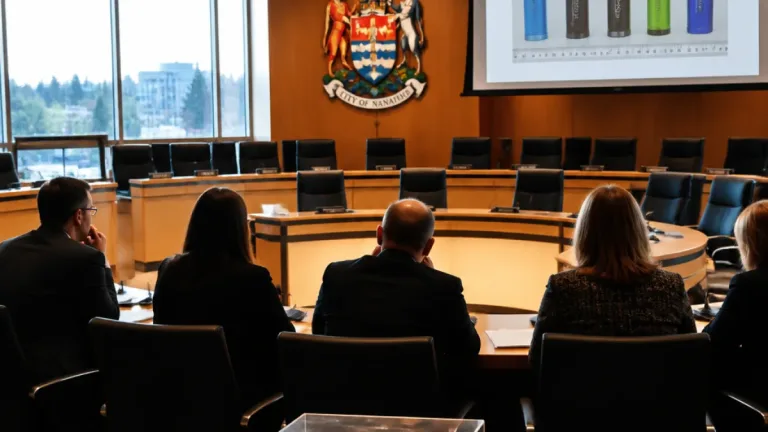
A new urban canopy assessment presented to the City of Nanaimo last week estimates the municipality’s urban forest provides roughly $13.7 million in annual benefits, while storing carbon valued at about $367 million. Prepared by Colorado-based consultancy PlanIT Geo Inc., the report identifies trees as a defining environmental asset in Nanaimo, crediting the canopy with cutting urban heat, filtering air and water, offering wildlife habitat and bolstering climate resilience.
“Ecosystem services” worth about $13.7 million annually.
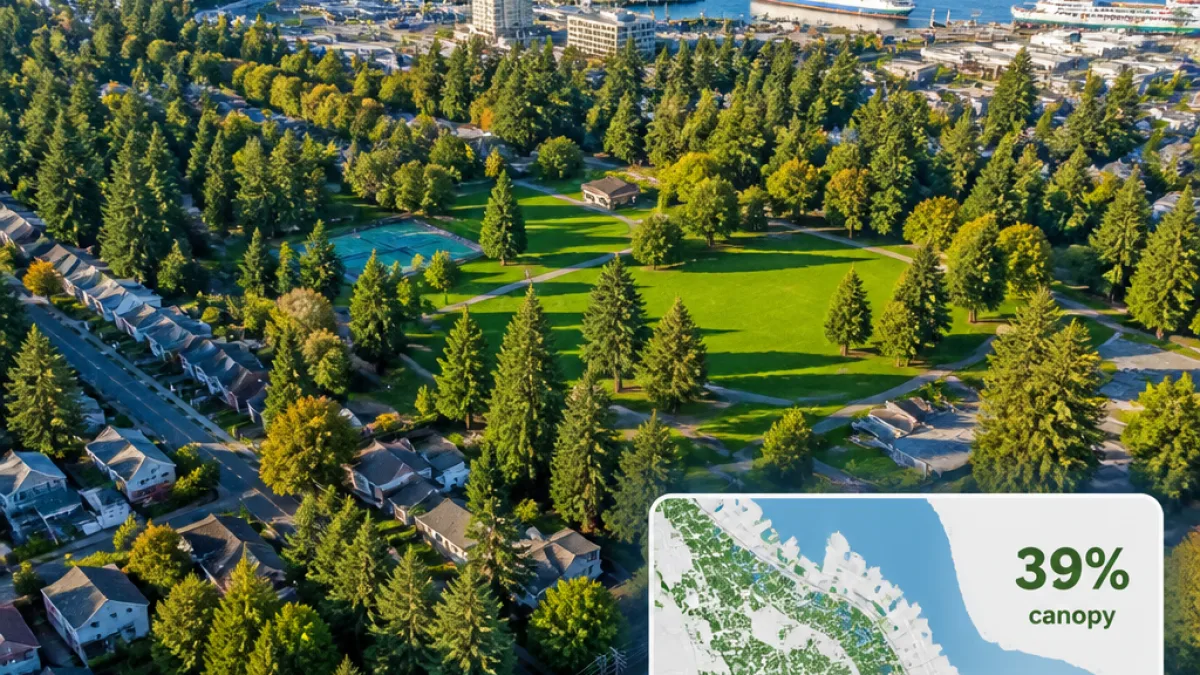
The consultants calculate that trees now cover 39 per cent of Nanaimo’s land base — a canopy spread of approximately 3,792 hectares out of the city’s 9,808 hectares. The analysis also highlights a remarkable inventory of large trees: more than 500 exceed 30 metres in height, with the tallest reaching roughly 63 metres.
Gains outpace losses since 2016, despite pressures
While acknowledging ongoing development and climate-related stressors, the assessment finds Nanaimo’s canopy has grown over the last decade. Between 2016 and 2025, the city recorded a net gain of about 515 hectares of canopy — a 5.3 per cent increase over nine years. Over the same period, losses totalled roughly 269 hectares, attributed to factors including development, severe weather, drought, pests, natural mortality and operational removals. Development alone accounted for close to 60 hectares of canopy loss, an area the report equates to approximately 84 soccer fields.
Those setbacks were outweighed by an estimated 785 hectares of new canopy added through tree growth, natural regeneration and planting. The authors caution that part of the observed increase may reflect the spread of invasive species such as English hawthorn, which threatens sensitive Garry oak ecosystems and native plants.
Room to grow — and choices ahead
The consultants identify more than 1,000 hectares — about 11 per cent of Nanaimo’s land base — as suitable for future planting. That finding frames an opportunity for policy-makers and residents: where to prioritize new trees to maximize cooling, stormwater mitigation and habitat, and how to balance planting with other land-use needs.
For a city grappling with heat waves, drought conditions and infill development, the figures underscore a familiar trade-off. Trees reduce surface temperatures, capture rainfall and improve air quality, but their long-term benefits depend on protection and stewardship through subdivision, roadwork and redevelopment. The report’s accounting of both losses and gains points to the importance of maintaining mature canopy while planning for strategic additions in neighbourhoods with lower coverage.
By the numbers
| Indicator | Value |
|---|---|
| Annual value of services | $13.7M |
| Carbon storage (value) | $367M |
| Current tree canopy | 39% of land area |
| Total land area | 9,808 ha |
| Canopy area | 3,792 ha |
| Net canopy change (2016–2025) | +515 ha (+5.3%) |
| Losses (all causes, 2016–2025) | 269 ha |
| Losses from development | 60 ha (~84 soccer fields) |
| Gains from growth/regeneration/planting | 785 ha |
| Potential planting opportunity | >1,000 ha (~11% of land) |
What this means for residents
The assessment offers an evidence base for decisions that touch everyday life — from how streets are shaded to which parks receive replanting. It also sets a benchmark against which future canopy changes can be measured across neighbourhoods. The report singles out the prominence of large trees in Nanaimo’s landscape, a reminder that safeguarding mature specimens matters for cooling, stormwater management and biodiversity.
- Canopy expansion has outpaced removals since 2016, but development continues to erode tree cover in some areas.
- There is significant space for new planting, particularly where shade and stormwater benefits would be most felt.
- Invasive species are a complicating factor, potentially inflating canopy figures while undermining native ecosystems.
The findings arrive as communities across British Columbia weigh how best to manage growth and climate risk. For Nanaimo, the numbers quantify what residents see across parks and streetscapes — that the urban forest is both an infrastructure asset and a stewardship responsibility.