
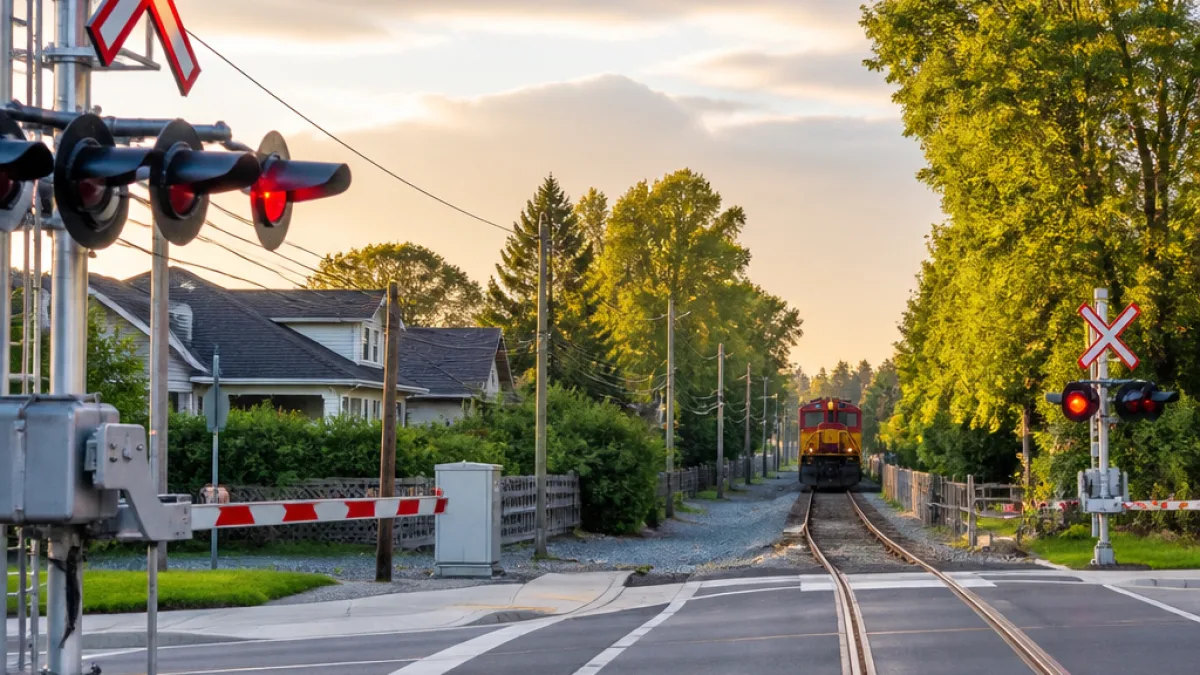
Council votes to seek whistle cessation at eastern edge crossing
New Westminster city council has formally asked federally regulated railways to stop routinely sounding their train whistles at the Braid Street crossing in Sapperton, a step city staff say follows years of upgrades to meet federal safety standards.
The resolution, adopted at council on July 13, directs rail companies to cease the use of locomotive horns at that location. Under the Railway Safety Act (Canada), railways have 30 days after receiving such a municipal directive to discontinue regular whistle use, except in specific safety circumstances.
“This is obviously really exciting to see come forward. I’m really happy that staff were able to move on this crossing. This will be welcome news for folks.” — Coun. Tasha Henderson
The railway corridor through Braid Street is operated by three carriers: Canadian National Railway (CN), Burlington Northern Santa Fe (BNSF) and Canadian Pacific Kansas City (CPKC). The crossing sits at New Westminster’s eastern edge, near the border with Coquitlam.
Years of work precede the decision
City staff told council the Braid Street crossing has been on a long-term list for whistle cessation because it required significant technical work. A July report to council states that the city has completed upgrades and now meets the criteria to request cessation.
“Work on Braid has been years in the making. We have been actively working on all the infrastructure to help support … getting us to the point of whistle cessation for a number of years now,” said Kwaku Agyare-Manu, deputy director of engineering and public works.
- Resolution passed at council: July 13
- Railway companies involved: CN, BNSF, CPKC
- Effect: whistle cessation within 30 days unless safety concerns arise
- Location: Braid Street crossing, Sapperton (near Coquitlam border)
What residents should expect
Officials caution that whistle cessation will reduce but not eliminate noise at the crossing. Whistles remain required in particular situations involving safety risks — for example, when sightlines are obstructed or train movements present hazards. The decision is part of a broader municipal program to pursue whistle cessation at multiple crossings from Sapperton to Queensborough.
| Item | Detail |
|---|---|
| Crossing | Braid Street, Sapperton |
| Council action | Resolution requesting whistle cessation (July 13) |
| Railways | CN, BNSF, CPKC |
| Timeframe | Railways have 30 days to comply, subject to safety exceptions |
For residents who have dealt with decades of rail noise, the council resolution represents a tangible change following extensive municipal planning and investment. City staff continue to evaluate other crossings across New Westminster for similar measures as part of a staged program to improve livability near the rail corridor.