
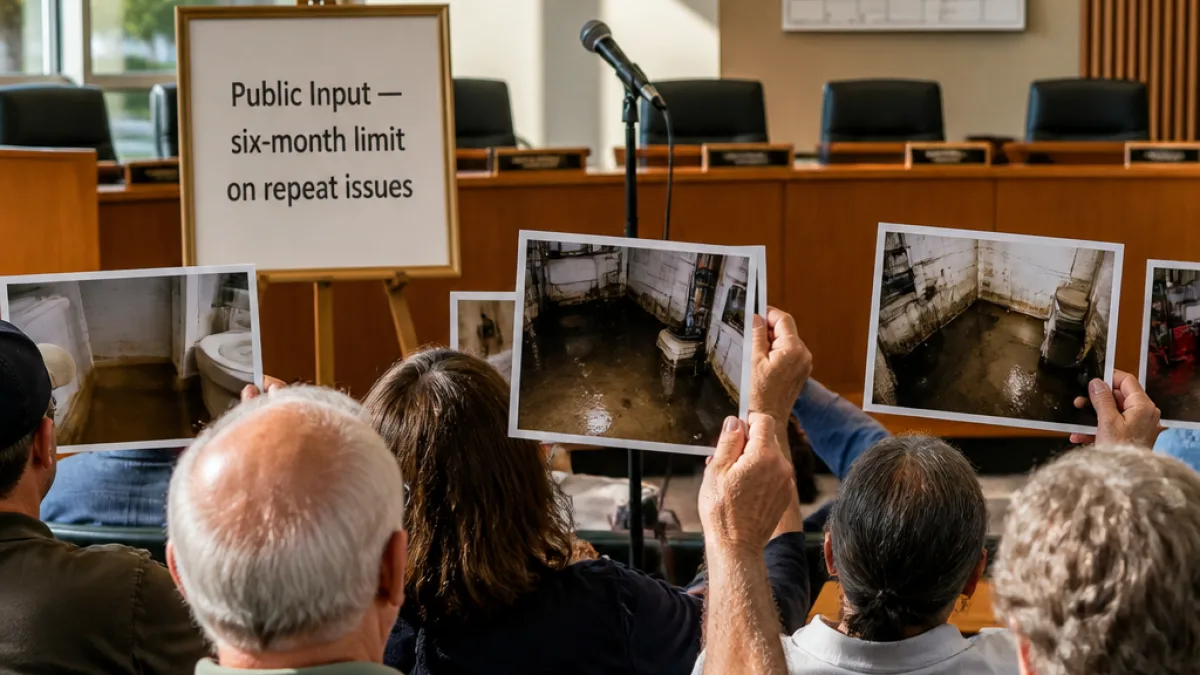
Public input narrowed to curb repetition, says mayor
Trenton’s town council has adopted a six‑month limit on how often residents can bring the same issue to a meeting, unless they can present new information. The change, introduced in the spring, is intended to keep meetings on track and avoid revisiting identical questions, according to Mayor Alec Dove.
In recent months, council sessions in the Pictou County town have grown more heated, with dozens of attendees turning up to voice concerns. The new rule has become a focal point for that tension, with several residents arguing it shuts down meaningful participation on unresolved, persistent problems.
Resident with sewage damage says she can’t return until September
Among those affected is Alison Ellsworth‑Cameron, who lives on Strickland Avenue, where she says sewage backflow has been a recurring problem for years. She addressed council in March about repeated backups and the toll on her household, only to experience another incident she says led to $50,000 in damage. Under the policy, she says she cannot raise the matter again until September without fresh evidence.
“We are not being heard by council,” Ellsworth‑Cameron said. “I addressed all of these situations that were happening, the impact that it was happening on us emotionally, financially, physically, when we have to clean up these situations.”
Ellsworth‑Cameron said she left her March appearance discouraged when, after outlining the scope and impact of the sewage problem, councillors offered no comments.
Town hall’s rationale: keep debates moving
Mayor Dove acknowledged the rollout has had “bumps in the road” and that he understands residents’ frustrations. He framed the policy as a practical way to reduce duplication and maintain order during meetings that have increasingly drawn large crowds and repeated interventions on the same topics.
“If you ask Question A, Question A is answered. Then I honestly don’t understand why somebody else comes up and asks the same question,” Dove said. “They’re going to get the same answer.”
The mayor said the focus is on avoiding cyclical discussions that consume agenda time, while still allowing people to return with new details that could change the conversation or prompt different action.
How the rule works
| Policy element | Details |
|---|---|
| Frequency limit | Same issue cannot be presented more than once within six months |
| Exception | Residents can return sooner if there is new information |
| Timing | Implemented in the spring |
| Purpose | Streamline meetings and reduce repeated questions |
While the policy is meant to streamline agendas, its practical impact is felt most by residents dealing with ongoing issues, such as infrastructure failures that unfold over time. Those affected argue that limiting return appearances can delay public accountability and reduce pressure for fixes when problems persist between meeting cycles.
Mounting pressure at meetings
The town has seen a rise in contentious exchanges as community members attempt to keep long‑running concerns in front of council. That growing pressure reflects broader anxieties about local services and the pace of municipal responses, especially in neighbourhoods facing repeated service disruptions like wastewater backups.
What changes and why it matters
- Residents now face a cooling‑off period before revisiting the same topic, which may slow momentum on unresolved issues.
- The exception for new information leaves some room for flexibility, but places the onus on residents to bring forward additional facts or developments.
- For households grappling with significant damages and health concerns tied to infrastructure problems, delayed access to the council floor can heighten stress and costs.
The debate in Trenton underscores a familiar municipal balancing act: protecting meeting efficiency while maintaining a forum that feels accessible and responsive to residents who rely on it to seek remedies. As community members and town hall continue to navigate the policy’s boundaries, the real‑world test will be whether the rule improves meeting flow without sidelining those with ongoing, unresolved concerns.