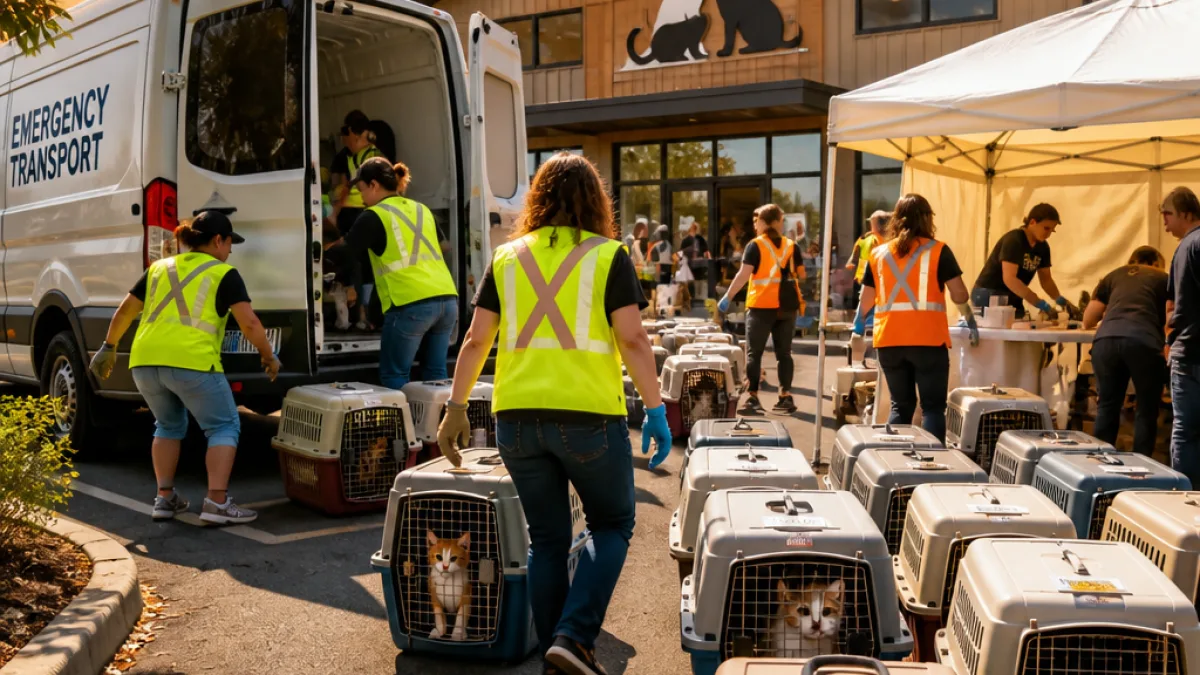
Emergency transport brings animals to Greater Victoria
The Victoria Humane Society (VHS) has taken in 34 animals evacuated from wildfire-affected areas near Williams Lake, the organisation said in an Aug. 5 update. The group received the animals after an emergency transport from the Central Cariboo arrived in the Lower Mainland and volunteers completed the final leg to Greater Victoria.
Animals arriving in difficult conditions
The intake included 13 puppies, one adult dog and 20 kittens, all of which were brought to VHS for immediate care. The society said the animals were transported through smoky conditions and credited an individual, Jim Sullivan, for driving overnight to ensure their safe arrival. VHS described the journey as made through “
horrific conditions.”
Local effort to stabilise and rehome
Volunteers met the arriving animals with food, baths, medication and socialisation. VHS said staff and foster families are performing medical evaluations and helping the animals settle into temporary accommodations in the region. The society asked the public to refrain from enquiring about adoption or fostering until assessments are complete and posted updates are available.
Ongoing need as fires continue
VHS warned that wildfires across B.C. continue to threaten people, pets and livestock, and that similar transports are expected throughout the summer. The organisation said support from northern rescue partners, volunteers and foster homes made the transport possible.
- Animals received: 34 total
- Breakdown: 13 puppies, 1 adult dog, 20 kittens
- Immediate needs: volunteers, foster homes with fenced yards, donations
| Category | Number |
|---|---|
| Puppies | 13 |
| Adult dogs | 1 |
| Kittens | 20 |
| Total | 34 |
In its social-media post, VHS praised those who assisted and singled out Mr. Sullivan for making the overnight trip. The society also conveyed the scale of the crisis, noting that
“Currently, thousands of homes across B.C. are estimated to be affected by the wildfires, putting countless families, pets, and livestock at risk.”
Those in Greater Victoria who can help — by offering foster space, volunteering, or donating — are directed to the society’s website for information on how to assist. VHS highlighted an immediate preference for foster homes with fenced yards to accommodate some of the animals safely during recovery and assessment.
The arrival underscores how local animal-welfare organisations are likely to play a recurring role in responding to wildfire displacement across the province this season, coordinating with remote partners to provide short-term refuge while owners and communities cope with evacuation and recovery.