OTTAWA / EDMONTON — Recent agreements between Ottawa and Alberta have moved a long-discussed plan for a pipeline to the Pacific from a private-sector prospect toward a model dominated by governments, with construction conditional on a large-scale carbon capture project and Alberta aligning with federal climate policy.
From MOU to government-led infrastructure
Federal and provincial officials first set a framework in November 2025 with a memorandum of understanding that aimed to open a route for oilsands crude to reach Asian markets. That MOU required Alberta to accept a suite of federal climate actions in exchange for Ottawa’s cooperation, including a pledge toward net-zero by 2050, higher provincial carbon pricing, and support for national electrification efforts.
In early July, Prime Minister Mark Carney and Premier Danielle Smith advanced that work with an agreement to take a proposed million-barrel-per-day pipeline forward to the federal Major Projects Office for assessment. The deal announced on July 7, however, changed the original concept of a privately financed pipeline.
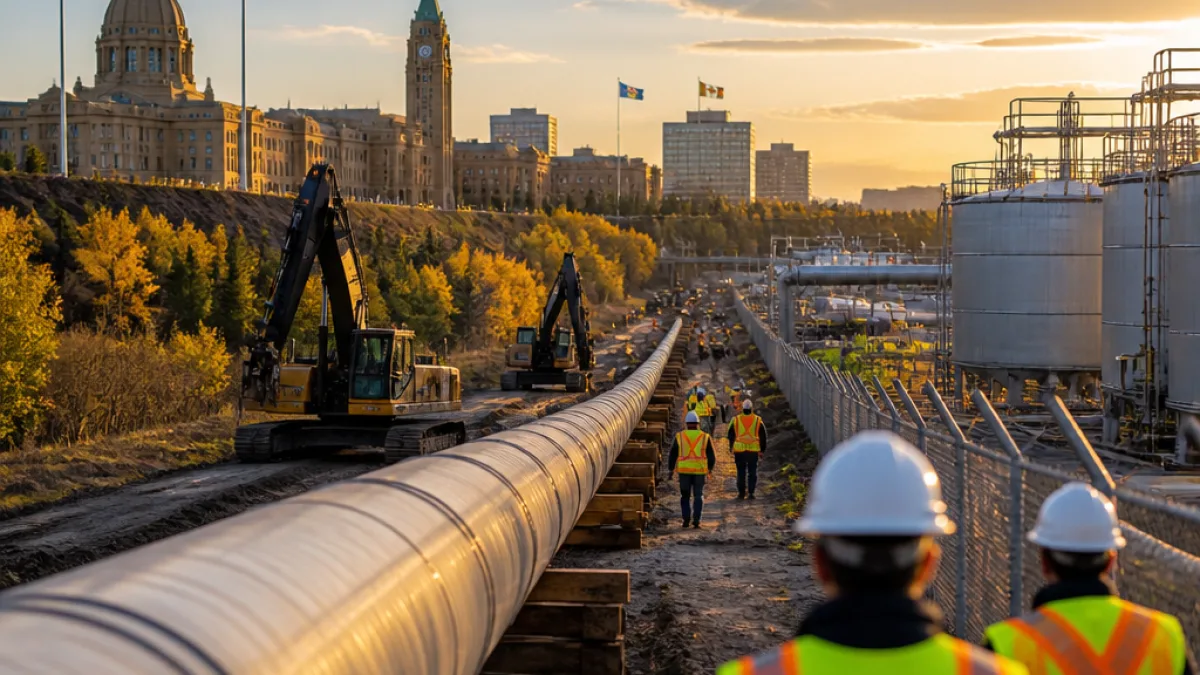
Under the revised approach, the pipeline would be primarily delivered as a government infrastructure project. Financing and ownership roles would be shared between the Alberta Petroleum Marketing Commission (a provincial Crown corporation) and the federally owned Trans Mountain Corporation, while private companies and Indigenous groups would play advisory roles and may have minority stakes.
Carbon capture at the centre
A key condition of the arrangement is the construction of an unprecedented carbon capture, utilization and storage initiative known as Pathways. Ottawa and Alberta have attached the pipeline’s progress to Pathways, which they describe as a project intended to reduce the carbon intensity of Alberta oil by capturing emissions from production and processing.
On July 12, the governments and a consortium of five major oilsands producers — organised as the Oil Sands Alliance — announced an agreement to build the Pathways CCUS project alongside the pipeline plan. Public statements framing the project characterise Pathways as a central climate mitigation tool for the oilsands, though details about financing splits and timelines remain limited.
- Who funds the pipeline: primarily provincial and federal Crown entities.
- Private sector role: advisory input and potential minority investment from industry.
- Climate condition: implementation of the large-scale Pathways CCUS project.
Who benefits and who carries the risk
Shifting the project into the public sphere changes who stands to gain and who absorbs risk. Under the new structure, direct profits from pipeline tolls and related earnings are expected to flow largely to government coffers rather than to private oilsands firms in the first instance. At the same time, taxpayers will carry more of the upfront capital and political risk if the project faces legal, regulatory or market setbacks.
Analysts and commentators have previously noted that earlier iterations of the plan placed heavier obligations on Alberta — including commitments to federal climate measures — while offering Ottawa more flexibility on implementation details. The latest agreements underscore that trade-offs remain central to advancing a Pacific export route.
| Element | Role |
|---|---|
| Pipeline financing | Alberta Petroleum Marketing Commission & Trans Mountain Corporation (government-led) |
| Industry participation | Advisory/minority investment (e.g., Pembina, other producers) |
| Climate requirement | Construction of Pathways CCUS project |
The plan now moves to the Major Projects Office for review, a federal process that will assess impacts, permits and conditions before any construction can proceed. Questions remain about exact financing details, timelines and the extent of Indigenous and private-sector ownership or revenues.
For Albertans, the deal represents a high-stakes bet: securing access to Pacific markets while binding the province to national climate ambitions and exposing public finances to a major energy infrastructure project.