A pledge made in Ladner that changed Delta’s daily life
In the spring of 1956, a packed hall in Ladner heard a promise that would redefine how Delta moved. At a banquet of the Lower Fraser River Crossing Improvement Association — drawing more than 600 attendees — provincial highways minister Philip “Flying Phil” Gaglardi signalled the green light for a new underwater crossing at Deas Island. He insisted the government’s decision rested on engineering evidence rather than whim, and he underscored a duty to the broader public.
“We are serving the people of British Columbia and not doing it as a favour to you people in Ladner. We must serve the people without fear or favour.”
Those remarks, delivered in Delta, framed the tunnel not as a gift to one community but as a response to the fast-growing transportation needs of the province. Then-premier W.A.C. Bennett amplified that message, suggesting the new link would be only the beginning of an era of expansion across British Columbia.
From commitment to concrete: opening years later
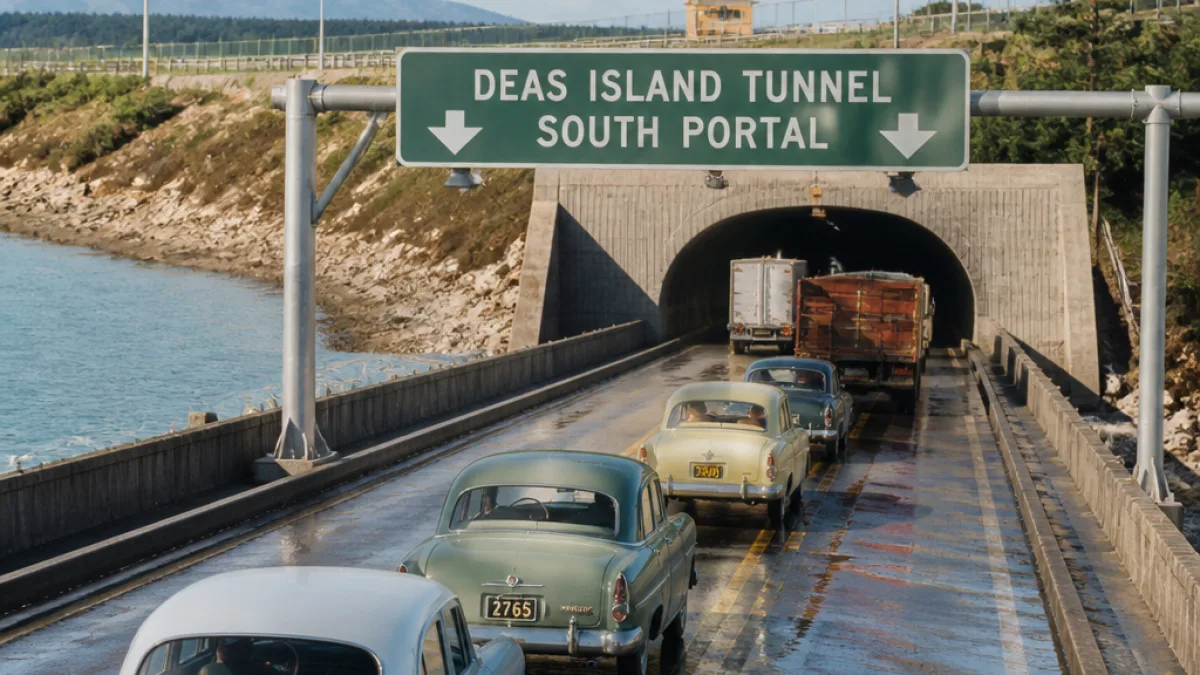
By 1959, celebration replaced speculation as the Deas Island Tunnel opened to traffic. At an opening banquet, Lassen Nielsen, who led the firm that both designed the structure and oversaw construction, offered a sober forecast: the facility would soon strain under rising traffic. His prediction, delivered amid festivities, acknowledged that demand in the Fraser delta region was already accelerating beyond initial expectations.
As the crossing moved from blueprint to backbone, communities on either side of the Fraser began to reorganize around the new route. For Delta, the tunnel became a daily proving ground for the promise of improved mobility — and, as Nielsen cautioned, a reminder that capacity can be overtaken by growth. In time, the structure that had been launched as the Deas Island Tunnel would be renamed the George Massey Tunnel, honouring the Delta resident whose persistence had long propelled the vision for a river crossing.
Accountability and ambition in early remarks
Gaglardi’s appearance in Ladner punctuated a larger message of public service and evidence-based decision-making. He stressed that the crossing was built on “sound engineering facts,” drawing a boundary between political theatrics and technical justification. Bennett’s suggestion of “phenomenal” expansion across the province offered an ambition that resonated with local residents — many of whom were navigating rapid changes in work, housing and travel patterns along the estuary.
- Evidence-led case: The minister cited engineering assessments as the foundation for proceeding.
- Province-wide framing: The premier set the tunnel within a wider promise of infrastructure growth.
- Early capacity warning: The design lead anticipated that rising volumes would test the crossing.
Milestones that still shape Delta
While the speeches belonged to a different era, their consequences have remained visible along Highway 99 and within Delta’s daily rhythms. Building at Deas Island connected communities and industries that rely on dependable passage across the Fraser. The foresight — and the limits — acknowledged by the tunnel’s backers continue to inform conversations about congestion, safety and resilience in a region where demand has repeatedly pushed up against available road space.
| Year | Event |
|---|---|
| 1956 | Announcement in Ladner of a new crossing at Deas Island; provincial commitment outlined. |
| 1959 | Tunnel opens; project leaders caution that traffic growth could outpace capacity. |
| Later | Crossing renamed the George Massey Tunnel in honour of a Delta advocate for the project. |
Why this history matters for Delta now
Infrastructure decisions made in rooms like that Ladner banquet hall are not mere artefacts; they guide the expectations residents bring to their commute and to planning debates today. The tunnel’s backstory records both a commitment to the public interest and an early recognition that growth would be relentless. In Delta, where the reliability of a single river crossing can ripple through business hours, household schedules and emergency response, the lessons are plain: build on proven need, plan for more than the present, and be candid about the pressures to come.
As anniversaries accumulate, the remarks from 1956 and 1959 continue to test leaders against their own standard: serving the people “without fear or favour,” while acknowledging that transportation infrastructure, once delivered, must keep adapting to the volumes and vulnerabilities of a changing region.