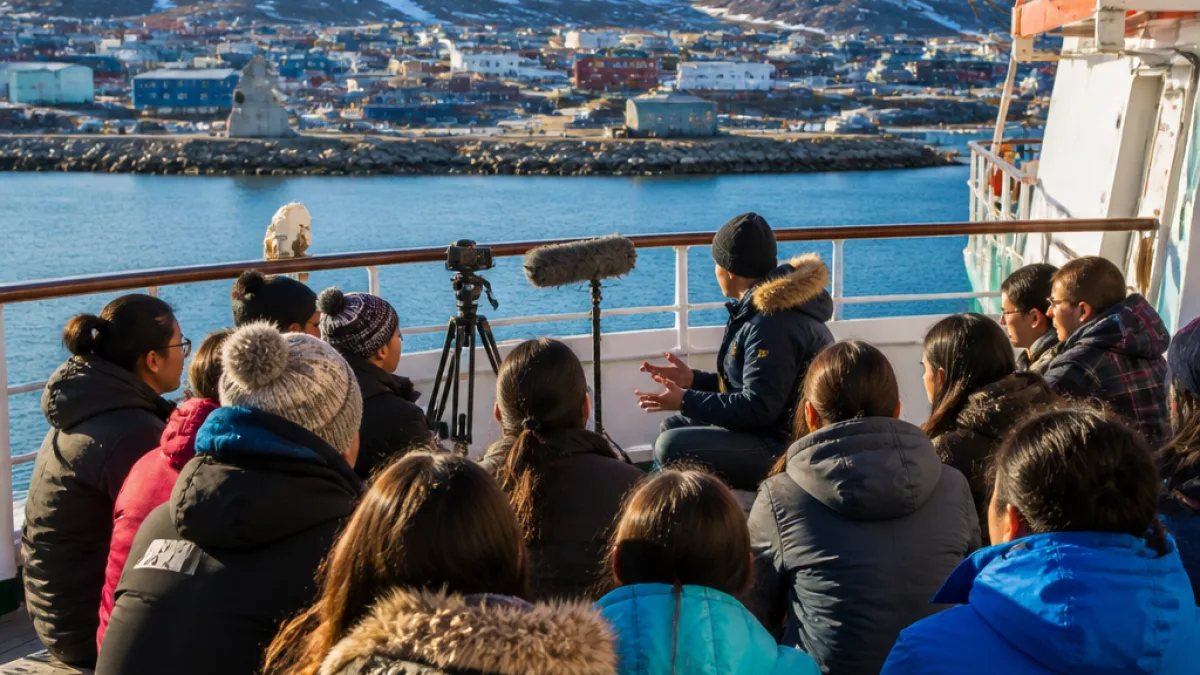
The deck of the MV Ocean Nova became a classroom and forum this week as a Students on Ice North-to-North expedition made its way toward Iqaluit, carrying 60 youth and 35 adults for 12 days of programming that focuses on climate change, reconciliation and Arctic leadership.
Two generations, one conversation
Among the participants are Steven Guilbeault, the former federal environment minister, and Reese Wainman, a teenager from Inuvik who identifies as Gwich’in and Inuvialuit. The pair joined Cabin Radio for an interview recorded on July 14, 2026, while crossing the Davis Strait from Greenland to Northern Labrador.
Guilbeault, who moved from Environment to Canadian Heritage before quitting Mark Carney’s cabinet last November over an oil sands pipeline agreement with Alberta, later said in May he would step down as a Member of Parliament, accusing Ottawa of weakening its stance on climate change. Wainman is profiled by Students on Ice as having a “strong connection to the land and my family’s roots,” and is noted as one of the Northwest Territories’ top young curlers and a flagbearer at this year’s Arctic Winter Games in Whitehorse.
What the trip aims to do
Students on Ice describes the North-to-North Expedition as a program to “strengthen cooperation across the Arctic through learning, dialogue, and relationship building.” For Iqaluit, the expedition’s arrival is a reminder that local communities sit at the centre of wide-ranging conversations about climate, governance and Indigenous leadership.
- Participants: 60 youth, 35 adults
- Vessel: MV Ocean Nova
- Focus: climate change, reconciliation, Arctic cooperation
“We are part of this expedition about awareness around issues like climate change, but also reconciliation,” Guilbeault said during the recorded conversation.
Local consequences and context
The expedition’s visit highlights the ongoing intersections between national policy debates and local realities in Nunavut. Community leaders, educators and youth in Iqaluit already navigate daily concerns — from housing and infrastructure to food security and changing sea-ice conditions — that are shaped by a warming Arctic and shifting federal priorities. Bringing young people from across the North together with high-profile figures offers an opportunity for those local voices to be heard directly, and for visiting participants to see first-hand the communities that bore the impacts under discussion.
Students on Ice and its guests say the goal is not simply to lecture but to listen and build relationships across generations and regions. For Iqaluit residents, the expedition and its conversations may reinforce the need for decisions made in Ottawa to reflect the lived experience of Arctic communities.
| Element | Detail |
|---|---|
| Expedition name | North-to-North |
| Length | 12 days |
| Recorded interview | July 14, 2026 |
As the ship completes its voyage to Iqaluit, the conversations from the deck will join a broader chorus of northern voices pressing for policy that accounts for Arctic realities — and for more opportunities for youth from communities like Iqaluit to help shape those policies in future.