Community push focuses on future of Kanata Golf and Country Club
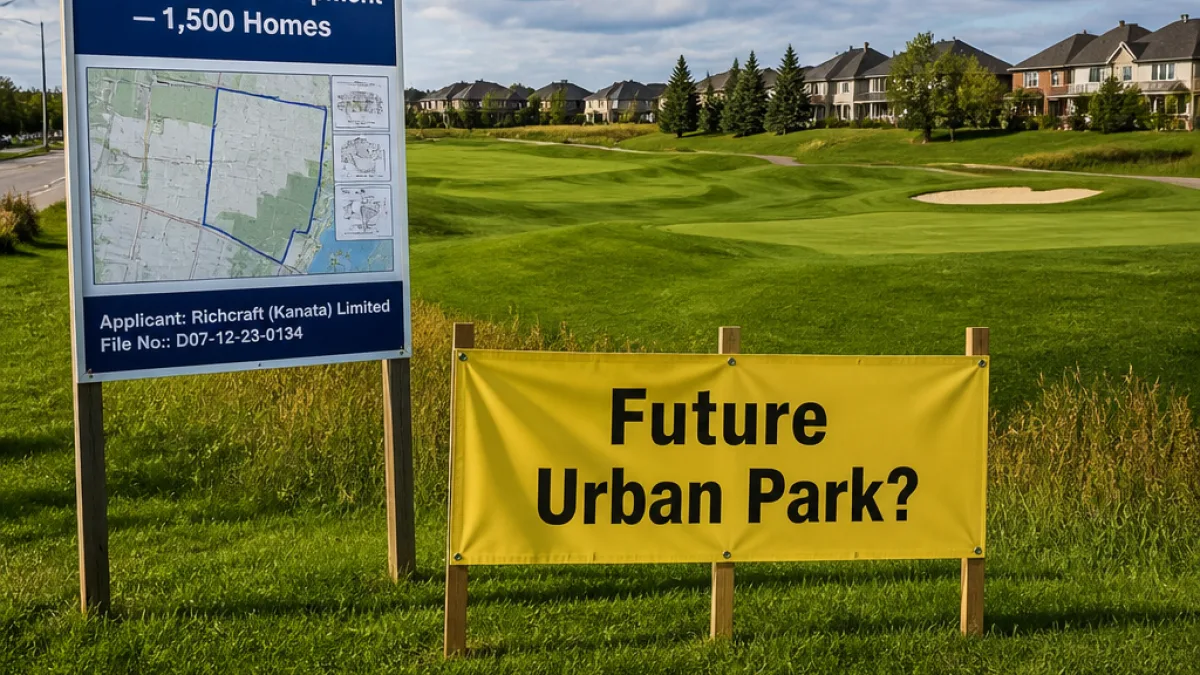
Three community groups are calling on the City of Ottawa to examine whether it should acquire the Kanata Golf and Country Club and convert the lands into an urban park. The stated aim is to prevent construction of approximately 1,500 new homes on the property, according to a recent public appeal.
The request asks the city to explore its options, rather than commit to a purchase. That exploration could include assessing the land’s recreational and ecological value, identifying potential funding sources, and evaluating legal avenues available to a municipality faced with competing pressures for housing and green space. No decision has been made by council, and no timeline has been set out in the advocacy materials referenced by the groups.
What the proposal could trigger at city hall
When residents urge the city to consider acquiring private land for public purposes, staff typically prepare background analysis before any council direction. In practical terms, an exploration phase could involve:
- Preliminary valuation and due diligence on the golf course lands and facilities.
- Assessment of land-use implications if the site is converted from private recreation to public parkland.
- Consideration of acquisition mechanisms, potential partnerships, and budget impacts.
- Public engagement to gauge neighbourhood and citywide views on green space and housing needs.
None of these steps pre-judge an outcome. Rather, they help council understand trade-offs between preserving open space and allowing residential growth at a time when Kanata and the broader city are managing population increases, infrastructure demands and intensification policies.
Balancing parkland aims and housing pressures
The call to protect the course as parkland puts a spotlight on two city priorities that often collide: expanding accessible green space and enabling more homes. Supporters of a park conversion argue that stitching the fairways and treed areas into a continuous public space could safeguard mature canopy, enhance stormwater absorption and provide year-round recreation. They also point to the role larger parks can play in linking trails and creating wildlife corridors within built-up suburbs.
On the other hand, redirecting a site earmarked by a private owner for 1,500 additional units would remove a potential location for new housing supply. That has implications for where growth would be accommodated instead, whether through higher-density infill, redevelopment of other parcels, or expansion pressures at the urban edge. Any shift in land use on a site of this size could also influence transportation planning, school capacity considerations, and local retail demand.
Costs, funding and governance questions
Exploring acquisition would raise practical questions about price, ongoing maintenance and governance. Municipal ownership of a large park adds operating costs for landscaping, amenities and programming, and would require a capital plan for paths, lighting, washrooms or sports infrastructure if desired in future. Funding options, if council wished to proceed beyond exploration, could range from city reserves to external grants or partnerships. Those details have not been proposed or decided; they would typically emerge from staff analysis and committee debate before any vote.
Residents watching the file may also look for clarity on how the public could access and use the land if it were converted to a park. Seasonal uses, snow clearing on pathways, leash rules, and integration with existing community trails are among the policy issues that commonly arise when private recreational land becomes public space.
Next steps: from advocacy to analysis
The community appeal is a request to the City of Ottawa to explore the idea; it does not, on its own, initiate acquisition. For city hall to act, a committee would need to receive a staff report or a councillor’s motion directing staff to study options and report back. That process would typically include opportunities for public delegations and written submissions.
As Kanata residents await council’s response, the discussion underscores a broader question facing fast-growing suburbs: how to balance the need for additional homes with the benefits of preserving and expanding green space. The outcome on this file will likely set expectations for how the city approaches similar proposals that pit redevelopment potential against long-term public access to open land.
At a glance: proposal and potential impacts
| Item | Details |
|---|---|
| Site | Kanata Golf and Country Club |
| Community request | City to explore acquiring site for an urban park |
| Development at issue | Approximately 1,500 new homes proposed on the land |
| City status | No council decision; request urges exploration only |