
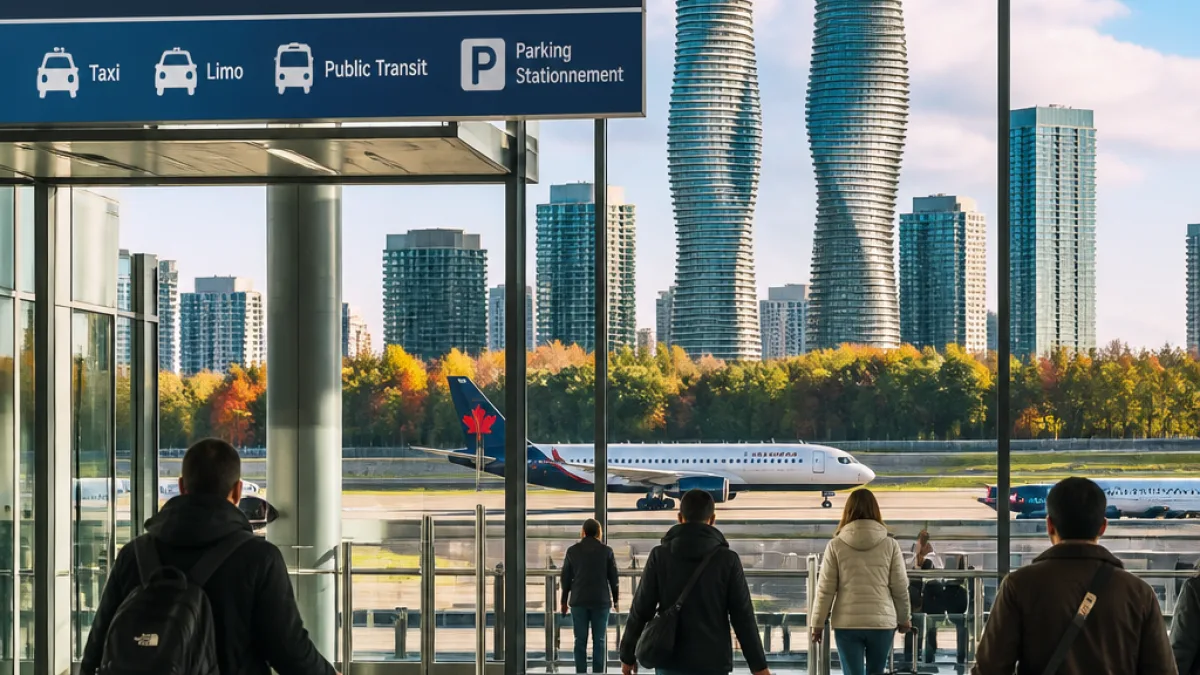
Mississauga’s first impression: a gateway city
A recent first-person account circulating internationally places Mississauga at the front door of Canada for many newcomers and returning visitors. The piece underscores the city’s role as the home of Toronto Pearson International Airport, described as the country’s busiest entry point, and paints a picture of travellers stepping from the arrivals hall directly into a community defined by urban density, green space and cultural diversity within minutes of landing.
The writer, comparing experiences arriving via KLM through Amsterdam’s Schiphol to Toronto, emphasizes how Mississauga increasingly feels familiar rather than foreign. That perception is rooted, the column suggests, in what visitors encounter almost immediately—major transportation access, visible high-rise growth and a civic landscape that blends residential neighbourhoods with waterfront corridors and parks.
“Each visit to Mississauga feels less like stepping into a foreign city and more like going home or reconnecting with an old friend.”
Where Mississauga sits in Canada’s urban map
The article situates Mississauga on Toronto’s western edge while summarizing Canada’s geographic scale and political layout. It notes 10 provinces and three territories, with Ottawa as the national capital and Toronto as Ontario’s capital. In that framework, Mississauga is presented as one of the country’s most multicultural and economically active communities—attributes residents witness in local business districts, cultural programming and everyday life along major corridors.
| Geographic scope | Figure |
|---|---|
| Canada land area (excl. lakes/rivers) | 9,093,507 sq. km |
| Canada total area (incl. freshwater) | 9,984,670 sq. km |
For international visitors, that context matters: a country of continental scale, with Mississauga positioned within the core economic region of Ontario. The narrative links travel patterns to everyday impressions of Canadian cities, highlighting how this city operates as both a logistics hub and a community with its own civic identity.
Iconic skyline and architectural identity
A focal point in the piece is the instantly recognizable Absolute World Towers, often referred to as the “Marilyn Monroe Towers.” The twisting, hourglass-like design is described as a signature silhouette on the Ontario skyline. The writer frames these two buildings—50 and 56 storeys—as shorthand for Mississauga’s confidence and appetite for contemporary architecture, a theme that resonates with travellers used to major urban skylines abroad.
While the commentary is personal, it echoes a broader local observation: architecture shapes first impressions. For residents, these towers function as more than an address—they anchor how the city is recognized in photographs, travel guides and conversations with those who only see Mississauga briefly on arrival or departure.
Urban fabric beyond the arrivals hall
According to the account, the transition from runway to city is quick—described as immersion within about 25 minutes of landing. That speed, tied to proximity and road connections to Pearson, introduces visitors to a mix of built-up areas and parks, waterfronts and cultural spaces. While the source focuses on first-hand impressions rather than municipal policy, the takeaway aligns with ongoing local priorities around growth, urban design and recreational access that shape daily life as much as tourism.
The narrative also places Mississauga alongside metropolitan references—Toronto, Lagos, Abuja and even New York—making the case that the city compares in energy and diversity, not just as a suburb but as its own centre with distinct markers, routines and rhythms.
Why these impressions matter locally
First-contact stories can affect how investors, students, migrants and returning Canadians choose communities. A welcoming airport region, a memorable skyline and visible public spaces become part of a city’s value proposition. For residents, the portrayal in this travelogue mirrors what many experience: a community that is at once connected to Toronto and assertive about its own profile.
- Gateway role: Pearson’s presence means Mississauga often forms Canada’s first impression for arriving travellers.
- Recognizable skyline: The Absolute World Towers symbolize a modern, design-forward identity.
- Diverse urban environment: The city is depicted as multicultural, with parks and waterfronts embedded in its urban fabric.
The account is not an official city document and does not enumerate tourism metrics or municipal strategies. Rather, it offers a vantage point that residents will recognize: Mississauga as both a practical port of entry and a place with architectural ambition and cultural breadth—qualities that shape how the city is seen from the moment wheels touch down.