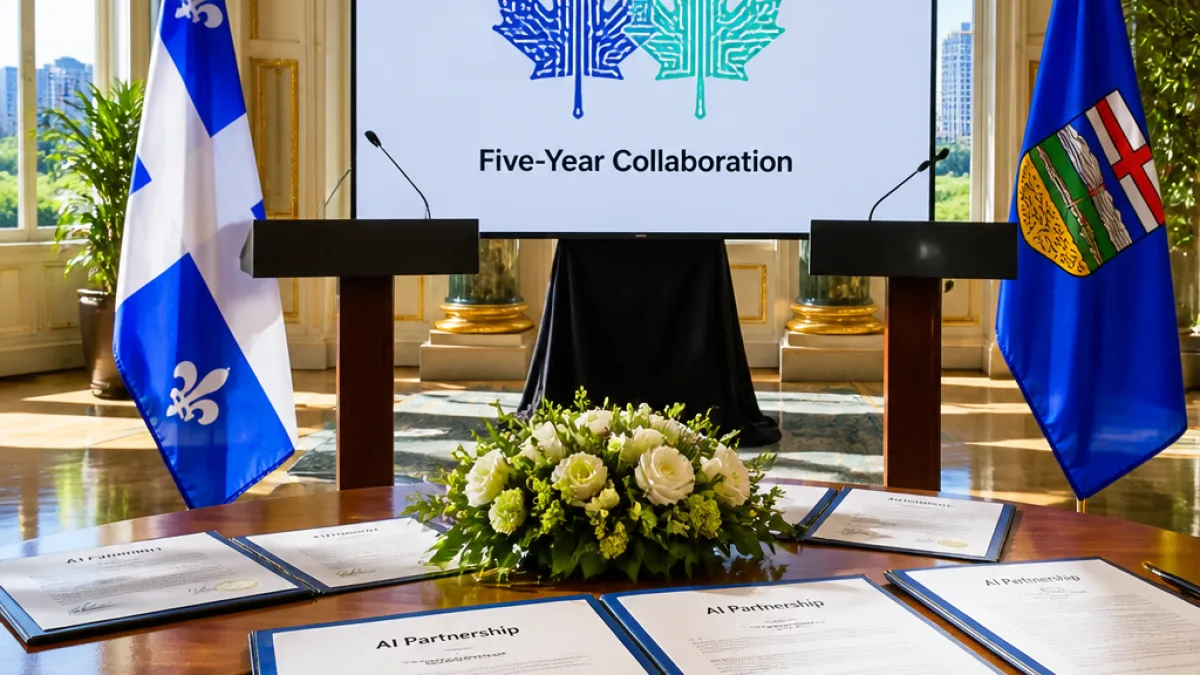
Quebec and Alberta have made their informal talks on artificial intelligence official, signing a five-year arrangement to share expertise on integrating AI into public administration.
Scope and purpose of the agreement
The announcement was made Tuesday by France-Élaine Duranceau, Quebec’s minister of cybersecurity and digital technology, and Nate Glubish, Alberta’s minister of technology and innovation. The partnership does not include any direct financial commitments; rather, it establishes a framework for exchanging knowledge, best practices and practical experience as both provinces pilot and scale AI tools inside government.
Duranceau said the provinces have been in discussions about AI since 2022, and that making the collaboration official will allow them to avoid duplicating work while learning from each other as the technology evolves.
“We’re all moving forward on AI, it’s new, and it changes at a phenomenal speed… So why start from scratch, each on our own? We chose to work together and exchange freely to learn from what the other jurisdiction is doing.”
Why the provinces are partnering
The deal reflects both jurisdictions’ interest in accelerating government transformation with AI while trying to manage risks around cybersecurity, privacy and public trust. Alberta has actively positioned itself as a hub for data centres and AI investment, a trend noted in recent academic research, and Quebec has emphasised building secure, responsible digital services.
Officials described the agreement as a knowledge-sharing arrangement rather than a fund or joint procurement vehicle. It is intended to help public servants and policy-makers:
- compare approaches to AI governance and oversight;
- share technical and operational lessons from pilots and deployments; and
- coordinate cross-jurisdictional thinking on cybersecurity and data management.
Key facts
| Item | Detail |
|---|---|
| Duration | Five years |
| Financial commitment | None — knowledge sharing only |
| Parties | Government of Quebec and Government of Alberta |
Context and local impact
Government adoption of AI raises practical questions for provincial services such as automated decision-making, client-facing chat tools, fraud detection and internal analytics. For Quebec residents, the agreement could speed up the introduction of AI-backed services while giving Quebec officials access to Alberta’s operational experience and data-centre industry developments.
For public servants, the partnership may lead to shared training resources, common procurement standards and coordinated policy work on governance frameworks. For the public, it could mean clearer standards on transparency, accountability and privacy where AI is used in service delivery.
Officials have framed the move as pragmatic: rather than each jurisdiction reinventing governance and implementation strategies in parallel, they will exchange what works and what does not, an approach intended to reduce cost, risk and time to deployment.
Further details about specific programs, working groups or timelines for pilot projects were not released at the announcement. The ministers said their offices will continue to collaborate and provide updates as initiatives develop.
This formal partnership follows several years of interprovincial conversation about how to harness AI in the public sector and arrives amid growing interest across Canada in establishing responsible AI standards for government use.