Council decision opens door to more food retail
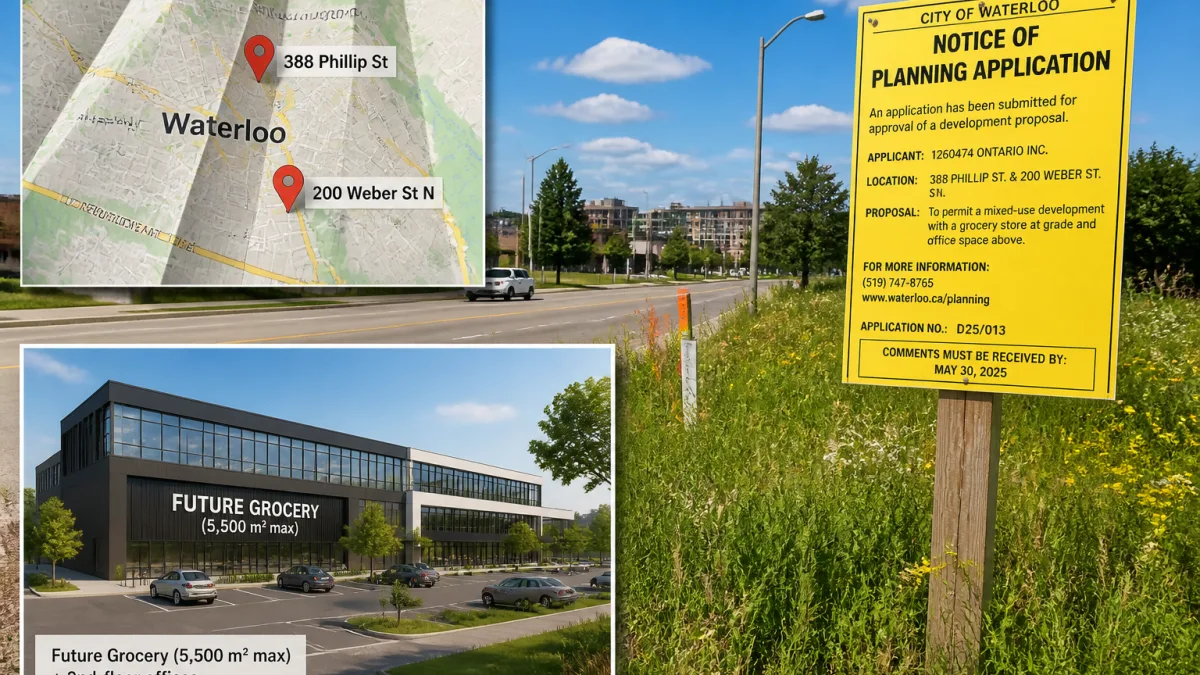
Waterloo City Council has approved land-use changes to permit new grocery stores in two neighbourhoods, advancing retail options in areas identified by staff and councillors as suitable for added services and potential employment. The amendments, passed Monday, authorize “food stores” at 388 Phillip Street and 200 Weber Street North (south of University Avenue East).
According to the city, the approval at 200 Weber Street North enables a proposed grocery store with offices on a second floor, pairing retail with employment space on the same property. On Phillip Street, the site-specific permissions now allow a store up to 5,500 square metres, with an added technical allowance for “a horizontal connection to a vertical geothermal system” on an adjacent property.
What the amendments change
- Enable “food stores” at two addresses: 388 Phillip St. and 200 Weber St. N.
- Authorize a potential second-floor office component at 200 Weber St. N.
- Set a maximum store size of 5,500 m² at 388 Phillip St.
- Permit a connection to a neighbouring vertical geothermal system at the Phillip Street site.
Councillors noted during the decision that the updated land-use permissions are intended to support job creation in the surrounding areas. The dual-use concept at Weber—pairing retail with office space—aligns with that aim by building employment opportunities into the same footprint as the grocery anchor. The Phillip Street permission, including its 5,500 m² cap, establishes clear parameters for any future builder while reserving room for a full-service format should a proponent advance a plan.
Addresses and permitted features
| Address | Key permission | Notes |
|---|---|---|
| 388 Phillip St. | Food store up to 5,500 m² | Allows horizontal connection to neighbouring vertical geothermal system |
| 200 Weber St. N. | Food store | Proposed grocery with second-floor offices supported |
Next steps and local impact
The approvals are a planning milestone, not a building start. Any proponent would still require detailed design review and standard municipal processes before construction. Monday’s changes remove land-use barriers so an operator can advance site-specific plans that meet the new permissions and technical requirements.
For residents, the decision positions two neighbourhoods to gain closer access to everyday goods while adding commercial space that can sustain jobs. The Weber site’s office component, if built as proposed, would concentrate employment on a corridor already served by established city infrastructure. The Phillip permission’s geothermal connection clause could allow an eventual project to tap into neighbouring energy systems, subject to technical and property arrangements.
By enabling food retail in both locations, council set conditions that could draw investment and improve choice for households in the vicinity. Timelines will depend on proponent readiness, market conditions and subsequent municipal approvals. Council’s action ensures that when a builder is prepared to proceed, the zoning is in place for a grocery store and, on Weber, an upper-storey office use.