Viral air redraws surfing’s lines
An Australian teenager has turned a controlled training ground into a world stage, landing a one‑handed backflip in a Texas wave pool that ricocheted across social media. The clip by Hughie Vaughan drew millions of views within hours and a cascade of reactions from elite athletes and pop‑culture figures, underscoring how engineered waves are accelerating the most dangerous corner of modern surfing.
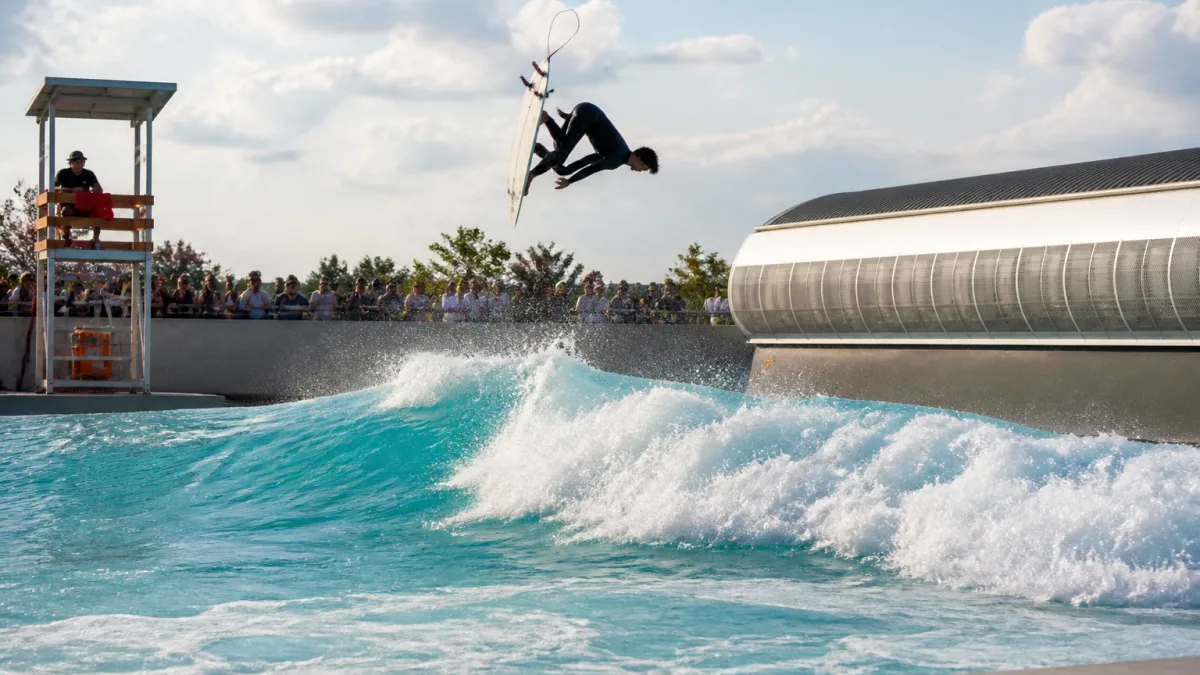
The move — later labelled the “stalefish flipper” — involved a clean launch above the lip, a backflip while gripping the board with one hand, and a steady ride out. What followed was neither a fist‑pumping celebration nor a long claim. Vaughan simply paddled back out, glanced at his board and kept going. He described the moment later as a whirlwind, noting that the idea came together on the fly during a session that took roughly a dozen attempts before it stuck.
“It was a pretty crazy moment,” he said. “When I went over there they were asking me if I had any tricks I wanted to try … It took me 10 or so tries, and then I got it.”
From niche aerials to mainstream spectacle
Aerials have been part of surf progression since the 1980s, but the mainstream response to Vaughan’s manoeuvre — amplified by a reliable, repeatable pool setting — shows how quickly the ceiling is moving. Former world champion Italo Ferreira called the clip “insane,” while American DJ Diplo wondered aloud if it was AI. Surfing legend Mick Fanning admitted he had to rewind repeatedly to understand the sequence. Skateboarding icon Tony Hawk provided a name that stuck in the community’s shorthand.
For audiences in Vaughan and elsewhere, the takeaway is not just the novelty of a teen landing a high‑risk flip; it is the role of pools as laboratories. These facilities remove the unpredictability of ocean swells, letting athletes attempt the same section again and again until muscle memory catches up with imagination. That repeatability is fuelling faster iteration — and, increasingly, headline‑grabbing moments that cross into non‑surf media.
Consistency, critique and accountability
Wave pools have long drawn mixed reactions inside the sport. Purists raise concerns about divorcing performance from the ocean’s variability; others see a training tool that makes spectacular, once‑improbable airs feasible. Vaughan’s backflip illustrates this tension. The set‑and‑reset rhythm of a pool enables risk that would be hard to justify in shifting line‑ups offshore, while also demanding athletes keep themselves anchored to ocean standards when the venue changes.
Vaughan’s recent surge did not come out of nowhere. Barely a month before the Texas clip, he won Stab High, a leading aerial‑surf contest that rewards above‑the‑lip innovation. The rapid sequence — contest victory, viral trick, and new sponsors — highlights how quickly the marketplace responds when gym‑style repetition meets a sport built on fleeting conditions.
Reactions capture a sport in transition
- High‑profile endorsements and disbelief greeted the clip, from a world champion’s “insane” to a mainstream artist’s “Is this AI?”
- Veteran surfers acknowledged the difficulty of parsing the rotation in real time, reflecting how far aerial complexity has advanced.
- Naming by a cross‑sport figure — Tony Hawk — hints at the growing overlap between board sports as tricks migrate and evolve.
For Canadian viewers, the episode doubles as a case study in how controlled environments are redrawing performance boundaries. The ability to repeat the same section until a move is dialled does not erase the ocean’s authority, but it is clearly rewriting training pathways that once depended entirely on weather, tide and luck. The result is a pipeline of athletes arriving at ocean heats with gym‑honed timing — and audiences primed to expect fireworks.
What the numbers say
Even stripped of hype, a few simple figures tell the story of reach and repetition behind this moment.
| Detail | Figure |
|---|---|
| Estimated attempts before landing | About 10 |
| Views of viral clip | ~2 million |
| Recent result | Stab High winner |
What has changed is not only who can land advanced airs, but how quickly a new variation can be attempted, refined and shared. The distribution loop — pool, camera, social feed — is now part of the progression arc. For communities like Vaughan, far from consistent ocean surf, that loop is also how the sport increasingly arrives: as a steady stream of precision clips that push standards and stir debate over where innovation should live.