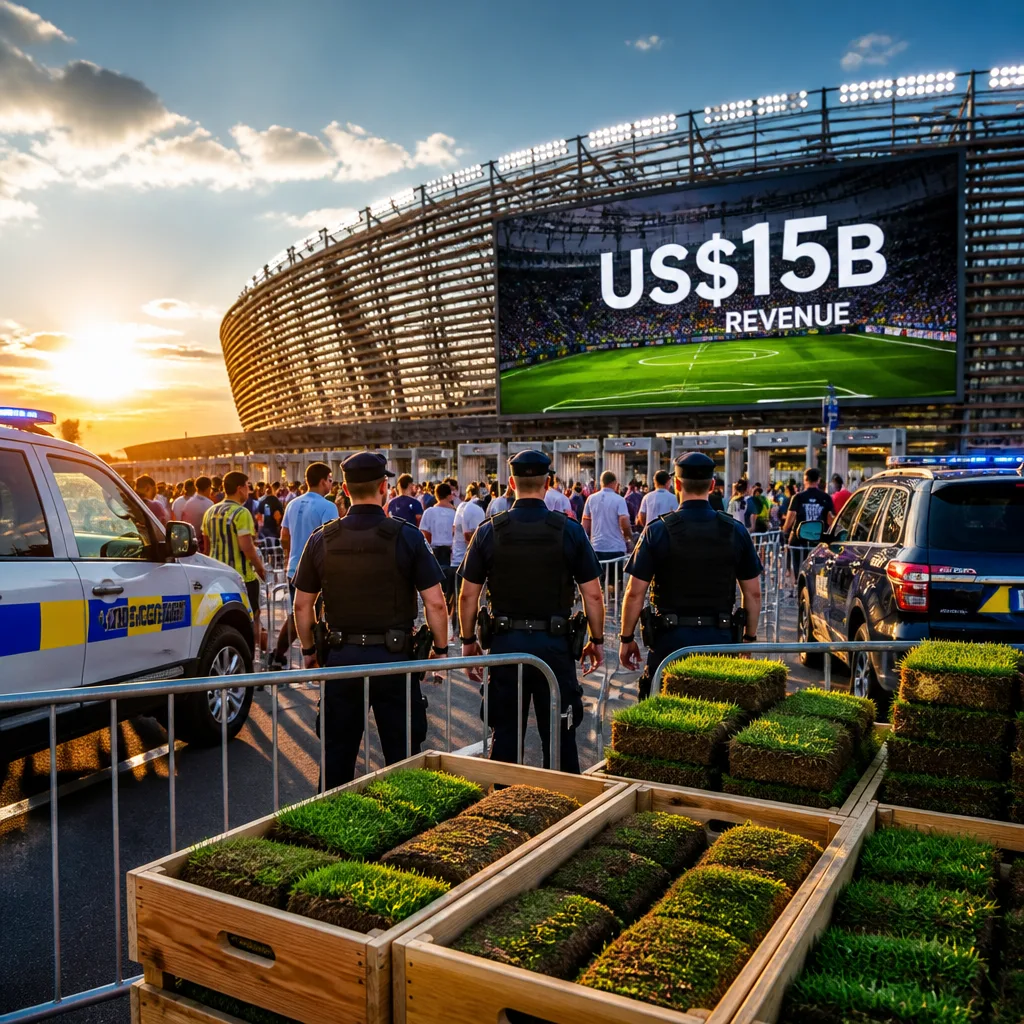
FIFA is poised to confirm a record-breaking revenue haul of US$15 billion (approximately £11.2 billion) from this summer’s World Cup, significantly outstripping internal targets, according to a report from The Guardian cited by Sky Sports’ Sunday round-up. The figure would mark an unprecedented commercial return for the tournament, underscoring football’s expanding global marketplace and the surging value of broadcast, sponsorship and marketing rights clustered around the sport’s biggest stage.
Record tournament takings
The reported $15 billion total signals a step-change in the World Cup’s financial footprint, with The Guardian noting it will ‘significantly’ exceed projections set before the competition. While a full breakdown has yet to be disclosed, the headline number reinforces the World Cup’s position as the sport’s premier economic engine—an event that reliably reshapes balance sheets for the governing body and, through its revenue-sharing mechanisms, reverberates across national associations worldwide.
| Metric | Reported Outcome |
|---|---|
| Total World Cup revenues | US$15 billion (approx. £11.2 billion) |
| Compared to targets | Significantly exceeded (per The Guardian) |
For stakeholders—from broadcasters and sponsors to grassroots programs depending on FIFA distributions—the number is more than a headline. It reflects a deepening commercial appetite around the tournament’s matchday drama, as well as the premium prices commanded by global media rights and on-site activations. It also arrives at a moment when major sports properties are being tested by changing viewership habits and the streaming pivot, making the sustained—and growing—appeal of the World Cup particularly notable.
Final under the spotlight
Even as the balance sheet swells, attention around the final has stretched beyond the pitch. The Telegraph reports that the expected attendance of former U.S. president Donald Trump has triggered an extensive security operation, including F-16 fighter jets and marksmen, described as the largest sporting security effort in United States history. The scale of the response underscores the heightened profile of the event and the parallel demands placed on host authorities when global politics and global sport intersect.
Meanwhile, the commercial theatre around the showpiece has drawn political pushback. According to The Athletic, the governor of New Jersey criticized FIFA for selling sections of the pitch from the stadium slated to stage the final, arguing that taxpayers effectively footed the bill for the venue and that the governing body’s move merited scrutiny. The clash speaks to a broader debate over how far event organizers can monetise every inch of a mega-event without inflaming public sentiment in host regions.
Context around the game
Two truths are colliding in real time. On one side, the World Cup continues to be football’s most powerful commercial asset, delivering windfalls that reshape the sport’s funding ecosystem. On the other, the tournament’s gravitational pull invites heightened security protocols and intense public scrutiny of how profits are made—and who ultimately benefits.
Those contrasts were echoed across the Sunday digest of headlines carried by Sky Sports, which gathered reporting from multiple outlets. It’s a snapshot of the modern World Cup: extraordinary sums, extraordinary security, and a battleground over what should—and shouldn’t—be for sale when the world’s game arrives on home soil.
- FIFA revenues: Reported at US$15 billion, far above targets (The Guardian).
- Security surge: Trump’s expected presence at the final prompts unprecedented measures (The Telegraph).
- Political pushback: New Jersey governor rebukes FIFA over selling pieces of the host stadium’s pitch (The Athletic).
The full accounting from FIFA is expected to set benchmarks across the sports industry, where governing bodies, leagues and clubs are recalibrating valuation models in a post-pandemic era dominated by streaming, sponsorship analytics and data-driven fan engagement. However, as this World Cup shows, the richest tournament in the sport also amplifies questions that can’t be settled in a ledger: the balance between spectacle and security, and the line between celebration and commodification.