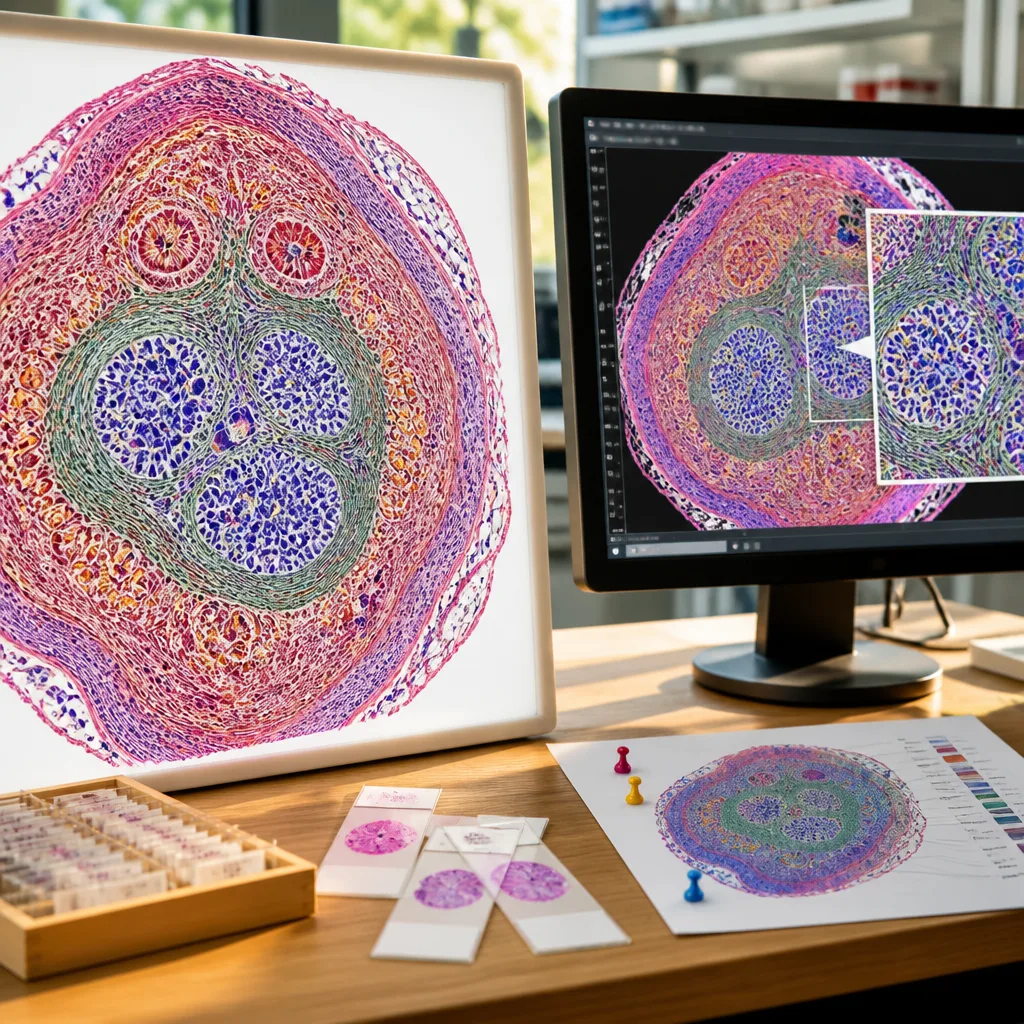
Scientists have produced a high-resolution cellular map of untreated breast tumours and identified discrete regions where cancer cells are not actively dividing but instead remain in a dormant, or quiescent, state. The work, published in Genome Medicine by researchers at the MRC Laboratory of Medical Sciences, Imperial College London and the UCL Genetics Institute, suggests those silent cells are often surrounded by immune and connective tissue that may shelter them from conventional therapies.
Dormant cells may evade treatment and later reactivate
The team used publicly available single-cell and spatial data to chart the cellular composition of breast cancers. Their maps revealed that tumours are not homogeneous masses of rapidly proliferating cells; rather, they include separate niches where growth has effectively paused. Those quiescent cells are of particular clinical concern because they can survive chemotherapy, which targets dividing cells, and later resume growth, contributing to relapse or metastasis.
"Quiescent cancer cells are very dangerous," explains Dr. Alexis Barr, co-lead author and head of the Cell Cycle Control group at the LMS. "These cells can hide from chemotherapy and then remain in this dormant quiescent state in the tumor, and then later reactivate to drive proliferation."
Protective microenvironments identified
Analyses showed that quiescent cancer cell clusters are frequently encircled by other cell types — notably immune cells and components of the connective tissue — that may form a local environment favouring survival rather than elimination. The researchers emphasise that it is the combination of cell state and local neighbourhood that appears to allow these cells to persist in untreated tumours.
- Quiescent cells: non-dividing, able to survive stress, potential source of recurrence.
- Active tumour cells: rapidly proliferating, primary targets of chemotherapy.
- Surrounding cells: immune and stromal cells that may create a protective niche.
Implications for treatment strategies
The study argues that future therapies will likely need to do more than attack fast-growing tumour cells. Effective long-term control may require approaches that identify and disrupt the niches that permit dormancy, or that directly target the biology of quiescent cells while limiting harm to normal tissues.
| Feature | Quiescent vs Active tumor cells |
|---|---|
| Proliferation | Quiescent: minimal or no division; Active: frequent division |
| Therapy sensitivity | Quiescent: relatively resistant to chemotherapy; Active: more sensitive to agents targeting cell division |
| Microenvironment | Quiescent: often surrounded by immune/stromal cells forming a niche; Active: mixed neighbourhoods with expanding cancer cells |
Authors used existing datasets to reconstruct spatial relationships rather than generating new clinical samples. As such, the findings define associations — where quiescent cells are located and which cells neighbour them — but do not yet prove the precise mechanisms by which surrounding cells protect dormant cancer cells.
The mapping provides a framework for future experiments that could test whether disrupting those microenvironments reduces recurrence in animal models or clinical trials. If validated, the approach would broaden the target set for anti-cancer therapy beyond proliferating cells to include the cellular contexts that support dormancy.
The research underscores the complexity of tumours and the need for therapies that account for both cellular state and tissue architecture. For patients and clinicians, it highlights why some cancers return even after aggressive treatment and points to new directions for preventing relapse.