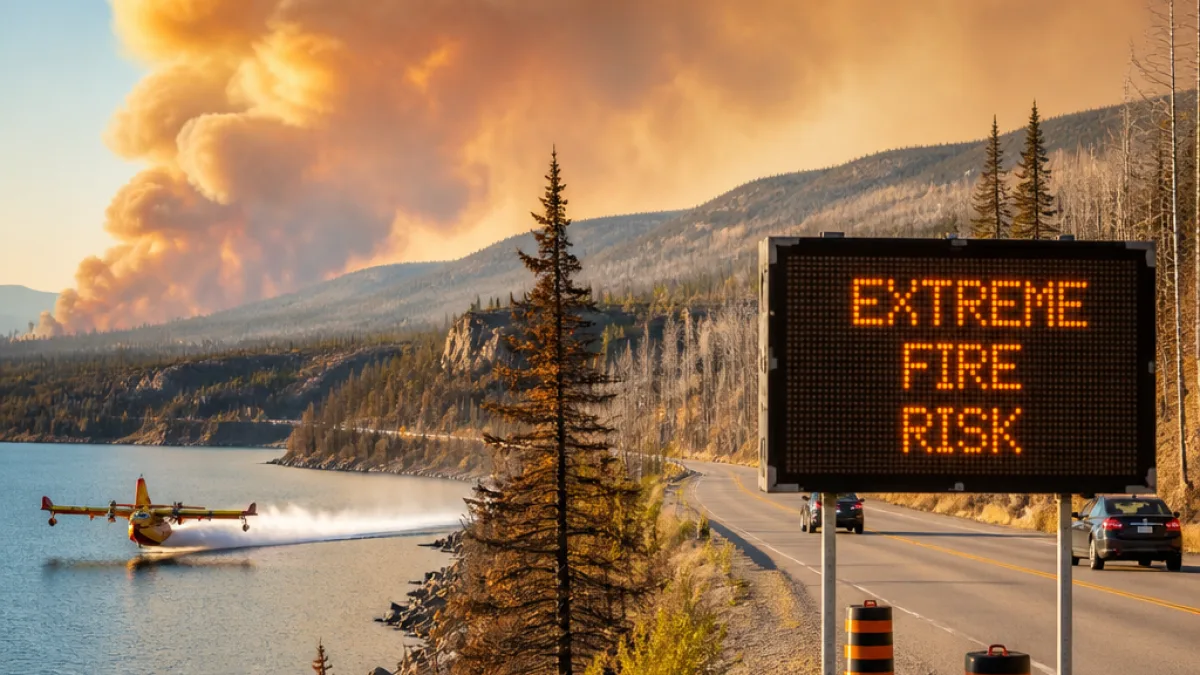
Premier visits as wildfire season intensifies
Premier Doug Ford travelled to Thunder Bay on Saturday alongside provincial ministers and the city’s mayor to address an increasingly severe wildfire season in northern Ontario. Reporters were told that the province is contending with just under 200 active fires across the region, a situation that continues to shift hour by hour.
Ford said his government is prepared to finance the response as conditions evolve.
“If it’s $500 million this year, so be it,”he said, reiterating that the province would marshal the resources required to support communities affected by the fires. Critics, however, argue that northern municipalities and First Nations need clearer provincial direction and more timely information as they make difficult decisions about evacuations and essential services.
Thunder Bay 36 dominates the season
The largest and most consequential blaze identified Saturday is Thunder Bay 36, which has grown to 318,812 hectares and is burning in Wabakimi Provincial Park northwest of Thunder Bay. Local journalist Jon Thompson, who has been covering the situation on the ground, said the scale and pace of change make real-time reporting challenging.
“The situation is so fluid that I’m struggling to take things to press,”
Thompson said, adding that the single fire offers a stark measure of this year’s severity:
“This will be what we remember when we look back to the summer of 2026. To give you a sense of the size of that, the average 10-year average in Ontario for all fires is 210,000.”
By comparison, Thunder Bay 36 alone already exceeds that benchmark, underscoring how extraordinary this season has become for the northwest.
Pressure points: evacuations and communication
Thompson emphasized long-standing strains between northern communities and Queen’s Park, arguing that communication gaps are complicating local emergency management:
“Northern Ontario struggles with a political culture and disconnect with southern Ontario in every way, all the time. This is that, turned up to 11.”
He said communities are seeking clearer, more consistent guidance from the province as they weigh evacuation triggers, transportation logistics and accommodations for residents displaced by smoke and fire activity. According to Thompson, some local leaders feel that the information flow from Ontario is not sufficient for the decisions they are being asked to make.
What the numbers show
Available figures and context from Saturday’s update and on-the-ground reporting include the following:
| Indicator | Latest detail | Source/Context |
|---|---|---|
| Active wildfires in northern Ontario | Just under 200 | Provincial update in Thunder Bay |
| Thunder Bay 36 size | 318,812 hectares | Largest recorded fire currently burning |
| Ontario 10-year average (all fires) | 210,000 | As reported by Jon Thompson |
| Location of Thunder Bay 36 | Wabakimi Provincial Park | Northwestern Ontario |
Local impact and next steps
While each fire behaves differently with shifting winds, weather systems and fuel conditions, the concentration of blazes in the northwest is interrupting daily life across a wide geographic area. Communities are managing smoke exposure, potential road and air travel disruptions, and contingency plans for critical services. Local authorities continue to coordinate with provincial crews on fire suppression and structure protection, while preparing for rapid changes if conditions worsen.
Ford’s appearance in Thunder Bay signals the province’s focus on response capacity and funding. But the season’s pace and the outsized footprint of Thunder Bay 36 highlight concerns raised by front-line observers: that northern communities need more predictable communication and support while they decide when and how to move people safely.
What residents should watch
- Monitor local advisories and municipal channels for evacuation alerts and transportation guidance if conditions change.
- Expect variable air quality as wind and weather shift; sensitive groups should plan accordingly based on public health advice.
- Follow instructions from local emergency officials if protective measures or relocations are announced.
The province has not released a comprehensive forecast for when fire activity may ease. For now, officials stress that the situation remains dynamic, particularly in northwestern Ontario, and that residents should rely on local emergency information for the most current direction.