Granby connection, Massachusetts honour
A resident of Granby in western Massachusetts has been recognized among the 2026 class of Commonwealth Heroines for leading large-scale, community-driven public art. Working from a studio in Springfield, the founder of the nonprofit Common Wealth Murals was selected by state Rep. Mindy Domb, D-Amherst, and is one of 147 women chosen statewide — including four in Hampshire County — through the Massachusetts Commission on the Status of Women program.
The honouree, whose organization has helped create roughly 100 public installations across western Massachusetts since 2019, has centered her practice on elevating everyday neighbours. Her murals — painted on apartment buildings and parking garages — often feature people who are not household names but are pillars in their communities. She described the recognition as appreciated but uncomfortable, preferring to spotlight others.
“I don’t generally talk a lot about myself,” she said in an interview at her Springfield studio. “It’s lovely to get this honor, and it also feels a little awkward because I’ll always put someone else forward if I have the chance to.”
From a spark in Barcelona to mobilizing hundreds at home
The shift to full-time community mural-making followed a formative trip to Barcelona, where a dense landscape of street art reshaped her ambitions. She left work as an education consultant in 2019 and redirected her energy into building a nonprofit that treats public art as a shared civic project, not just an artist’s signature on a wall.
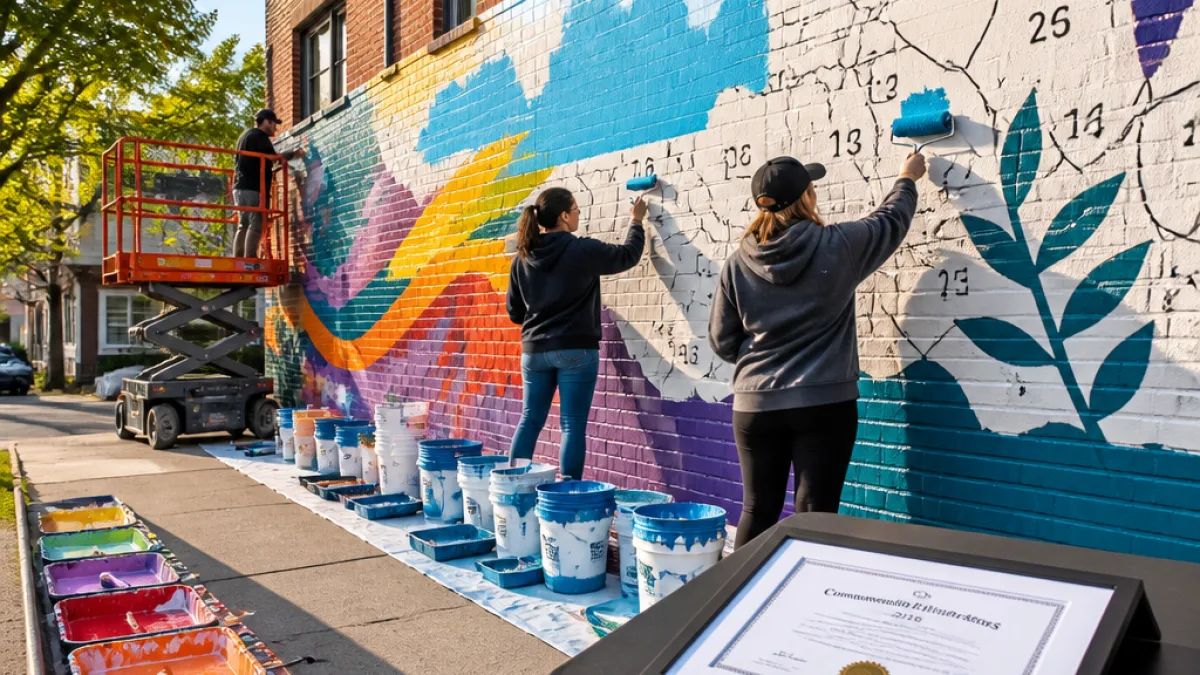
In its first year, the group produced 10 murals. Nine followed a traditional model featuring a professional artist. The tenth project broke that mould and invited about 700 community members to participate in creating the piece. That experience reoriented the entire mission.
“What really motivates me is, what if we made public art that was actually by, for and about the public living with the art?” she said.
Numbers behind the recognition
| Measure | Detail |
|---|---|
| Statewide honourees (2026) | 147 |
| Hampshire County honourees | 4 |
| Total installations since 2019 | About 100 |
| Murals in first year | 10 (9 traditional; 1 with community) |
| Community participants (one project) | About 700 |
Why this resonates beyond one state line
For readers in Granby, Quebec, the recognition speaks to how community arts can operate as public service — a way to convene neighbours, surface local stories and animate shared spaces. While this honour was awarded in Massachusetts, the approach detailed here shows how a focus on ordinary residents can transform walls into local memory, with participation on a scale that reaches into the hundreds.
The program led by the Massachusetts Commission on the Status of Women highlights people who improve everyday life where they live. In this case, the practice emerged from a simple premise: that the public should help decide what public art looks like and, when possible, lend a hand in making it. The honouree resists ranking her projects, describing them collectively as equally valued — more like a body of work that belongs to the communities who helped shape it.
Community-led art as civic infrastructure
Across western Massachusetts, these installations are not just decorative. They have become landmarks that reflect local narratives — from neighbours delivering scripture passages to residents known for looking after others. The sustained pace of production since 2019 suggests a model that communities have embraced, balancing professional design with broad participation. It is a reminder that arts infrastructure can be as much about engagement as about paint on brick.
- Local participation can scale quickly when projects are designed for many hands.
- Recognition programs help validate behind-the-scenes civic work, especially by those who deflect attention.
- Everyday stories are powerful drivers for public art that residents see as their own.
The honouree’s reluctance to stand in the spotlight underscores the ethos behind the murals: centre the community, share the brush, and let the finished work speak for the people who live with it every day.