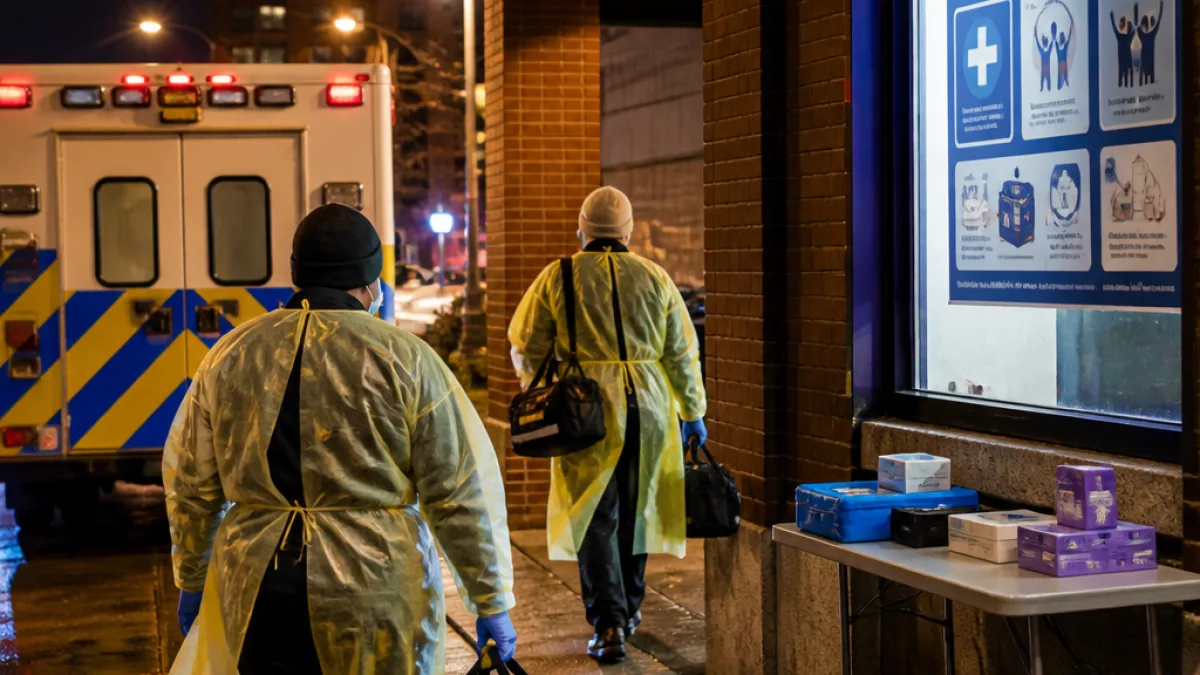
Calls falling but poisonings persist
Moncton has seen a notable decrease in the volume of emergency calls for suspected overdoses since a sharp spike in June, but public safety and health workers warn the risk has not disappeared. First responders were answering as many as 50 calls a day at the peak of the surge. That figure has since dropped to about 10–12 calls daily, according to Moncton Fire Chief Conrad Landry.
New protocols at shelters and clinics
Health-care and shelter staff report changes to how they manage suspected poisonings are helping limit calls to emergency services. Medical staff at the Salvus Clinic, which is part of the Horizon Health Network, say frontline teams have adopted different practices to cope with a drug supply tainted by medetomidine, a potent veterinary tranquilizer that has been found mixed with fentanyl.
- Shelter and outreach workers are handling more incidents on site instead of automatically calling EMS.
- Teams are relying on available reversal kits and adapted treatment steps to stabilise clients.
- Fire services have deployed a smaller response vehicle to improve agility for overdose calls.
Frontline stress remains an issue
Although call volumes have declined, officials stress the toll on responders has been heavy. "It's been a difficult time," said Dr. Erin Rogers, a family physician with Horizon Health Network who works at the Salvus Clinic. Chief Conrad Landry said responders are hoping numbers continue to fall, noting concerns for both the individuals affected and the mental health of firefighters.
"We're hoping that it goes down … obviously for these citizens, these vulnerable people that are being affected by it, and the mental health of firefighters," said Moncton Fire Chief Conrad Landry.
How the response evolved
At the height of the crisis, staff described discovering groups of several people unconscious at a time — sometimes five or eight individuals together — requiring repeated use of opiate reversal kits by volunteers and shelter staff. As local agencies refined their on-site treatment protocols and triage, emergency medical services reported fewer calls for assistance in situations that could be managed without ambulance dispatch.
| Period | Approx. daily calls |
|---|---|
| June peak | ~50 |
| Recent | 10–12 |
| Typical (pre-spike) | a few |
Officials caution that lower call numbers do not mean the underlying problem is resolved. The presence of medetomidine in the unregulated drug supply continues to pose a threat, and health-care and shelter providers say vigilance and adapted response measures remain necessary to protect vulnerable residents.
This report is based on interviews with local health and emergency personnel and on updates from the Horizon Health Network and Moncton Fire Department.