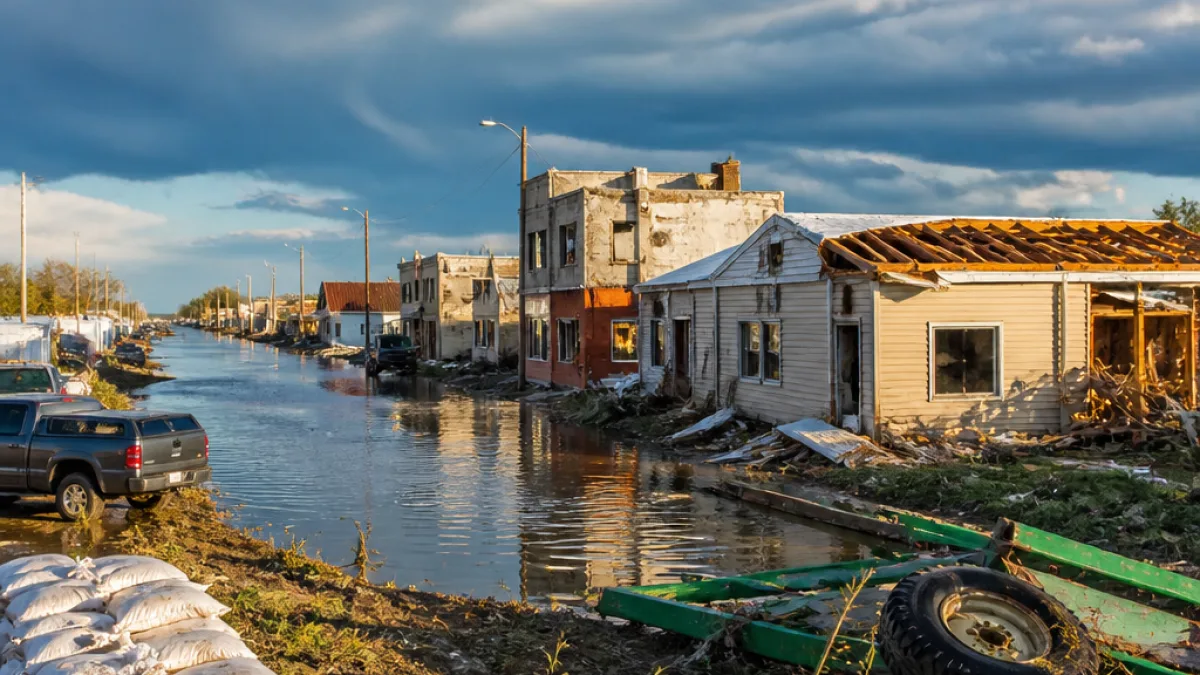
Severe storms that swept across Manitoba and Saskatchewan on June 9 and 10 have produced at least $728 million in insured damage, according to preliminary analysis by CatIQ — a figure that underlines growing climate-driven costs on the Prairies just as a promised federal flood insurance backstop remains undelivered.
Storm damage and stalled policy
The June event included tornadoes, large hail, damaging winds, intense rainfall and flash flooding that affected communities across both provinces. The losses coincide with separate flooding in Montreal and surrounding areas on June 20 and 21, which CatIQ estimates at more than $409 million in insured damage.
Despite a federal campaign commitment in 2025 to contribute $450 million toward a national flood insurance backstop and an intended April 2026 launch, industry officials say the program is still being designed and there is no confirmed delivery timeline. That leaves households at highest risk of overland flooding without affordable, broad coverage from either private insurers or a public backstop.
"These recent and past catastrophes are a reminder that flood risk is no longer a future challenge, it is a current reality affecting Canadians from coast to coast," said Liam McGuinty, vice-president of Federal Affairs at the Insurance Bureau of Canada.
Long-term trend of rising water-related losses
CatIQ's analysis places the recent Prairie event within a broader pattern: over the past two decades, flood and water-related insured losses have climbed substantially, accounting for a growing share of catastrophic claims. The organisation notes that flood and water incidents now represent a sizeable portion of total insured catastrophe losses.
Insurers have been handling multi-billion-dollar catastrophe years in recent times. Since 2009, annual insured payouts for extreme-weather catastrophes average more than $2 billion, with record totals reported in 2024 and 2025.
What this means locally
For homeowners and businesses in Saskatchewan, the immediate implications are practical and financial:
- Properties damaged by overland flooding or wind-driven water loss may face large out-of-pocket expenses where coverage is limited.
- Approximately 1.5 million Canadian households considered highest risk nationally remain without access to affordable overland flood insurance while the backstop is being finalised.
- Communities and municipal services may see strain from repair costs and increased demand for emergency supports.
Provincial and municipal authorities are typically responsible for on-the-ground emergency response and short-term supports, but longer-term recovery and affordability of insurance hinge on federal policy decisions and private-market offerings.
| Event | Estimated insured damage |
|---|---|
| June 9–10 storms (Manitoba and Saskatchewan) | $728 million |
| June 20–21 Montreal-area floods | $409 million |
Officials at the Insurance Bureau of Canada and other stakeholders have renewed calls for a clear timeline and programme design so that federal contributions can effectively function with private flood coverage. Until that coordinated framework is in place, residents in flood-prone areas will continue to face uncertainty about coverage and affordability.
Coverage gaps also create policy tensions: insurers, governments and homeowners will need to negotiate how to manage risk, share costs and incentivize mitigation work such as improved drainage, land-use planning and infrastructure upgrades in communities across the Prairies.
As provincial and municipal officials consider recovery and resilience measures, affected residents should contact their insurers and local emergency services for guidance on claims and supports available following storm damage.