Holiday period, higher exposure on the water
Quebec has entered the peak of its summer drowning season just as the construction holiday begins, with the Quebec Lifesaving Society reporting 39 suspected drownings so far in 2026 and cautioning that the two-week vacation period consistently drives those numbers higher.
The organization’s executive director, Raynald Hawkins, said the province typically sees a notable rise in incidents during this interval as more residents head to lakes, rivers and shorelines. At the same time last year, Quebec had recorded 37 suspected drowning deaths. Based on five years of provincial data, Hawkins expects at least nine additional fatalities over the next two weeks if past patterns hold.
“This is the time of the year where we have more drowning situations during one week, everywhere in Canada,”
he said, pointing to a confluence of vacation schedules and favourable weather that draws people in, on and near the water.
Open water risks: currents you cannot see
Recent events underscore how quickly outings can turn dangerous on the St. Lawrence River. On Friday, two men from Montreal were reportedly fishing near Marsoui in the Gaspé when one slipped into the water; the second is believed to have tried to help and was swept away, according to the Sûreté du Québec (SQ). Volunteers recovered one body that morning; as of Sunday, police said the search continued for a 45-year-old man.
Marsoui’s mayor, Renée Gasse, told Radio-Canada that tides had been unusually strong in recent days. Hawkins noted that conditions on large rivers can be deceptive: a calm surface may conceal powerful subsurface movement.
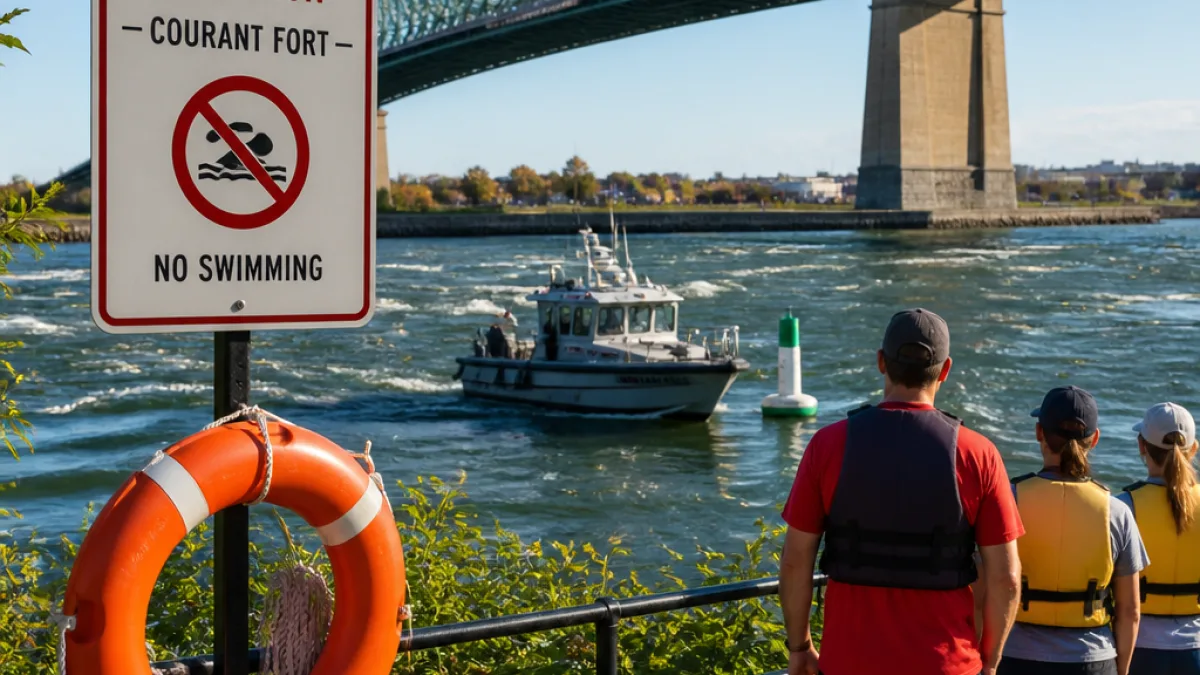
“A river like the St. Lawrence may appear ‘flat,’ but there can be a strong current under the surface that’s like a ‘vortex.’ At the surface, you will not see that.”
Where drownings happen in Quebec
Public perception does not always match the evidence. The Lifesaving Society cites data from the Quebec coroner showing that, between 2013 and 2022, more than half of suspected drowning deaths occurred in open water such as rivers and lakes — not primarily in backyard pools. The finding aligns with the risks highlighted on the St. Lawrence and other large bodies of water where changing tides, wind, and current speed can quickly overwhelm even strong swimmers.
The Society’s own survey, referenced by Hawkins, found many respondents initially assumed children and swimming pools were the most likely setting for tragedies. The coroner’s data, he said, points instead to open-water environments as the predominant risk area, particularly in summer months when boating, fishing and shoreline activities increase.
Seasonal patterns and what to watch
The construction holiday concentrates water recreation into a short period across Quebec, increasing overall exposure. Hawkins said that when high participation meets hot weather and complex river dynamics, drowning probabilities rise. In addition to the St. Lawrence corridor, popular inland lakes and river systems in the Laurentians, Lanaudière, the Outaouais and the Eastern Townships typically see more traffic — and, by extension, more incidents — through late July and early August.
Officials also emphasized that storm activity amplifies the force of currents. Hawkins said that during and after storms, current speed can ramp up below the surface without obvious visual cues. That reality is consistent with reports from the Gaspé coastline this week of stronger-than-usual tides and fast-changing water behaviour.
What the numbers show so far in 2026
| Indicator | As of mid-July 2026 | Same point in 2025 |
|---|---|---|
| Suspected drowning deaths (province-wide) | 39 | 37 |
| Expected additional deaths over construction holiday (projection based on 5-year trend) | 9+ | — |
While year-to-date totals can vary, the persistent spike during the construction holiday has led safety advocates to stress heightened vigilance on rivers and lakes over the next two weeks.
Key context for residents and visitors
- Open-water settings — especially large rivers like the St. Lawrence — account for a majority of drowning cases in Quebec over the past decade, according to coroner data cited by the Lifesaving Society.
- Surface calm does not guarantee safety; subsurface currents can be swift, particularly after storms or during periods of strong tides.
- Police confirmed the search continues for a 45-year-old Montreal man swept away near Marsoui, after another fisherman was found deceased on Friday.
As vacationers disperse across the province’s lakeshores and riverbanks, emergency responders and municipal leaders are urging care around open water — a message repeated yearly, but especially resonant now as Quebec enters the most perilous stretch of the summer season.