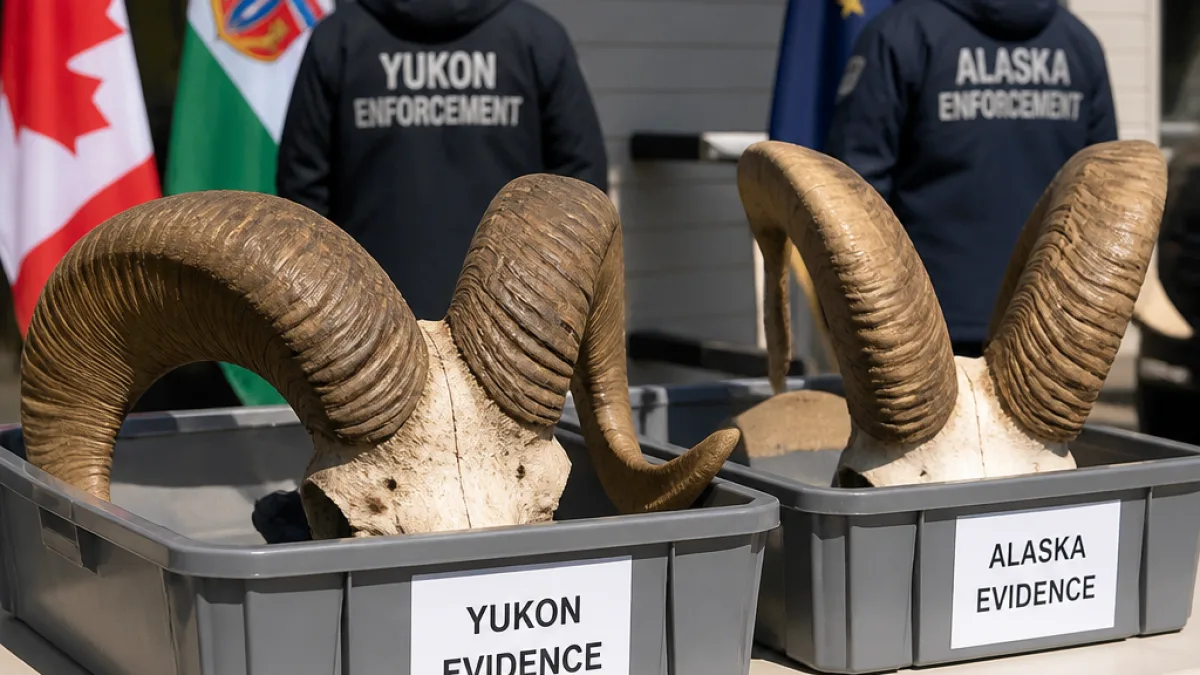
WHITEHORSE — Two sets of horns from thinhorn (Dall's) sheep illegally taken on Yukon land have been returned to the territory following prosecutions in both Yukon and Alaska, the Yukon government announced this week.
End of a cross‑border enforcement effort
The exchange of the animal remains occurred during a spring meeting between Yukon and Alaska enforcement officials and brings to a close a case that began in August 2022. The hunt started in Alaska and ended with the killing of the sheep on the Yukon side of the border.
"It marks the end of an international legal saga that involved both U.S. and Canadian courts."
In Yukon Territorial Court in 2024, three American hunters — Kenneth Eberle, Nathan Eberle and Justin Nagel — pleaded guilty to offences related to the harvesting of the animals and were fined a total of $37,000. The trio later pleaded guilty in Alaska to unlawful transportation of wildlife and were ordered to pay more than $80,000 in restitution to the Yukon government.
What will happen to the remains
According to the Yukon government, one set of horns will be retained by the territory for educational purposes. The other set will be donated to the U.S. National Park Service. The associated capes will be sold at auction, with proceeds earmarked for conservation initiatives.
- Incident began: August 2022 (hunt started in Alaska, ended on Yukon land)
- Legal outcomes (Yukon): Guilty pleas in 2024; fines totalling $37,000
- Legal outcomes (Alaska): Guilty pleas; more than $80,000 in restitution to Yukon
- Disposition: One set of horns kept by Yukon, one donated to National Park Service; capes to be auctioned for conservation
| Item | Disposition |
|---|---|
| Set of horns A | Retained by Yukon government for education |
| Set of horns B | Donated to U.S. National Park Service |
| Capes | To be auctioned; funds directed to conservation |
Officials say the resolution reflects coordination between Canadian and U.S. enforcement agencies and courts. The return and planned uses of the remains aim to support public education about wildlife laws and to channel auction proceeds into conservation work that benefits the species and its habitat.
For residents and visitors, the case underscores that wildlife taken on Yukon territory is subject to Yukon law and that cross‑border activities may prompt investigations and prosecution in multiple jurisdictions.
Further details about the planned auction and specific conservation projects to receive funds were not provided in the government announcement.