Education led, prosperity followed—and the statistics require nuance
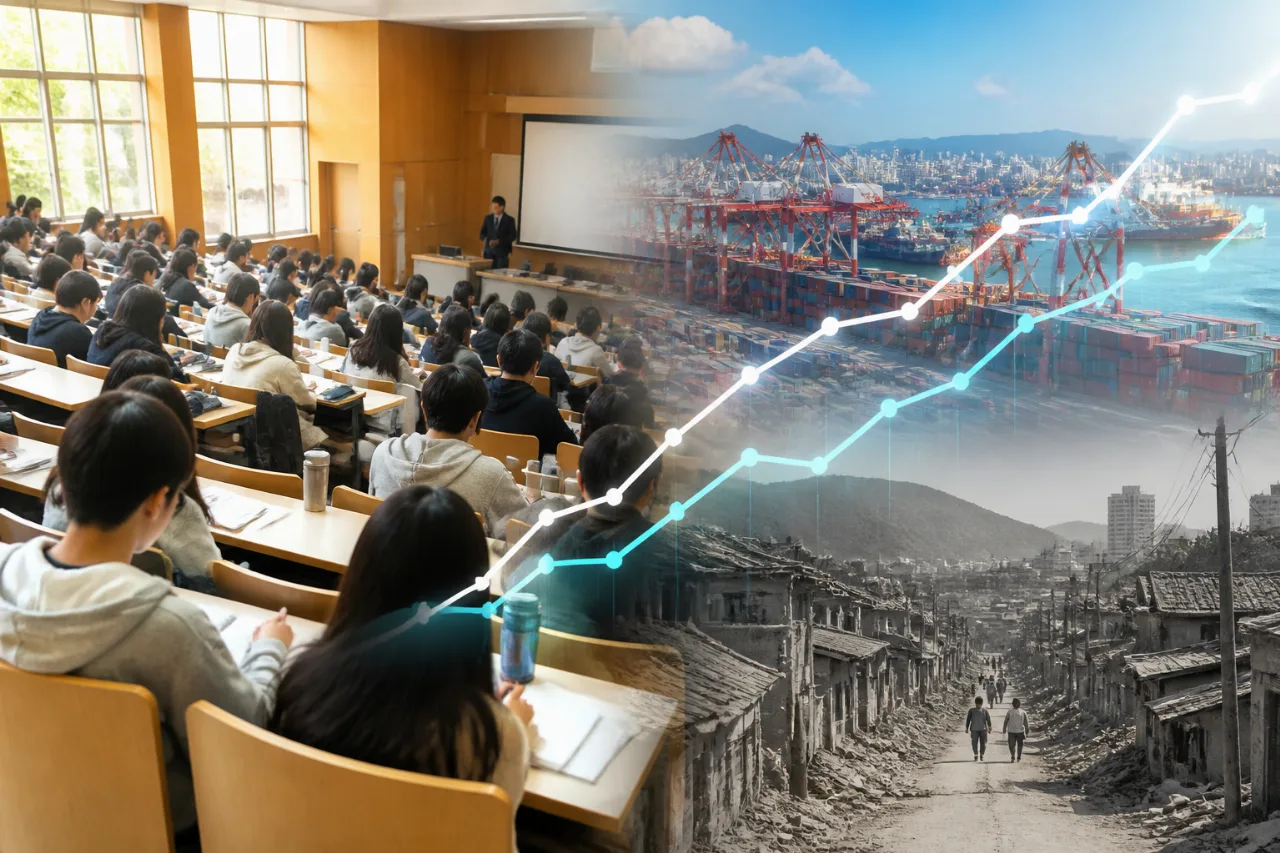
South Korea’s transformation from postwar devastation to a nation with one of the highest life expectancies and the top rate of tertiary attainment among young adults in the OECD did not happen overnight, nor by accident. Newly surfaced analysis underscores two points for readers who track international benchmarks: period measures such as life expectancy and attainment rates can be misread, and the country’s education push was embedded in a broader, sometimes turbulent, policy agenda.
In 1953, as the country emerged from the Korean War, the World Bank estimated income per person at roughly $70—a current-dollar historical figure that placed South Korea among the poorest economies globally. About 60% to 70% of the population lived in extreme poverty, and foreign aid covered around 90% of government spending. The state faced acute shortages of food, housing, health care and capital.
Seven decades on, a child born in South Korea enters a society where people live about 84 years on average, and where young adults are more likely to hold a university-level credential than in any other OECD member. But experts caution that life expectancy at birth is a period calculation based on death rates at a point in time, not a literal forecast for newborns today. Likewise, education outcomes vary by measure: while tertiary attainment among young adults leads the OECD, indicators of adult skills, employment and student well-being paint a more complex picture.
What changed—and when
South Korea’s growth accelerated under export-oriented development plans in the 1960s. But the groundwork was laid earlier and more broadly. The policy mix combined land reform, foreign assistance, public investment, industrial policy and an unusually early, system-wide push to put children in school. That last element—rapidly expanding access to basic education before the country was affluent—proved pivotal for later shifts into manufacturing and technology.
“Miracle on the Han River.”
The shorthand above is often used to describe the country’s rise. The new analysis argues the phrase obscures key realities: the transformation was neither sudden nor mysterious, and it unfolded alongside authoritarian rule, labour repression and political conflict. Those features complicate simple narratives about education and growth, even as they highlight how a coordinated policy agenda can change long-run outcomes.
Interpreting the metrics policymakers watch
For readers comparing national systems, three technical cautions stand out:
- Life expectancy is a snapshot: It reflects current mortality patterns, not a guaranteed lifespan for today’s newborns.
- Attainment vs. skills: High tertiary completion does not always translate into uniformly high adult skills or employment rates.
- System design matters: Early, universal schooling access can raise attainment quickly, but quality, equity and well-being require sustained attention beyond enrolment targets.
Key markers of the transition
| Indicator | Postwar (circa 1953) | Recent snapshot |
|---|---|---|
| Income per person | ~$70 (current-dollar historical estimate) | Higher-income economy (relative gains emphasized) |
| Extreme poverty | 60%–70% of population | Much reduced (exact level not specified in source) |
| Gov’t budget financed by aid | ~90% | Not specified |
| Life expectancy at birth | Low (not specified) | ~84 years |
| Tertiary attainment (young adults) | Not specified | Highest in OECD |
Why this matters for education debates
South Korea’s experience reinforces a practical lesson for system planners: getting children into school early and at scale can set up rapid gains in attainment that support economic upgrading. But the wider policy frame—industrial strategy, public investment and governance—shapes how far those educational gains translate into skills, jobs and well-being. And for anyone using international indicators to guide reform, understanding how those statistics are constructed is essential to drawing the right conclusions.
The history also cautions against tidy stories. South Korea’s ascent depended on sustained choices over decades, supported by external financing and contested at home. It is a reminder that education policies work best when paired with coherent economic planning, continuous investment in quality and attention to the lived experience of students beyond enrolment and credentials.