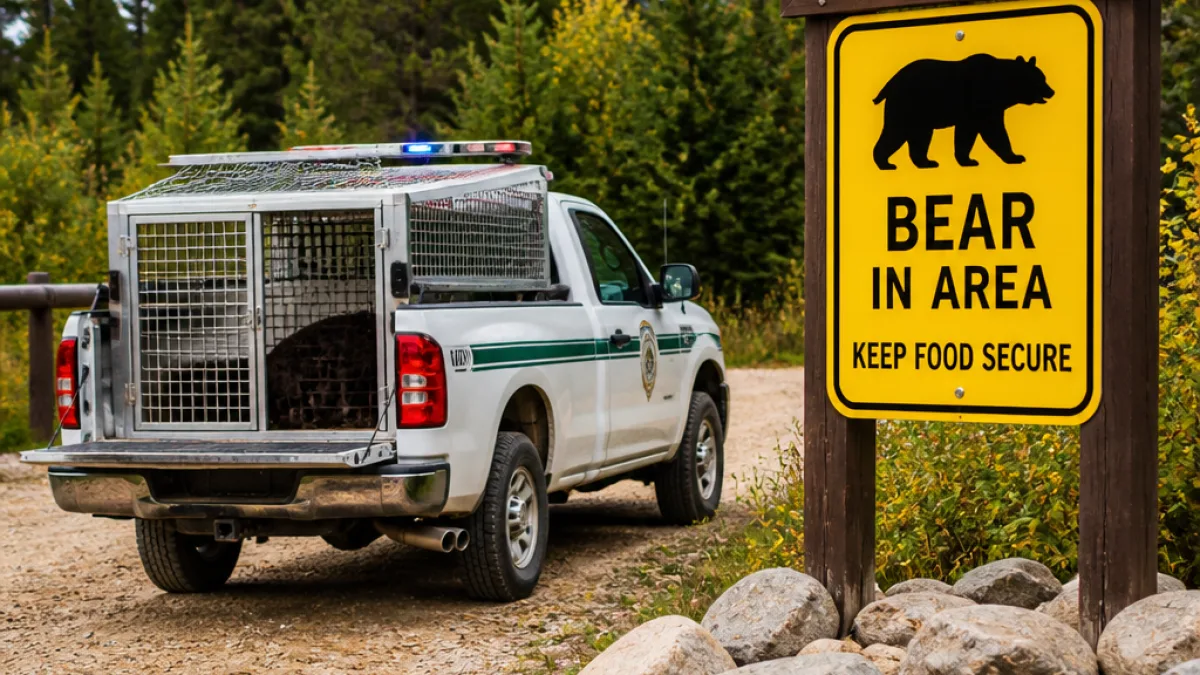
Encounters trending lower amid heightened concern
Officials in northern Saskatchewan say reports of bear encounters are down this season in Prince Albert National Park (PANP) and around La Ronge, even as two recent fatalities have sharpened public concern and prompted renewed attention to wildlife safety in parks, communities and remote work sites.
Tom Perry, acting resource conservation manager at PANP, said the park has responded to 29 bear-related interactions so far this year. At the same point last year, staff had dealt with roughly 44. He described this year’s activity as consistent with longer-term patterns.
“Bear interactions are actually down from last year and more in line with long-term norms,”
Perry spoke before this week’s incident near McTavish Lake — later confirmed by the province to have involved a bear — that left two people dead. The area is about 90 kilometres north of La Ronge. Authorities said a suspect bear was located and euthanized, with remains sent to the Western College of Veterinary Medicine for a necropsy.
Calls for service fall in La Ronge area
The Ministry of Community Safety reported that, as of July 9, conservation officers in the La Ronge area had responded to 82 bear-related calls for service, down from 133 at a similar point last year. Those calls led to a range of interventions, including traps and relocations, though some bears were destroyed when they posed ongoing risks.
- Traps deployed: 32
- Bears trapped: 11
- Bears relocated: 8
- Bears euthanized: 9
The ministry said bears that become habituated to people or human food can continue to threaten public safety and may be unsuitable for relocation.
Context: rare fatalities, steady vigilance
Fatal bear attacks remain rare in Saskatchewan, but the two deaths this week near McTavish Lake follow another fatal incident roughly two months ago, when a 27-year-old contractor was killed by a black bear at a remote work site northeast of Points North Landing. Together, the events have amplified questions about safety in northern communities and high-use recreational areas, even as overall reports remain within expected ranges.
Officials stressed that lower encounter figures do not eliminate risk. Seasonal food availability, natural bear movements and human activity patterns can all shift conditions quickly. The data so far suggest a return to typical levels in PANP and a notable decline around La Ronge compared with last year’s early season.
What the numbers show
| Area | Measure | 2024 (to date) | 2023 (same period) |
|---|---|---|---|
| Prince Albert National Park | Bear interactions | 29 | About 44 |
| La Ronge area | Calls for service by conservation officers | 82 (as of July 9) | 133 (by June 10 last year) |
Note: Time frames reflect the reporting dates provided by officials and may not be directly comparable.
Practical safety reminders
While the ministry and park staff emphasize that current bear activity is not unusually high, they also underscore the importance of reducing attractants and knowing how to respond if a bear is encountered. Residents, campers and backcountry users can help by:
- Securing food, garbage and pet feed to prevent bears from associating people with easy meals.
- Storing attractants in vehicles or bear-proof containers and keeping campsites clean.
- Travelling in groups where possible and making noise to avoid surprising wildlife.
- Carrying bear deterrents such as bear spray and knowing how to use them.
- Reporting problem wildlife to local conservation officers promptly.
Officials reiterated that each intervention — relocation, hazing, or euthanasia — is determined by the bear’s behaviour and its level of habituation to human food and spaces. The goal is to lower risks to people while managing wildlife with minimal harm whenever possible.
As investigations continue into the McTavish Lake incident, authorities say the broader picture remains one of caution, not alarm: encounters are trending downward from last year’s pace, but the potential for conflict persists wherever bears and people cross paths.