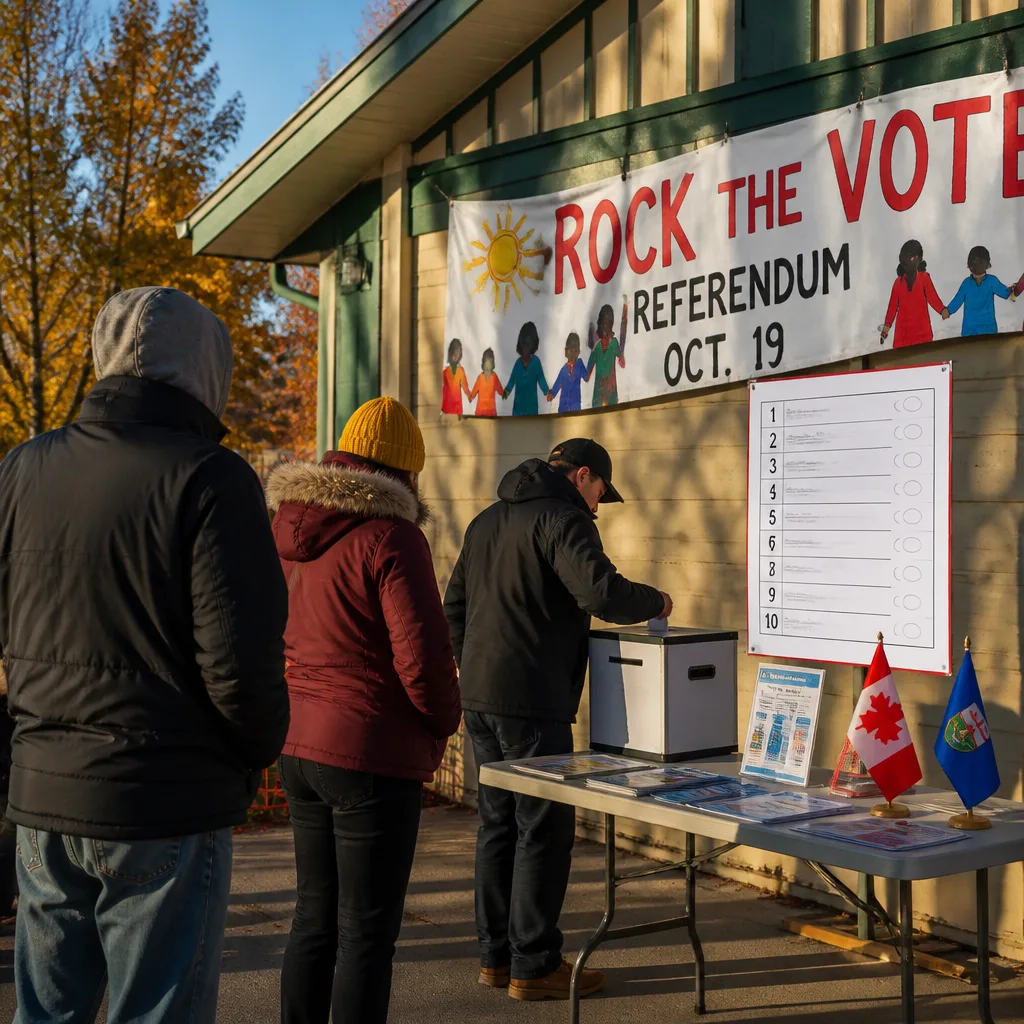
First Nations leaders in northern Alberta are preparing a renewed voter‑mobilization drive to confront the province’s separatist push, signalling wider stakes for Canadian unity as Albertans head to the polls this fall.
Grand Chief Trevor Mercredi of Treaty 8 First Nations in Alberta said communities plan to revive the 2015 “Rock the Vote” effort that spurred unprecedented participation by on‑reserve voters in a federal election. The initiative comes ahead of an Oct. 19 referendum that will present 10 ballot questions, including whether Alberta should remain within Canada or begin the legal steps toward a second binding vote on leaving the country.
“The Indigenous Rock the Vote was very successful,” Mercredi said. “We have to get our people out to vote and we have to campaign.”
The 2015 campaign’s origins trace to Tania Cameron of the Niisaachewan Anishinaabe Nation in Treaty 3, northwestern Ontario, who organized it from home without funding, sponsors or party ties. That effort produced the highest on‑reserve share of ballots cast in a federal contest since Elections Canada began reporting First Nations turnout in 2004. Alberta leaders now want to adapt those tactics for a provincial referendum with direct implications for the province’s place in the federation.
Mercredi said the immediate barrier is not enthusiasm but access. Many on‑reserve residents lack a formal civic address or commonly accepted identification, such as a driver’s licence, which complicates eligibility checks on voting day. As he put it:
“That’s the biggest problem right now, is making sure our people have the proper documents to move forward.”
Ballot stakes and logistical hurdles
The referendum’s unity‑related question places Indigenous participation in the foreground. First Nations leaders have repeatedly emphasized that any decision affecting the province’s constitutional relationship with Canada also touches Indigenous communities, who are organizing to be heard when voters render their verdict on the suite of questions this October.
Organizers say the playbook from 2015 can be tailored to provincial rules: information blitzes on required ID, rides to polling places, and coordinated get‑out‑the‑vote operations in the final stretch. Those measures proved decisive in lifting turnout a decade ago, and backers argue they can again reduce procedural pinch points that often depress participation on reserves.
- Mobilization model: A reprise of the grassroots, non‑partisan 2015 drive that boosted on‑reserve turnout to a modern high.
- Core obstacle: Gaps in civic addresses and government‑issued ID for on‑reserve electors.
- Referendum scope: Ten questions, including one tied to Alberta’s status within Canada.
Key dates and elements
| Item | Detail |
|---|---|
| Referendum date | Oct. 19 |
| Number of questions | 10 |
| Unity question | Remain a province of Canada or commence legal process for a second binding secession vote |
The renewed campaign underscores a practical dimension that often determines who can participate: documentation. Advocates are focusing on helping residents compile acceptable identification and address verification well before ballots are cast. In the past, insufficient paperwork has translated into eligible voters being turned away or discouraged by uncertainty at the polls.
Leaders behind the push stress its non‑partisan character. While the political repercussions of the referendum would extend beyond Alberta, the mobilization itself is framed as a civic exercise to ensure First Nations voices are counted on questions with sweeping constitutional resonance. With less than a season to go, attention has shifted from debating the ballot wording to solving the mechanics of participation—how to get people registered, informed and ready to vote.
For Indigenous communities, organizers say, the path to influence begins with turnout. Their calculation is straightforward: if administrative barriers are lowered and information gaps closed, the electorate will more closely reflect the communities affected by the referendum’s outcome.