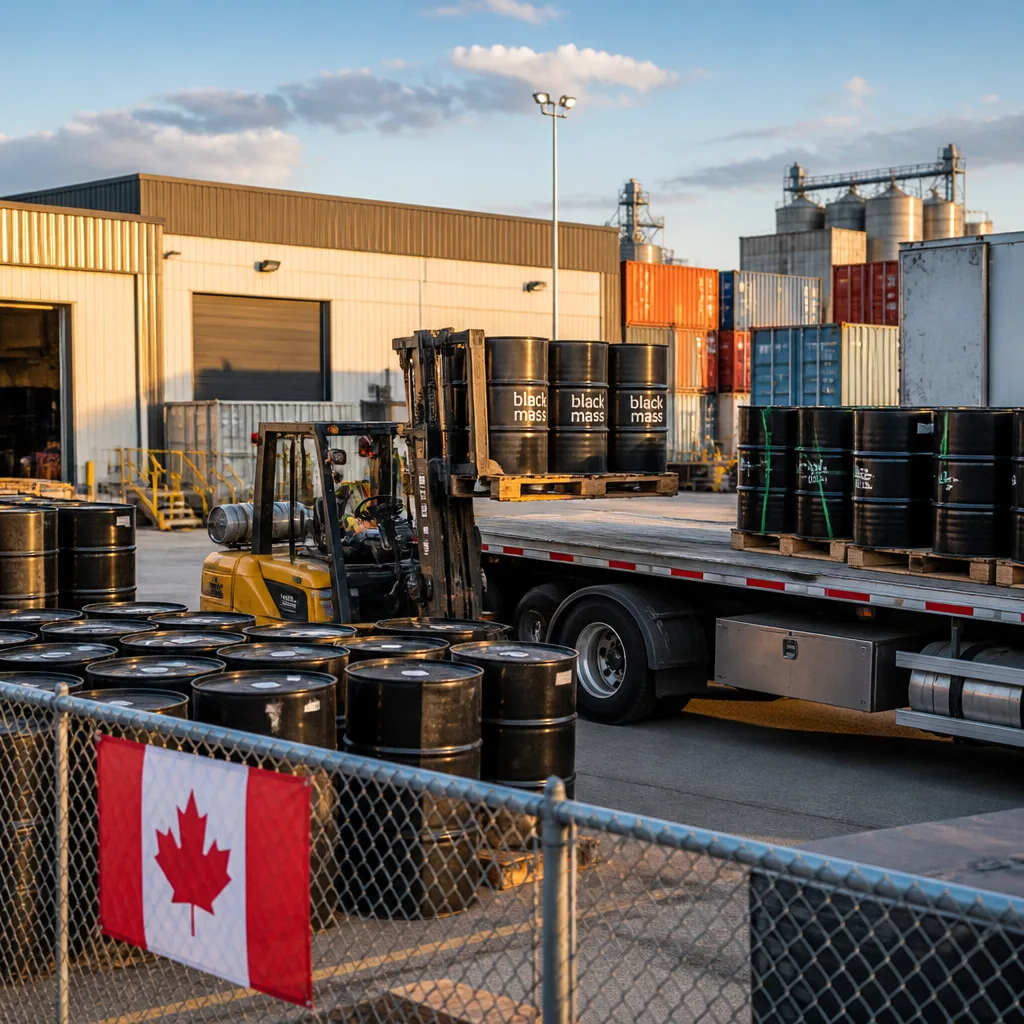
The U.S. Department of Commerce has granted a licence allowing American Battery Technology Company to export up to US$100 million of recycled battery material known as black mass, the company disclosed in a securities filing on Oct. 1.
What the licence enables
The permit covers exports of processed battery waste — material recovered from spent lithium-ion batteries that contains valuable metals such as lithium, nickel, cobalt and manganese. The company said the licence, issued under recently updated federal export controls, will help the firm expand international sales tied to its recycling operations.
Commercial scale-up and production
American Battery Technology Company began operating its first commercial-scale recycling plant near Reno in 2023. That facility produces lithium-rich intermediates and other recovered materials used to feed battery supply chains. The company is now scaling a second recycling facility, supported by US$150 million in grants from the U.S. Department of Energy.
- Export licence value: US$100 million
- Reported growth: more than 400% year-over-year revenue increase
- DOE support for expansion: US$150 million in grants
- Commercial recycling operations: first facility began in 2023 near Reno
Why it matters
Recycled black mass is a concentrated source of critical battery metals. Permitting its export under federal controls signals that regulators see processed secondary materials as legitimate trade goods within the global supply chain for electric-vehicle batteries and other lithium-ion applications. For a company that reported more than 400 per cent year-over-year revenue growth, the licence can help monetise recovered materials beyond the domestic market while the firm scales up capacity.
| Metric | Value |
|---|---|
| Export licence | US$100 million |
| Year-over-year revenue growth | Over 400% |
| DOE grants for second facility | US$150 million |
| First commercial facility operational | 2023 (near Reno) |
The licence was disclosed in an 8-K filing with the U.S. Securities and Exchange Commission. The company characterised the authorisation as supportive of its commercial recycling operations and as strengthening its position in critical mineral supply chains.
Context and constraints
Federal export controls governing battery materials have tightened in recent years as governments seek to secure critical mineral flows and balance national-security and trade objectives. This licence shows how processed secondary materials can fit into that regulatory framework, but it does not remove other trade, transport or contractual hurdles the company may face when selling internationally.
Investors and industry observers will be watching whether additional facilities come online on schedule and how export volumes and international demand for recycled intermediates evolve. For jurisdictions looking to develop domestic recycling capacity or to reduce reliance on mined supplies, the commercial scaling of firms such as American Battery Technology Company offers a practical example of turning battery waste into feedstock for battery manufacturing.
Reporting is based on the company’s SEC filing and the summary provided in the company’s public disclosure.