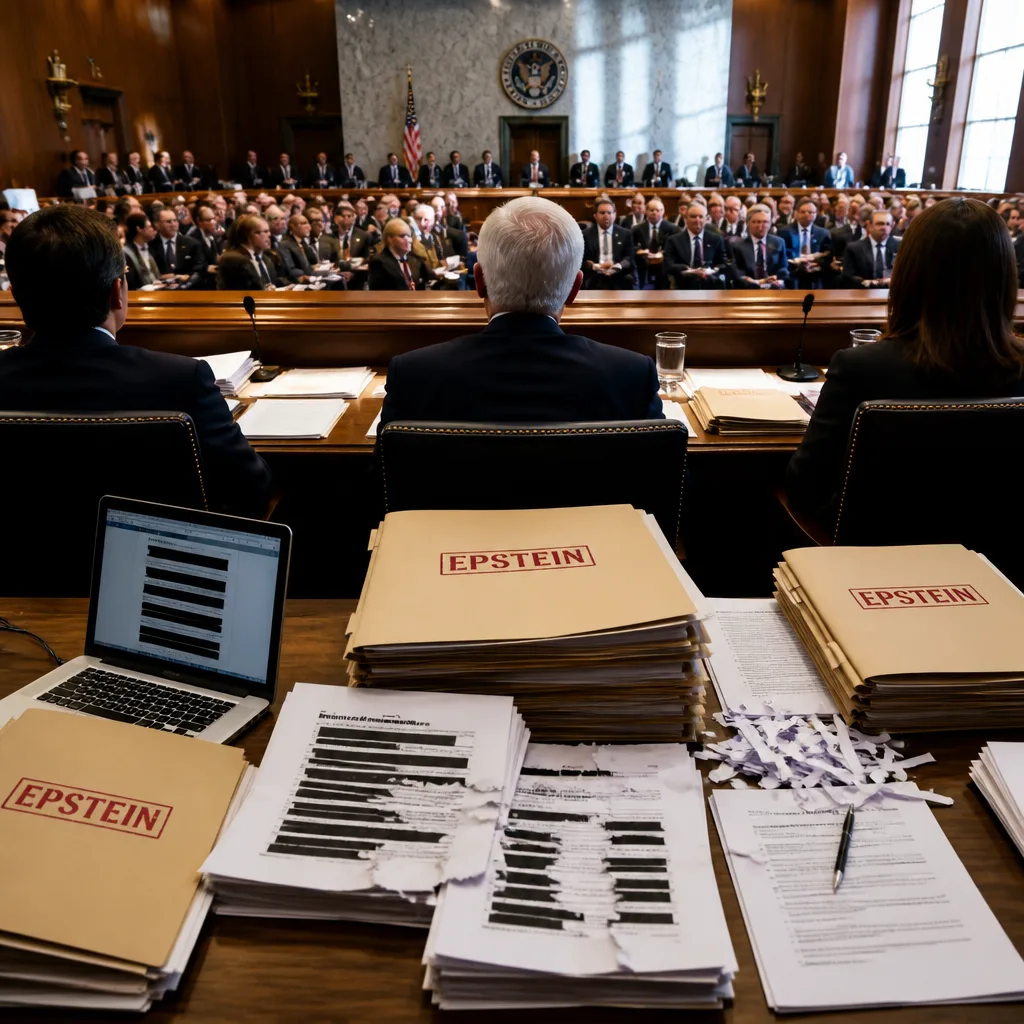
Acting U.S. Attorney General Todd Blanche told the Senate Judiciary Committee on Wednesday that the Justice Department carried out a vast review of records connected to convicted sex offender Jeffrey Epstein and accepted responsibility for redaction errors that revealed survivors’ personal details and images.
Scope of the review and mistakes acknowledged
Blanche said the department had "undertaken a Herculean task to review millions and millions of potentially responsive files" after Congress enacted the Epstein Transparency Act and President Donald Trump signed it into law. He conceded that some documents were released with insufficient redactions and that his team worked rapidly to correct those errors.
"That doesn't excuse the mistakes, of which I take responsibility," Blanche said. "But it does mean that we tried to fix them."
He told senators that the department had dozens of lawyers on call to address the problems and that the Justice Department had been in touch with survivors’ representatives.
Engagement with survivors and investigatory posture
Responding to criticism that he has not personally met with Epstein survivors, Blanche said the department and the FBI have been asked to meet with survivors and their counsel. He added that the department has spoken with more than 30 representatives of dozens of victims.
Blanche also told the committee the Justice Department will pursue indictments if new information justifies criminal charges — a position he framed as a current prosecutorial standard. That stance represents a shift from an unsigned July 2025 memo issued by the FBI and Justice Department while Blanche was deputy attorney general, which had stated investigators had not found evidence meriting probes of uncharged individuals.
Context: Blanche’s role and the larger inquiry
Blanche, who previously served as President Trump’s defence lawyer, became acting attorney general after Pam Bondi was dismissed in early April. His testimony comes amid ongoing congressional scrutiny of the Epstein records release and questions about how the Justice Department balances transparency with the privacy and safety of survivors.
- Key figures: "millions and millions" of files reviewed; "dozens" of lawyers mobilized; contact with "more than 30 representatives".
- Policy shift: Blanche signalled willingness to indict if new evidence emerges, differing from the July 2025 unsigned memo.
- Accountability: Blanche accepted responsibility for redaction failures and described corrective steps.
| Item | Detail |
|---|---|
| Legislation prompting review | Epstein Transparency Act (signed by President Trump) |
| Department action | Large-scale review; redaction corrections; outreach to survivors’ representatives |
| Notable prior document | Unsigned FBI/DOJ memo (July 2025) cited as saying no evidence merited new investigations |
The hearing highlights tensions between open government and victim privacy, and places Blanche at the centre of decisions about how the Justice Department implements transparency mandates while protecting survivors. Senators pressed him on both the technical failures that produced harmful disclosures and on whether the department’s prosecutorial posture would change as new information becomes available.
Blanche defended the department’s overall transparency record under the current administration, asserting it had been more open on this matter than predecessors, while acknowledging the real harm caused by the redaction errors and promising corrective measures.