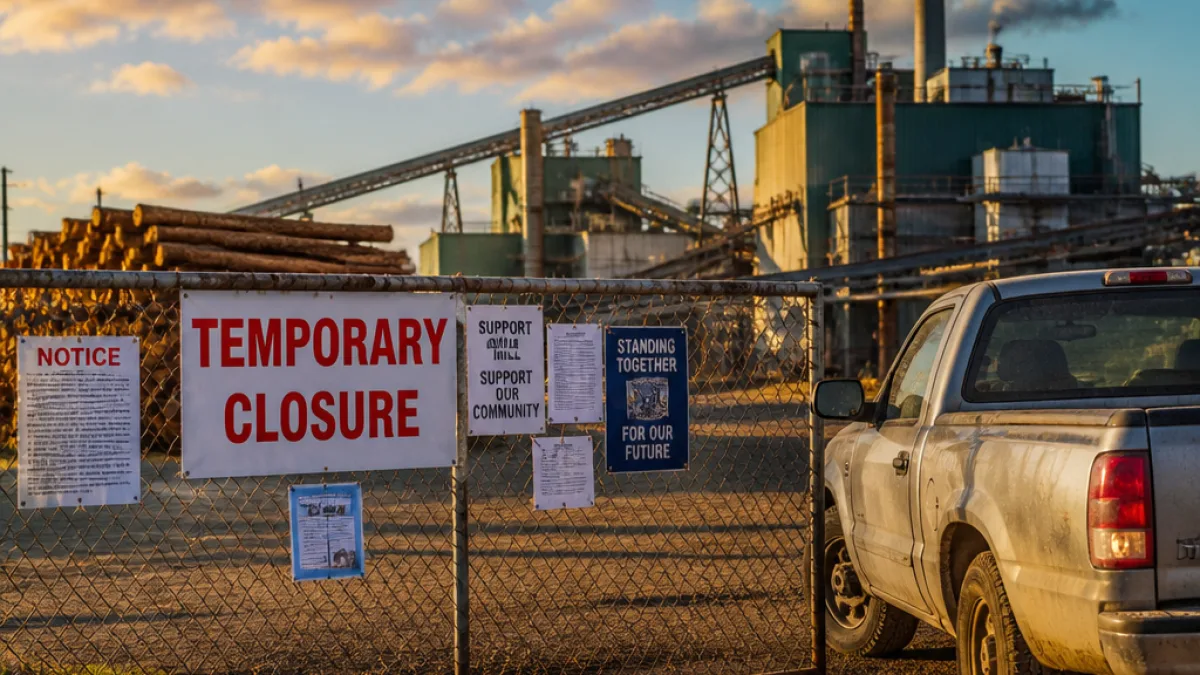
The recent closure of a Canfor pulp mill has intensified scrutiny of British Columbia's struggling forestry sector, with union leaders and local officials warning of cascading job losses and the forests minister signalling imminent changes to permit rules.
Immediate fallout for workers and communities
Unions say the Canfor shutdown reverberates beyond the mill floor in Prince George, a city of roughly 67,000, threatening sawmill work, contractor livelihoods and local businesses that depend on forestry payrolls.
- Unifor western regional director Gavin McGarrigle cautioned that pulp-mill closures can trigger additional job losses in sawmills and among contractors.
- Industry groups point to global oversupply of pulp and sustained low prices as key economic pressures.
- Provincial officials say permitting delays and competition from low-cost jurisdictions are complicating recovery.
Permitting reform promised
Forests Minister Ravi Parmar told reporters he expects to unveil changes to the province's permitting system "imminently." He said his goal is to move away from a project-by-project approach towards longer-term planning that would allow companies and First Nations to map out ten- or 20-year operational plans before seeking approval.
"My vision for forestry, and what I am going to be delivering on in the weeks ahead, is a vision where I don’t believe we need cutting-permit-by-cutting-permit forestry."
Industry representatives have long argued that it can take years to secure the cutting permits sawmills rely on, creating uncertainty that discourages investment and inhibits responsiveness to market changes.
Broader industry pressures
Canfor cited a global increase in pulp production capacity and falling prices as factors behind the shutdown, and the minister noted the challenge of competing with producers in jurisdictions he described as having "very little to no labour standards, zero environmental standards." He suggested the sector should shift toward higher-value wood products rather than competing on commodity prices.
| Recent notable closures | Location |
|---|---|
| Crofton pulp mill | Crofton |
| West Fraser sawmill | 100 Mile House |
| Drax pellet mill | Williams Lake |
The BC Council of Forest Industries reports that 21 lumber mills have closed permanently or indefinitely in the province since 2023, underscoring the scale of the contraction.
What’s next for workers and policy
Union officials have pressed the province for immediate supports for affected workers and communities while urging a broader strategy to stabilise the sector. The provincial plan that Parmar describes aims to reduce permitting delays and encourage collaborative, long-range tenure planning with First Nations and industry partners. Any meaningful shift will require detailed timelines and measurable commitments to reassure communities facing lost employment.
For Prince George and similar Interior communities, the key questions are how quickly new policy measures can be implemented, what direct supports will be available to displaced workers, and whether industry transformation toward higher-value products can proceed fast enough to offset continued global commodity pressure.
As the province prepares to outline changes, local leaders, unions and companies will be watching for concrete steps to stabilise supply access, speed approvals and protect jobs.