Premier’s visit underscores escalating fire season
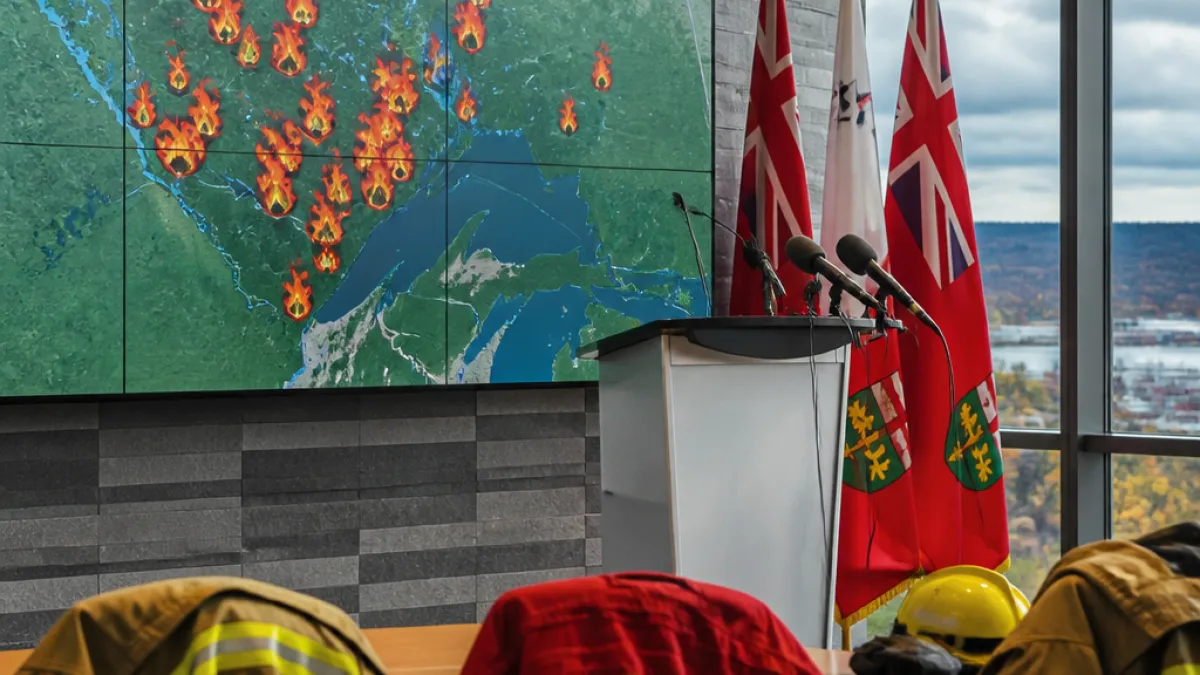
Ontario is tracking 191 active wildfires across the province, with seven new starts reported today, as the government flags an extremely volatile situation in the northwest. Premier Doug Ford travelled to Thunder Bay on Saturday to receive briefings and deliver remarks alongside provincial officials on the evolving effort to contain fires and protect communities.
The Ministry of Natural Resources and Forestry (MNRF) said that while overcast conditions and recent rainfall have helped limit spread in some areas, fuels remain dry enough in large parts of northwestern Ontario to sustain fast-moving fires if winds shift or lightning returns. Crews continue to prioritize protection of people, critical infrastructure and transportation corridors.
Conditions improve in pockets, risk persists in northwest
Saturday’s moderated weather has provided windows for ground crews and aircraft to consolidate containment lines, according to the province. However, officials cautioned that the underlying fire danger remains elevated in the northwest and can rebound quickly as temperatures rise or if new thunderstorms pass through.
Thunder Bay has served as a major coordination point for suppression activity and logistics, with the premier’s visit intended to highlight provincial support for front-line personnel and affected communities. The MNRF said resource allocation continues to adapt daily as new incidents emerge and existing fires change behaviour.
Today’s snapshot
| Indicator | Status |
|---|---|
| Total active wildfires in Ontario | 191 |
| New fires reported today | 7 |
| Weather influence | Overcast skies, recent rain slowing spread in some areas |
| Regional risk | Northwest remains highly volatile |
What residents should know
Authorities urge residents, travellers and outfitting operators across northern Ontario to keep a close eye on official advisories as the situation can change quickly. Air quality and visibility may fluctuate near active fires and along smoke plumes, and access restrictions can be implemented to keep the public and responders safe.
- Monitor provincial wildfire updates and maps from the Ministry of Natural Resources and Forestry.
- Follow directions from municipal officials and emergency management authorities if restrictions or closures are announced.
- Be prepared for travel delays on affected forest roads and remote routes.
During Saturday’s stop in Thunder Bay, the premier acknowledged the strain on first responders, municipal partners and Indigenous communities that are closest to the fire activity. The province says it is maintaining coordination across agencies and adapting to daily operational needs as conditions evolve.
Context for Ontario’s season
Ontario’s wildfire season typically peaks in the summer months, when persistent heat, lightning and dry vegetation combine to elevate risk. While short periods of cloud cover and rain can ease fire behaviour temporarily, forecasters and fire managers generally look for sustained precipitation over broad areas to materially reduce hazard levels. In the absence of that, pockets of high danger can reappear quickly after even brief improvements.
The MNRF’s focus remains on life safety and protection of communities, hydro corridors and other essential assets. Fixed- and rotary-wing aircraft, supported by ground crews and heavy equipment where terrain allows, continue to suppress priority fires and patrol for new starts.
Staying informed
Officials emphasize that timely information is critical as fire lines and weather trends shift. Residents are encouraged to check authoritative channels frequently for updates to advisories, restrictions or safety guidance applicable to their area.