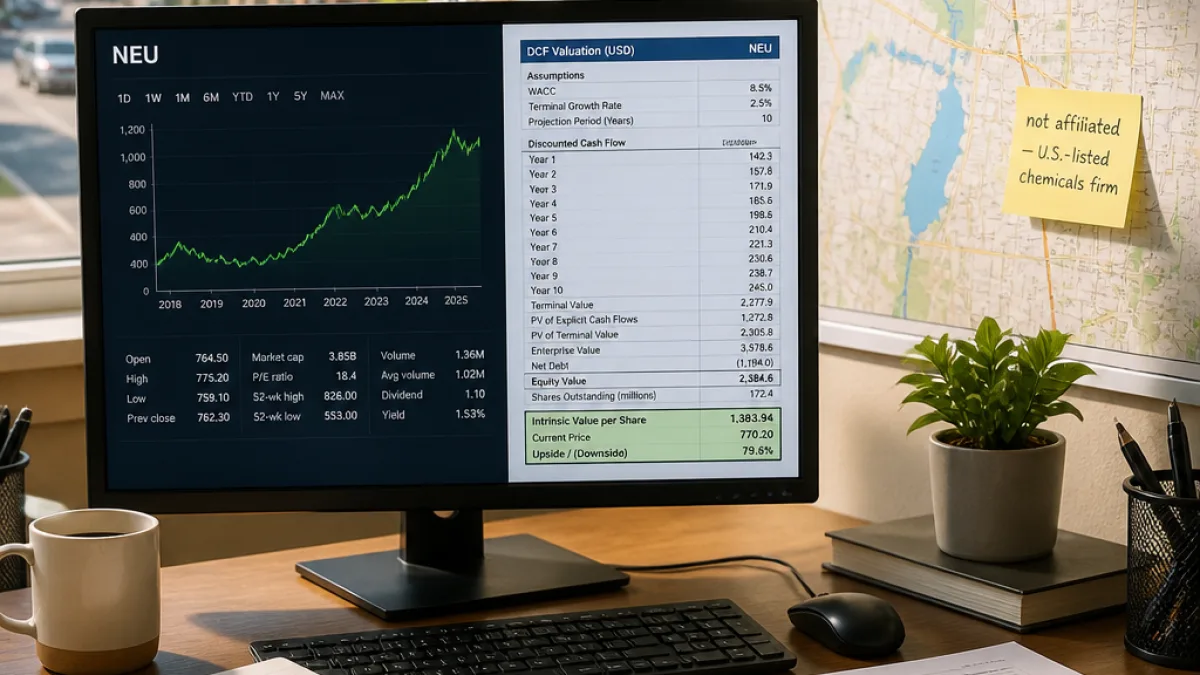
Clarifying the name: this is not the Town of Newmarket
Residents in Newmarket, Ontario may encounter headlines about a company called NewMarket Corporation (NYSE: NEU). Despite the shared name, the firm is a U.S.-listed chemicals business and has no connection to the municipality in York Region. A new third-party analysis indicates the stock could be trading below its estimated cash-flow value, even after a multiyear rise.
What the latest assessment says
According to the report, NewMarket shares recently traded around US$770.23. Using a discounted cash flow (DCF) model built on last-twelve-month free cash flow of roughly US$508.2 million, the analysis estimates an intrinsic value near US$1,384 per share. That gap equates to an indicated discount of about 44.4% on a cash-flow basis. The screening also finds the stock appears undervalued on four of six valuation checks, yielding a mixed but constructive picture rather than a definitive bargain.
| Metric | Figure |
|---|---|
| Recent share price | US$770.23 |
| LTM free cash flow | US$508.2M |
| DCF intrinsic value (est.) | US$1,384 |
| Implied discount (DCF) | ~44.4% |
| 5-year total return | 181.8% |
| 1-year return | 7.2% |
The report underscores that the company’s future ability to convert earnings to reliable free cash flow is central to whether that perceived discount persists. Any setback to profitability or changes in capital allocation could compress the apparent undervaluation.
Performance backdrop and sector context
The stock has already delivered a 181.8% total return over five years, while the most recent 12 months show a more modest 7.2% gain. That history frames the current question: whether additional upside is justified after a strong multi-year run, given the cash-flow model’s output. The analysis situates NewMarket within the chemicals industry, noting the latest returns in relation to sector peers, but it stops short of drawing conclusions about how the valuation compares across the full industry set.
“The stock screens as undervalued in 4 of 6 checks, so the broader assessment is a mixed picture rather than a clear bargain or clear overvaluation.”
Within that framing, the DCF approach is one lens among several. While cash-flow valuation methods can be informative for mature, steady cash generators, the outcome depends on assumptions for growth, margins and reinvestment. The cited model uses modest growth estimates consistent with a company in a stable phase rather than rapid expansion.
Why this matters to Newmarket residents
Local investors sometimes track companies that share the city’s name, which can cause confusion. In this case, NewMarket Corporation is a separate, U.S.-listed entity. The report’s figures may interest residents who follow cross-border equities from York Region, but they do not reflect any change in local public services, employment in Newmarket, or municipal finances.
- The name overlap does not indicate a connection to the Town of Newmarket or its operations.
- The valuation case relies heavily on continued free cash flow generation and disciplined capital allocation.
- Recent returns suggest strong long-term performance with more moderate gains over the past year.
Key takeaway
The latest third-party assessment suggests NEU shares could be trading below an intrinsic value estimate informed by free cash flow, even after years of appreciation. For readers in Newmarket who monitor U.S. markets, the numbers present a cautious value thesis: supportive in several checks, yet dependent on steady cash conversion and execution. As always, the figures pertain to a U.S. company and should not be confused with developments in Newmarket, Ontario.