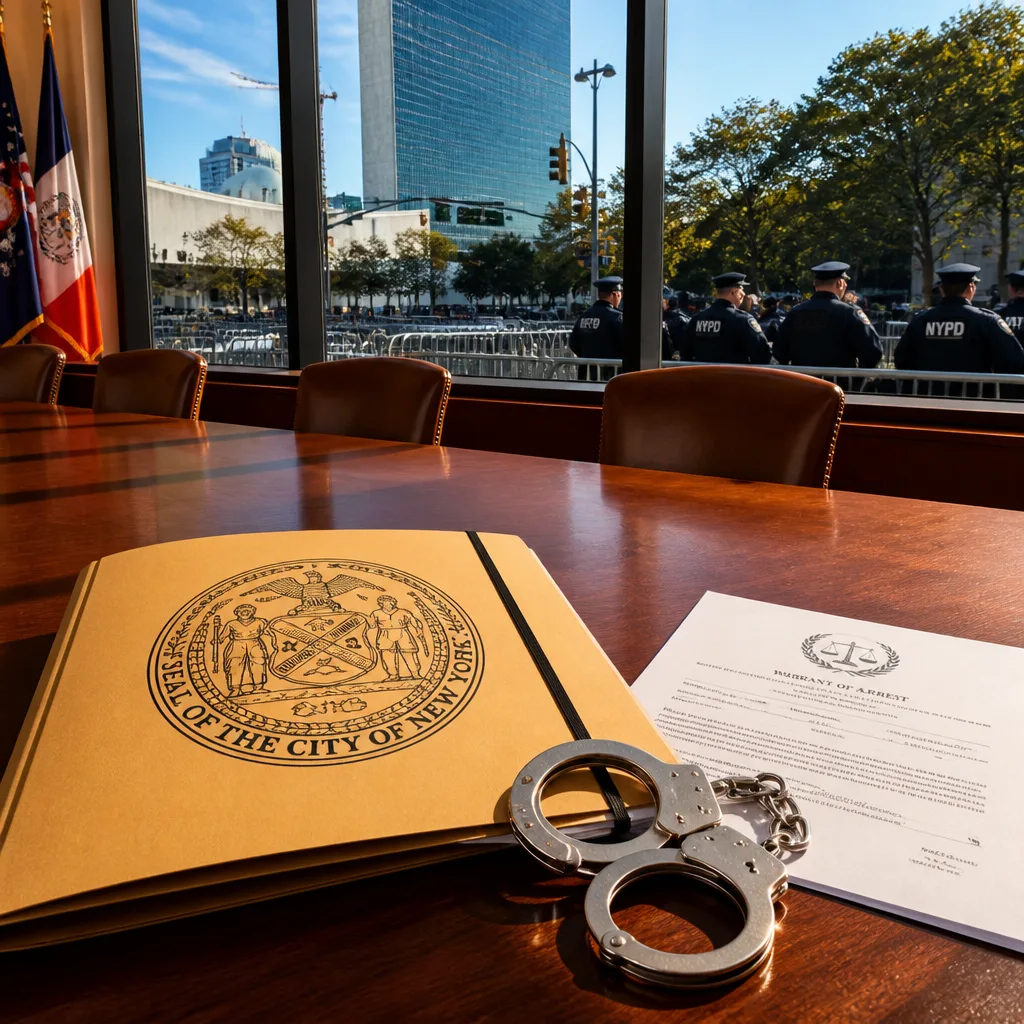
New York City’s mayor, Zohran Mamdani, says his administration is examining whether the city could arrest Benjamin Netanyahu if the Israeli prime minister arrives for the United Nations General Assembly in September, placing municipal authority and international law on a collision course ahead of one of diplomacy’s marquee annual gatherings.
In an interview on The New York Times’ podcast, the mayor said his office’s legal team is actively assessing the scope of its powers after he pledged during his campaign to pursue Netanyahu’s detention. He tied that stance to the International Criminal Court’s 2024 warrant targeting Netanyahu and other Israeli officials in connection with alleged war crimes following the October 7, 2023, Hamas attacks and the subsequent conflict in Gaza.
“I believe that Prime Minister Netanyahu belongs in The Hague,” he said, calling the Israeli leader “a war criminal who has been charged by the International Criminal Court.”
Pressed on the legal basis for any such move, the mayor said the parameters are under review. He acknowledged limits on municipal action, contrasting his approach with what he described as instances of national leaders straying beyond legal boundaries. Israel has rejected allegations tied to the Gaza war, and Netanyahu has publicly brushed off the arrest talk in U.S. media appearances this week.
Clashing views on the ICC and U.S. authority
The United States is not a party to the Rome Statute, which underpins the ICC and obliges member states to execute warrants. Both President Donald Trump and former president Joe Biden have denounced the court’s pursuit of Israeli officials. The current administration in Washington has maintained opposition, while the Trump administration intensified a longstanding confrontation with the tribunal.
U.S. officials continue to debate the ICC’s place in international order. Secretary of State Marco Rubio recently vowed to “dismantle” the court, describing it as waging a campaign against the United States through international law rather than force. The White House’s broader posture has fed criticism and support in equal measure, reflecting deep divisions over the court’s legitimacy and jurisdiction.
Political theatre or legal threshold?
The mayor’s comments drew swift pushback. U.S. Ambassador to the United Nations Mike Waltz dismissed the remarks as “pure political theater,” emphasizing that Washington is not an ICC member. Israeli officials have also moved to downplay the idea of an arrest on U.S. soil. Israel’s ambassador to the UN, Danny Danon, was cited in coverage of the widening dispute this week.
Even as the legal review proceeds at city hall, the practical barriers are considerable. Any attempt to detain a visiting head of government during UNGA would engage layers of U.S. federal authority, long-standing protections tied to diplomatic travel, and coordination with law enforcement bodies beyond municipal control. The city’s exploration underscores the friction between international criminal accountability mechanisms and the domestic legal architecture in a country that rejects the ICC’s jurisdiction.
What’s at stake ahead of September
The intersection of municipal governance and international criminal law raises procedural questions likely to echo beyond New York:
- How U.S. federal, state and municipal jurisdictions interact when ICC warrants touch down on American soil.
- Whether diplomatic engagements at the United Nations can proceed unimpeded amid threats of legal action.
- How public officials calibrate rhetoric and authority when global legal institutions collide with domestic constraints.
As the UN General Assembly approaches, the mayor’s stance signals a sharpened debate over accountability for wartime conduct, even in jurisdictions where the ICC’s writ does not run. Whether the city can translate that posture into any concrete step remains uncertain, but the discussion itself has already widened the aperture on how international justice claims reverberate through U.S. politics and diplomatic protocol.
| Actor | Stated position |
|---|---|
| NYC Mayor Zohran Mamdani | Legal team reviewing prospect of arrest tied to ICC warrant |
| Benjamin Netanyahu | Dismissed concerns in U.S. media this week |
| U.S. administration (current and former) | Both Trump and Biden criticized the ICC warrants |
| Secretary of State Marco Rubio | Pledged to “dismantle” the ICC |
| Ambassador Mike Waltz | Called the mayor’s remarks “pure political theater” |
The legal analysis inside city hall may not yield a decisive outcome before world leaders arrive. But the declaration itself has ensured that questions about the reach of the ICC—and the limits of U.S. cooperation—will shadow this year’s high-level diplomatic week in New York.