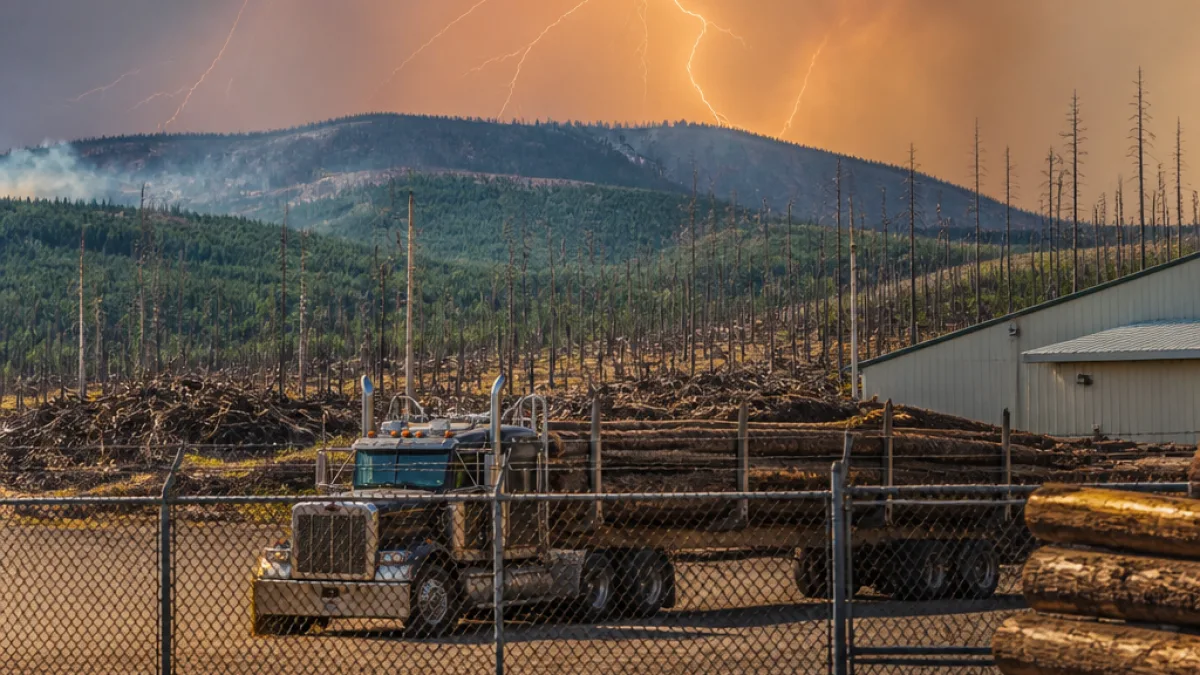
WINNIPEG — Manitoba’s logging sector is bracing for tighter wood supply as another intense wildfire season burns across Canada, fuelling concerns about lost harvest areas, mill slowdowns and ripple effects in rural and northern communities.
Veteran logger Arnold Reimer, who has worked the bush since his teens and later founded Spruce Wood Loggers north of Arborg in 1981, says the balance on the landscape is shifting. Walking through stands he once cut and replanted, he now finds a growing proportion of trees that are either dead or past their prime.
“As long as we have that type of timber [dead and overmature] surround the younger stuff, the younger stuff is in jeopardy,”
Reimer said, pointing to how tall, dry stems can act as ladders for fire if lightning strikes. According to the province’s forestry status report covering 2016 to 2020, 58% of wildfires in Manitoba are sparked by lightning. He estimates roughly a third of what he’s seeing on the ground is no longer healthy, adding that older, drier trees are more likely to carry flames and threaten nearby communities.
Recent fire seasons redraw the map
Last year’s national wildfire season scorched about 8.9 million hectares across Canada. Manitoba’s share was severe: provincial reporting for the 2025 wildfire year shows 445 wildfires and roughly 2.38 million hectares burned. Those losses can remove harvestable areas for years, complicate reforestation schedules and constrain feedstock for sawmills, pellet plants and chip operations that depend on predictable volumes.
The stakes extend far beyond individual operators. The federal government estimates Canada’s forest sector supports nearly 200,000 workers and contributes more than $20 billion to GDP. In Manitoba, sector representatives warn that reduced timber availability can translate into fewer shifts, curtailed investments and reduced purchasing in nearby towns. John Morris, executive director of the Forestry Industry Association of Manitoba, said dwindling timber means job losses and diminished opportunities, with disproportionate impacts in rural and northern areas where mills and logging crews are major employers.
Why older stands raise risk
Reimer’s concern centres on stand condition. Overmature trees still have value for specific products, but they carry lower moisture and are more receptive to embers and surface fire. Dead stems can behave like tinder, especially in wind. When those trees encircle younger growth, the next generation of forest — and its future harvest — becomes vulnerable to a single ignition.
- Dead and overmature trees dry quickly, heightening the chance of ignition.
- Lightning is a leading ignition source in Manitoba, responsible for most wildfires in recent years.
- Loss of recoverable timber disrupts supply chains for mills, contractors and transport firms.
By the numbers
| Indicator | Figure | Source/Context |
|---|---|---|
| National area burned (2025 season) | ~8.9 million ha | Government of Canada |
| Manitoba wildfires (2025) | 445 | Government of Manitoba |
| Manitoba area burned (2025) | ~2.38 million ha | Government of Manitoba |
| Lightning-caused fires (MB, 2016–2020) | 58% | Provincial forestry status report |
| Canadian forest sector GDP | $20B+ | Government of Canada |
| Canadian forest sector jobs | ~200,000 | Government of Canada |
Ground truth from a family operation
Reimer, now 68, grew up in a family of 11 where logging supplemented farm income. The business he founded supplies rough lumber, wood pellets, mulch, chips and firewood. His sons, Charles and Scott, have since taken over. He worries the enterprise could become harder to pass down if wood flows keep shrinking or become erratic. For firms like theirs, access to healthy stands is the difference between steady payrolls and unplanned downtime.
On the land base he knows, he says a greater share of the canopy appears past its peak. While older fibre can be used for certain products, rising fire danger around those stands raises the odds of large-scale losses that wipe out both mature and juvenile trees. That threatens the continuity of supply for mills and secondary manufacturers that depend on uniform volumes to plan purchases and production.
Community and economic implications
Lower timber availability ripples outward. Contractors scale back, equipment sits idle longer, and transport companies book fewer loads. Local spending on fuel, parts and groceries declines. In many small Manitoba towns, logging and milling are among the few year-round employers; any interruption can be felt quickly at the arena, the post office and the gas bar.
Reimer’s assessment from the bush is not a long-term forecast, but a present-tense snapshot: more dead and overmature trees on the edges of younger stands, and wildfire seasons that remove large areas from the harvest plan. With lightning behind a majority of provincial ignitions in recent years, the risk can spike on any given hot, dry afternoon. For his family’s company and others like it, the path forward hinges on how much healthy fibre remains reachable — and how much of it can be kept out of the fire’s way.