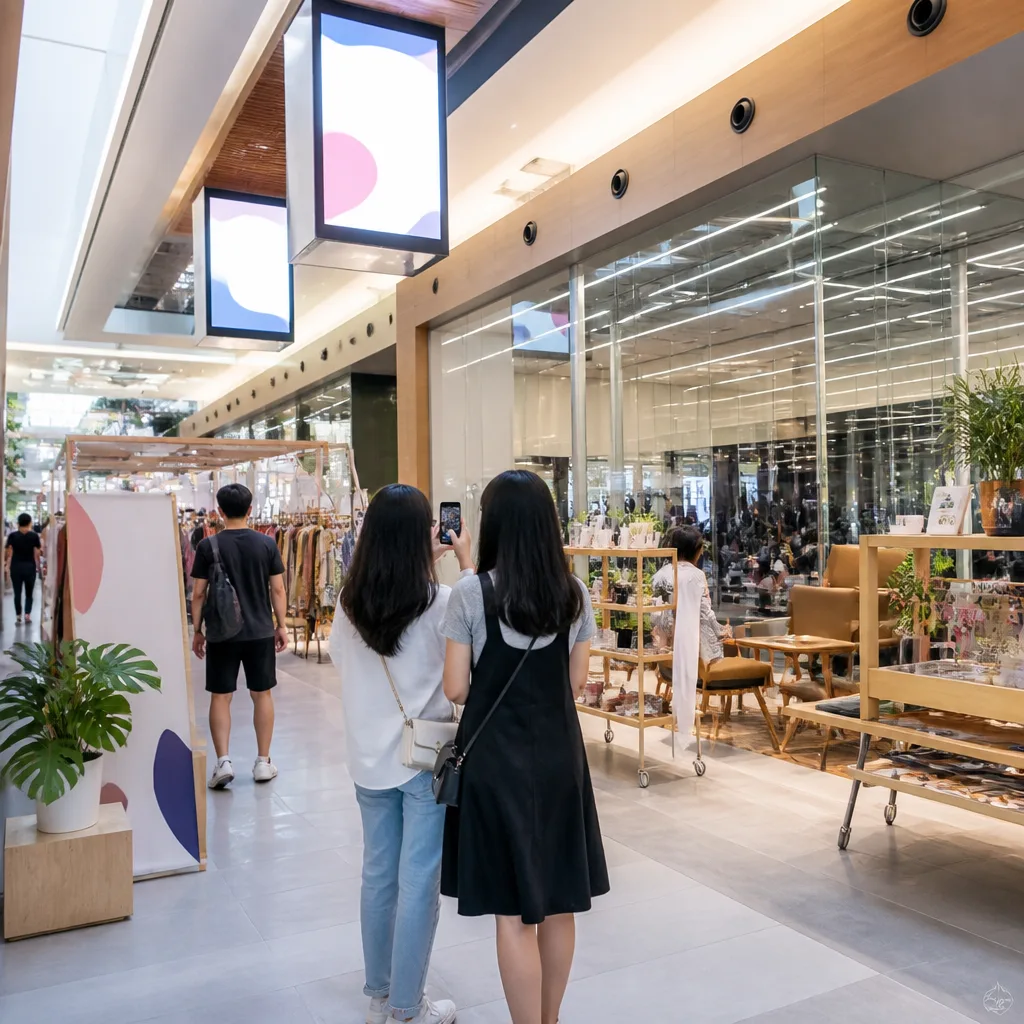
Shopping centres across the Asia-Pacific are leaning hard into pop-up retail, flexible layouts and mixed-use experiences as they court younger consumers who are returning to stores with fresh expectations, according to new analysis from Cushman & Wakefield.
Physical retail’s role is shifting
The firm’s latest Retail in the Trust Economy newsletter argues that brick-and-mortar is no longer just about transactions—it’s about delivering on promises that shoppers have already encountered online. As the line between digital discovery and in-person experience blurs, stores are being reimagined as trust-building touchpoints.
“What has changed isn’t the importance of physical retail, but what it’s expected to do,” said Sona Aggarwal, managing director and head of retail sales and strategy for Asia Pacific at Cushman & Wakefield. “Consumers are forming opinions before they enter a store, which means the store has to deliver on a promise that has already been made online.”
The report singles out Gen Z as a key force behind this evolution, noting that 64% of this cohort prefers shopping in physical stores. That appetite is influencing how landlords and retailers design spaces to be more dynamic, more social, and more experiential—often with shorter-term concepts that can pivot quickly.
Pop-ups rise as a permanent strategy
Far from being a novelty, pop-up formats are becoming a core part of leasing strategies across the region. Cushman & Wakefield estimates that Asia-Pacific will account for 32.4% of the global pop-up retail market, generating about $4.8 billion in revenue in 2025. Alongside this growth, modular store designs and flexible leasing are helping brands test ideas, rotate assortments and keep visits feeling fresh.
Increasingly, malls are embedded within mixed-use developments that blend retail with residential, office and leisure components, creating day-to-night neighbourhood hubs built for longer dwell times and repeat visits. That mix is paying off in markets where tourism and local footfall are rebounding.
South Korea as a testbed
South Korea features prominently in the analysis, with retail districts such as Myeongdong and Seongsu highlighted for weaving together shopping, beauty, wellness and cultural programming. Tourism momentum has supported this reset, with the country welcoming a record 18.93 million international visitors in 2025, according to the report.
“What we’re seeing in Korea is a retail ecosystem where multiple consumer needs are being addressed within a single environment,” said Suki Kim, Head of Research for South Korea at Cushman & Wakefield. “The integration of beauty, wellness and cultural retail is changing how space performs, with stores designed to drive engagement and repeat visits rather than just transactions.”
Key figures at a glance
| Metric | Figure | Year/Scope |
|---|---|---|
| Gen Z who prefer physical stores | 64% | Asia-Pacific |
| APAC share of global pop-up market | 32.4% | 2025 (projected) |
| APAC pop-up revenue | $4.8 billion | 2025 (projected) |
| International visitors to South Korea | 18.93 million | 2025 |
What this means for shoppers and brands
For consumers, the takeaway is simple: expect more discovery moments in-store. Rotating pop-ups, curated brand collabs and wellness or cultural tie-ins are becoming part of the weekly mall rhythm, designed to extend visits and encourage return trips. For retailers and landlords, the report underscores the value of agile formats and programming that can shift with tastes—especially if they’re aiming to capture younger demographics who want memorable, social-first spaces.
- Short-term activations and modular layouts keep experiences fresh.
- Mixed-use districts encourage all-day traffic, from morning coffee to evening culture.
- Tourism recovery can amplify footfall in well-positioned retail hubs.
While the findings are centred on Asia-Pacific, the underlying forces—digitally primed shoppers, experience-led design, and the blending of retail with lifestyle—are resonating globally. For anyone mapping a shopping weekend or planning a store concept, the signal is clear: the new mall trip is about more than a purchase. It’s about places that feel alive, evolve often and deliver on the promise you saw online before you ever stepped through the door.