
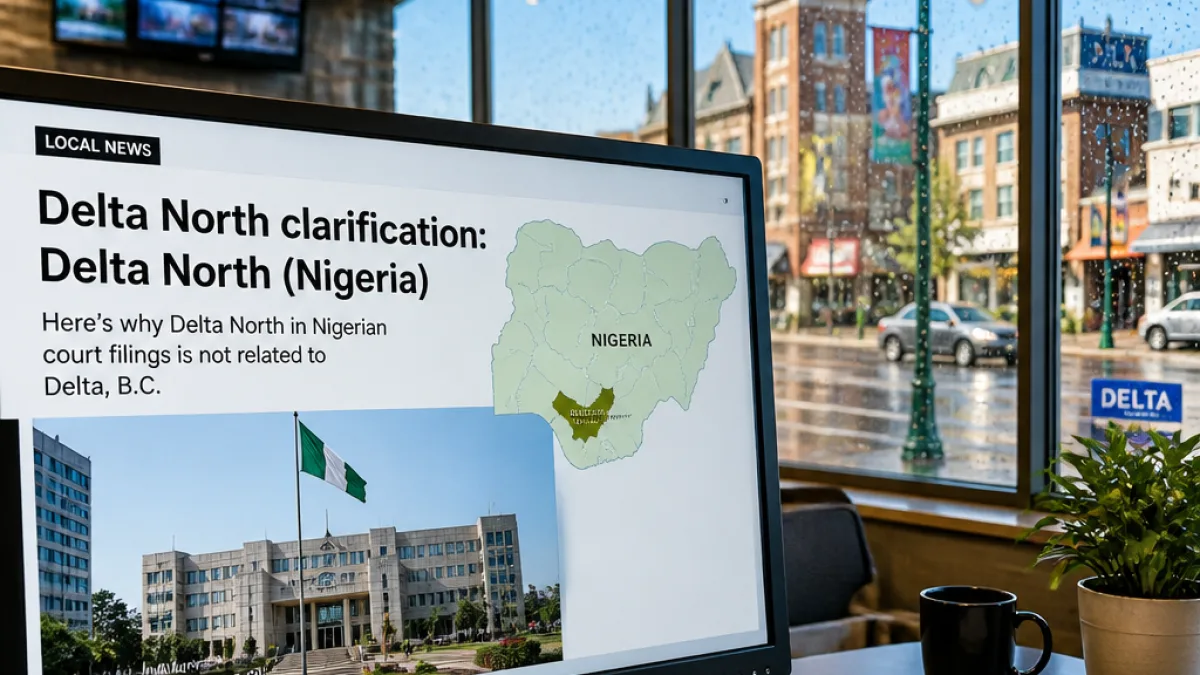
Why this story matters to Delta, B.C.
Residents in Delta may notice headlines referring to a dispute in “Delta North.” This case does not involve British Columbia. It concerns Delta North Senatorial district in Delta State, Nigeria, and was decided by a Federal High Court in Abuja. The matter speaks to how courts there handle internal party disputes ahead of elections and is included here to clarify the distinction for local readers.
Judge strikes out pre-election suit
A Federal High Court in Abuja has struck out a suit brought by Senator Ned Munir Nwoko that sought, among other remedies, to void the emergence of former governor Ifeanyi Okowa as a candidate of the All Progressives Congress (APC) for an upcoming contest in Delta North Senatorial district. The action, identified as FCT/ABJ/CS/1062/2026, named three defendants: the APC, Okowa, and the Independent National Electoral Commission (INEC).
According to the court record, the suit was initiated in the senator’s name through a person described in the originating materials as his lawful attorney, Dr. Mike Nwoko. The defendants, represented in part by counsel including Kehinde Ogunwumiju, SAN for the APC, opposed an attempt to amend the filing so that it would reflect the suit as being personally commenced by the senator rather than through the purported attorney.
Personal right cannot be exercised by an agent, court says
Ruling on the objections, Justice Mohammed Umar determined the case was fundamentally defective and therefore could not be salvaged by amendment. Upon examining the originating summons, the court found the action had indeed been instituted through the purported lawful attorney and thus took on the features of a representative claim at inception.
The court relied on Section 285(14) of the Constitution and Section 88(2) of the Electoral Act 2026, which specify who may bring a pre‑election matter. The judge emphasized that the right to commence such proceedings is a personal statutory right belonging to an aspirant who participated in the relevant party primary. It is not an ordinary civil right that can be assigned, transferred, or exercised through an agent or attorney. As framed, the court concluded, the suit could not proceed.
“The provisions were clear, explicit and unambiguous in vesting the right to institute a pre-election action in an aspirant, who participated in the relevant party primary.”
What the court’s reasoning centred on
- Mode of commencement: The materials showed the suit was filed in the senator’s name through a purported attorney, which the court viewed as representative in character.
- Non-delegable right: The right to bring a pre-election challenge is confined to the aspirant personally, not an agent, under the cited constitutional and statutory provisions.
- Amendment denied: Because the defect went to competence from inception, the court held the case could not be corrected by simply amending the originating processes.
Parties and their roles
| Party | Role in case |
|---|---|
| All Progressives Congress (APC) | Defendant; opposed amendment, represented by counsel including Kehinde Ogunwumiju, SAN |
| Ifeanyi Okowa | Defendant; identified as ex-governor and the candidate whose emergence was challenged |
| Independent National Electoral Commission (INEC) | Defendant in the pre-election matter |
| Senator Ned Munir Nwoko | Claimant; brought the suit via purported attorney, later sought amendment |
Implications explained
While the court’s order arises in Nigerian electoral law, the reasoning is straightforward: where legislation makes a pre-election challenge a right of the aspirant personally, a claim brought through an attorney as a purported representative will not meet the threshold for competence. The judge’s finding meant the proceeding could not continue and could not be repaired by later amendment.
For readers in Delta, B.C., the take-away is context. This ruling pertains to an electoral dispute in another country that happens to use the name “Delta” for one of its states and a senatorial district. The decision clarifies how that jurisdiction treats questions of who is legally entitled to bring internal party challenges ahead of a vote. No part of this case involves the City of Delta or British Columbia’s electoral processes.