
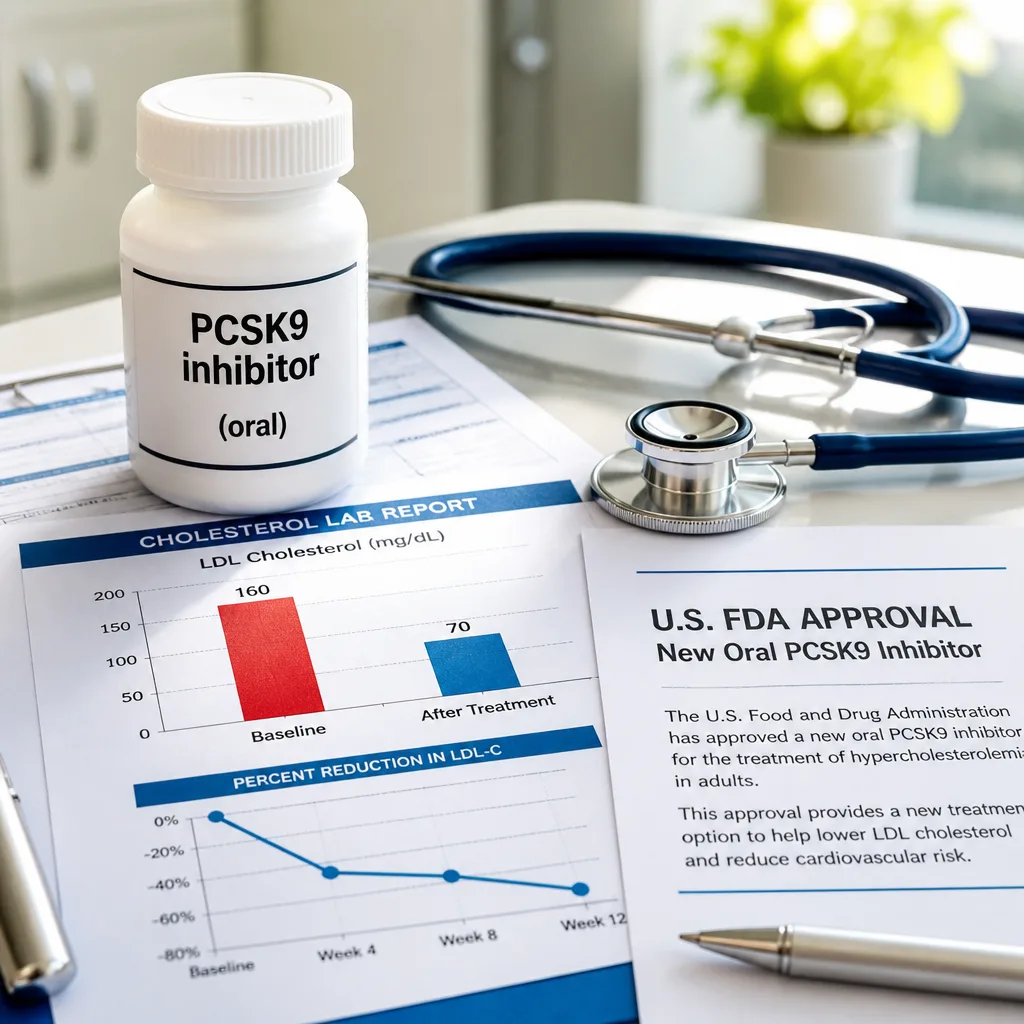
The U.S. Food and Drug Administration has approved Lipfendra (enlicitide), the first once-daily oral PCSK9 inhibitor to lower LDL or “bad” cholesterol in adults. The decision introduces a pill-based option in a treatment space previously dominated by injectable therapies, a development that could reshape how high cholesterol is managed for many people who struggle to reach targets with lifestyle measures and existing medications.
What the FDA approval covers
The FDA authorization allows Lipfendra to be used alongside diet and exercise in adults with high cholesterol, including people with heterozygous familial hypercholesterolaemia (HeFH) — an inherited condition that drives very high LDL from a young age. While options such as statins, ezetimibe and injectable PCSK9 inhibitors remain standard tools, this marks the first time a PCSK9-targeting treatment is available as an oral tablet.
How well it worked in trials
The approval is supported by two randomized, double-blind, placebo-controlled clinical studies enrolling 3,207 adults with severe hypercholesterolaemia. All participants were already on their maximally tolerated statin therapy. At 24 weeks:
- In people with established or high-risk atherosclerotic cardiovascular disease (ASCVD), average LDL fell by 56% from baseline compared with placebo.
- In adults with HeFH, the average LDL reduction was 59% compared with placebo.
Across the research program, the safety profile was broadly similar to placebo in one trial. Diarrhoea and dizziness were the most frequently reported side effects and occurred more often among people with HeFH who received Lipfendra.
| Study feature | Details |
|---|---|
| Design | Randomized, double-blind, placebo-controlled |
| Participants | 3,207 adults with severe hypercholesterolaemia |
| Background therapy | Maximally tolerated statins |
| Duration | 24 weeks (primary assessment) |
| LDL reduction (ASCVD) | 56% vs. placebo |
| LDL reduction (HeFH) | 59% vs. placebo |
| Common side effects | Diarrhoea, dizziness (more frequent in HeFH) |
Why this matters for heart health
High LDL cholesterol is a well-established driver of plaque build-up in arteries, raising the risk of heart attack and stroke. Many people respond well to lifestyle changes and first-line medications, but others — especially those with inherited conditions or established cardiovascular disease — need additional help to reach targets. An oral PCSK9 option could make advanced LDL-lowering therapy more accessible for patients who prefer a pill to injections.
What this could mean for Canadians
This decision applies to the United States. In Canada, any new therapy must be reviewed and authorized by Health Canada before it can be marketed. Coverage decisions — public or private — would follow separate processes. For now, Canadians who are struggling with cholesterol control have access to established options such as statins, ezetimibe and, for eligible patients, injectable PCSK9 inhibitors prescribed by clinicians. If approved here in future, a daily tablet could offer a different route for people who need more intensive LDL lowering.
Who might benefit, according to the approval and trials
- Adults with high LDL despite diet, exercise and maximally tolerated statins.
- People with HeFH, an inherited cause of very high cholesterol.
- Those with established or high-risk ASCVD who need deeper LDL reductions.
Safety and next steps
As with any cholesterol therapy, individual responses vary. The most common side effects reported were gastrointestinal and neurological (diarrhoea and dizziness), with higher frequency noted among HeFH participants on Lipfendra in one trial. People considering changes to their cholesterol management should discuss the latest options with their health-care provider, especially if they are already using multiple medications or have other conditions.
Bottom line: Lipfendra (enlicitide) brings a new oral approach to a proven cholesterol target, showing LDL reductions of more than 50% in late-stage trials when added to statins. It’s a U.S. approval for now, but it’s one Canadians will be watching closely as the conversation around convenient, potent LDL lowering continues to evolve.