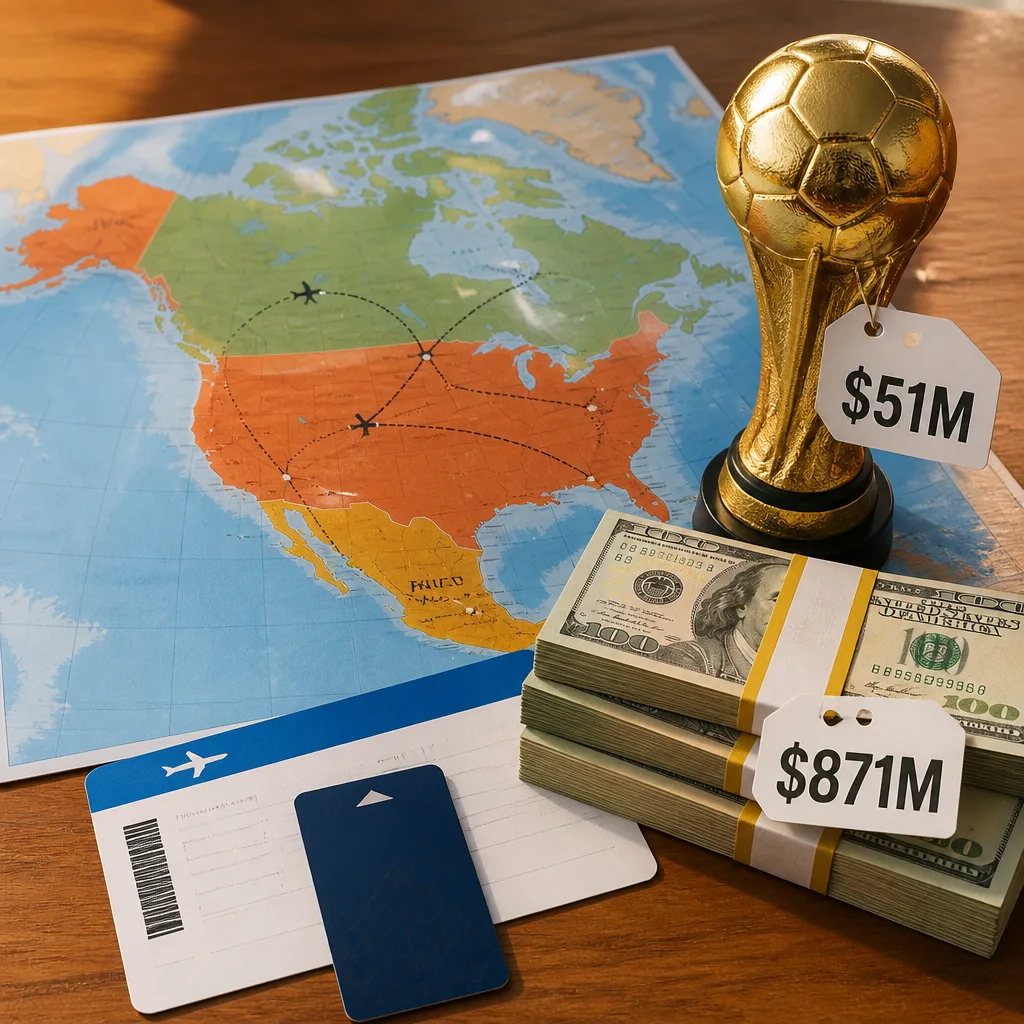
The 2026 FIFA World Cup will set a new financial benchmark: the champion will collect US$51 million as FIFA expands total team payments to a record US$871 million.
The governing body has increased the purse for the 48-team tournament, adding more than US$100 million this spring after federations — particularly in Europe — pressed for support to offset the realities of a competition stretched across three host countries and significant travel and lodging demands. The runner-up will receive US$34 million.
How the money flows
FIFA pays national federations in two buckets: performance-based prize money and standardized support for training and preparation. Every participant is guaranteed at least US$12.5 million for taking part — comprised of US$10 million tied to qualifying and playing in the group stage, plus US$2.5 million for pre-tournament expenses. The scale rises with each round advanced.
| Category | Amount (US$) |
|---|---|
| Total team payments (2026) | 871 million |
| Winner | 51 million |
| Runner-up | 34 million |
| Minimum per team | 12.5 million (10.0 + 2.5) |
FIFA says these upfront funds were put in place across past editions to prevent pre-tournament standoffs over unpaid bonuses — a recurring flashpoint in international football. By committing travel and training money before the first ball is kicked, federations can budget for extensive logistics while players have greater clarity on compensation structures.
North American staging drives costs — and pressure
This year’s purse reflects the unique geography of a World Cup played across the United States, Mexico and Canada. Training bases, charter travel and accommodation across long distances have escalated operational budgets. According to FIFA’s own breakdown, the additional US$100+ million approved in April followed lobbying by European federations concerned about covering those expenses at a 48-team event.
For Canadian readers, the dollars-and-cents of this tournament matter beyond a single match. Larger payments to participating federations can help stabilize national-team programs navigating a demanding schedule and broad footprint. The minimum guarantee alone — US$12.5 million per team — underscores how the World Cup has evolved into a substantial revenue event for every participant, not just the champion.
A windfall with perspective
Even at US$51 million, the winner’s purse is modest when set against global football’s broader economy. The total trails the money circulating in club competitions and the transfer market; it is smaller than what last year’s Club World Cup winner banked in a tournament also staged in the U.S., and, as noted this week, less than the transfer fee paid by English side Brighton for 19-year-old defender Luka Vušković, who spent most of this World Cup on the bench.
Still, the record pool sends a signal: FIFA is using its commercial clout to keep national federations onside as formats expand and travel intensifies. With elevated costs a fact of life for a World Cup spread across an entire continent, the richer purse is designed to reduce friction and ensure teams can plan confidently.
- All 48 teams receive money: at least US$12.5M plus more for each round reached.
- FIFA’s total team payouts hit a record US$871M, boosted by a springtime increase.
- The winner’s US$51M prize is significant — yet small next to club-level spending.
On the field, a trophy and, for the first time, championship rings await the victors. Off it, the balance sheet reveals how modern World Cups are financed: bigger stages, higher costs, and now, bigger cheques to match.