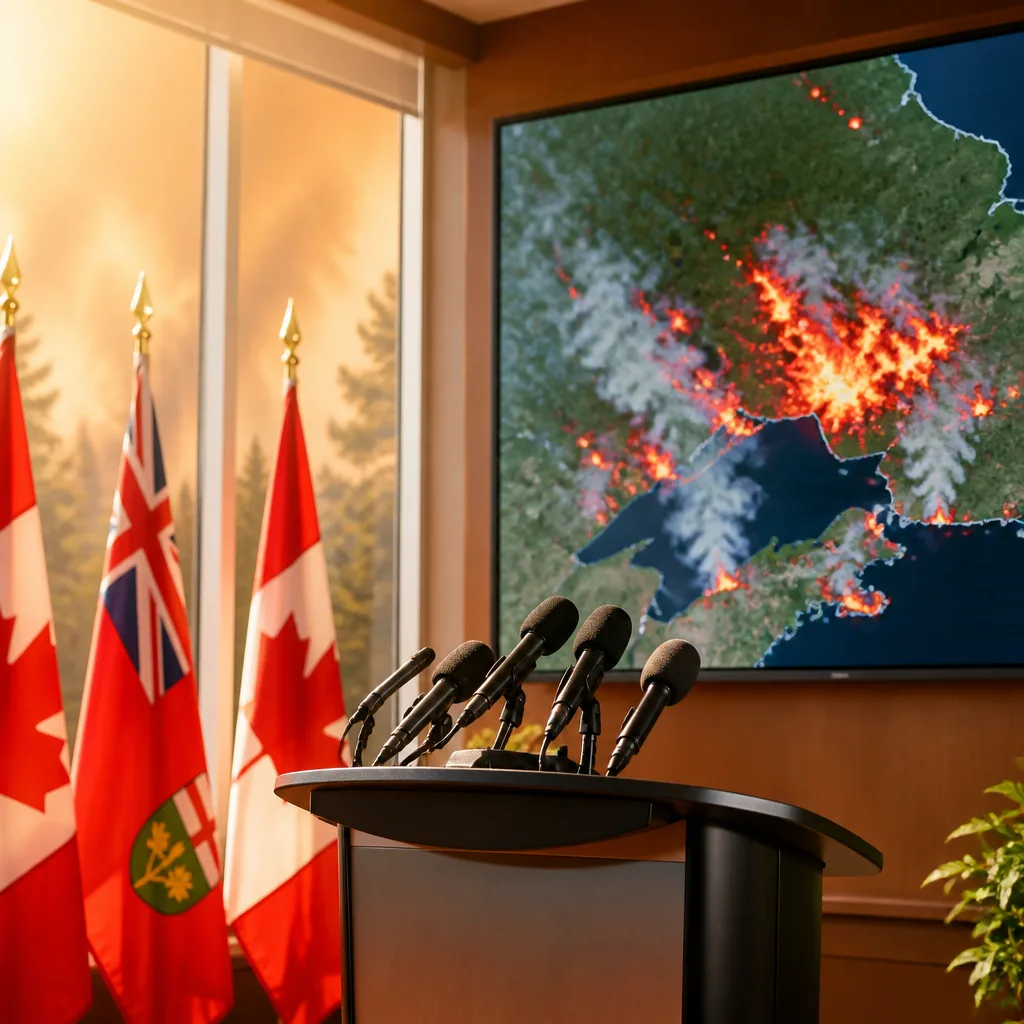
Ontario Premier Doug Ford publicly rejected criticism from American politicians of Canada’s wildfire response, defending current suppression efforts and pointing to previous Canadian assistance to the United States during severe fire seasons.
Premier answers U.S. critiques amid active emergency
Speaking Saturday at a news conference in Thunder Bay, Ford said some in Washington were levelling unfair accusations during an active emergency in northern Ontario. He singled out unnamed U.S. lawmakers and the Trump administration, characterizing their comments and reported threats as unacceptable. The premier argued that cross‑border solidarity has long been the norm when fire seasons intensify on either side of the border.
“I find it a shame the administration in the U.S. and Congress people [are] writing these letters and blaming us,” Ford said. “We had the water bombers and everyone going over to California. It was last year.... That’s what neighbours do.”
The remarks come as Ontario’s wildfire agencies continue to manage a demanding operational picture across the North. According to the provincial Aviation, Forest Fire and Emergency Services (AFFES), there were 191 active wildfires as of Saturday afternoon, with 73 not yet under control. The largest incident, known as Thunder Bay 36, has burned nearly 319,000 hectares, AFFES reported.
Suppression resources and evacuations
Ford said a substantial contingent of crews and aircraft remained engaged across affected regions. By his account, approximately 155 fire crews and roughly 80 water bombers were assigned to suppression operations on Saturday. He also said evacuations have been ordered in more than a dozen communities as conditions evolve.
Among those affected is Namaygoosisagagun First Nation in northwestern Ontario, where residents have faced displacement under mandatory orders. Officials cautioned that fire behaviour can change quickly depending on weather, fuels and access, and urged residents to follow local directives.
| Indicator | Figure | Source/Timing |
|---|---|---|
| Active wildfires (Ontario) | 191 | AFFES, Saturday afternoon |
| Not under control | 73 | AFFES, Saturday afternoon |
| Largest fire (Thunder Bay 36) | ~319,000 hectares | AFFES, Saturday afternoon |
| Crews deployed | ~155 | Premier’s remarks |
| Water bombers | ~80 | Premier’s remarks |
Cross‑border expectations and political stakes
The premier’s intervention highlights the political sensitivities that can surface when domestic emergencies intersect with international commentary. Ford’s reference to prior Canadian deployments of aircraft to assist in U.S. wildfire seasons underscores an established expectation of reciprocity in crisis management. While he did not detail the recent U.S. statements he objects to, his message suggested that public pressure from abroad is, in his view, counterproductive while suppression operations are ongoing.
Operationally, the focus remains on incident containment, evacuation support and protection of communities at risk. Strategically, Ford’s remarks function as a defence of provincial and federal capacity at a time when Ontario’s North is under strain and national attention is fixed on fire conditions. His comments also implicitly affirm that cross‑border support flows in both directions, a reminder that severe seasons can shift rapidly between jurisdictions.
What’s next
AFFES continues to update fire status and public safety advisories as conditions evolve. Authorities have urged residents in affected zones to monitor official channels and comply with local orders. Ford said Ontario would continue to assist neighbours when called upon, reiterating a commitment to mutual aid even as he condemned criticism from U.S. political figures.
- AFFES lists 191 fires active; 73 are not under control.
- Ford cites roughly 155 crews and 80 water bombers engaged in Ontario.
- Evacuations have been ordered in more than a dozen communities, including Namaygoosisagagun First Nation.