City charts new course for economic development
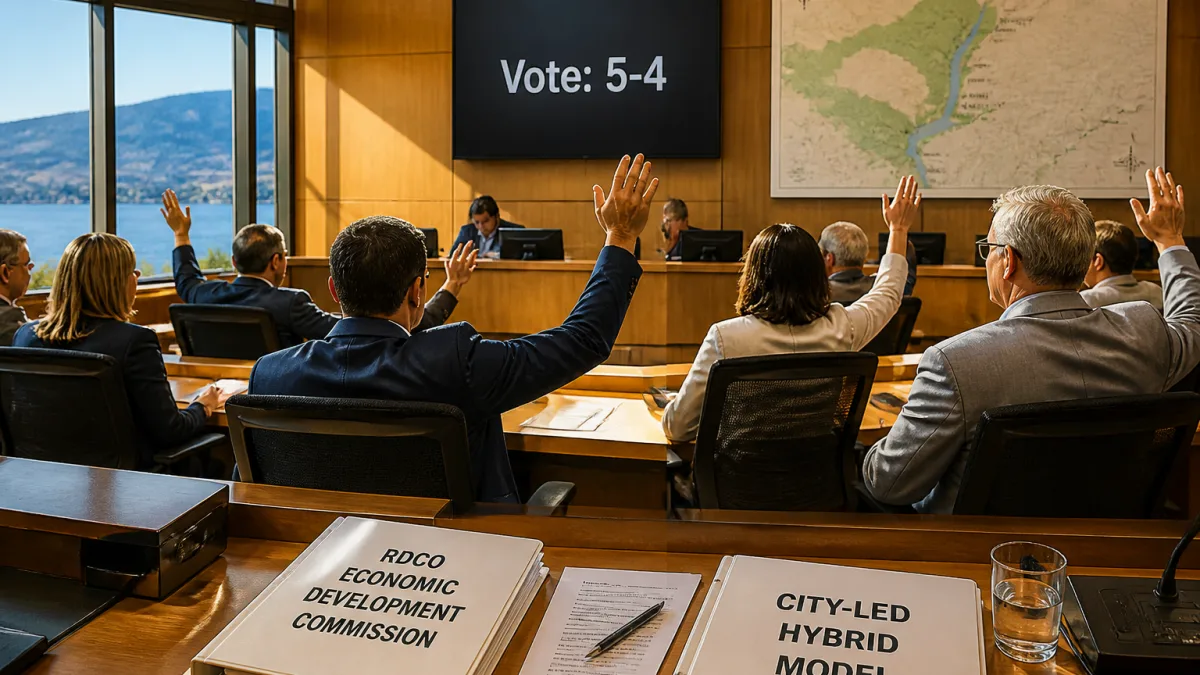
Kelowna will begin the process of withdrawing from the Central Okanagan Regional District’s economic development commission following a close 5–4 council vote on Monday, opting instead for an in-house, “hybrid” economic function recommended by the city’s economic prosperity task force.
The move ends Kelowna’s long-standing participation in a regional model that officials noted has existed for roughly 50 years. Councillors Loyal Wooldridge, Luke Stack Lovegrove (as reported), Charlie Hodge and Ron Cannan opposed the measure, warning of risks to collaboration and transparency. Supporters argued the city’s growth and complexity now require a more tailored, accountable approach.
Dissent over process and regional ties
Wooldridge, who also serves as chair of the RDCO board, raised concerns about the lack of prior engagement with regional partners and questioned whether the change was driven by a desire for greater municipal control rather than evidence of underperformance by the regional commission.
“It frustrates me because I don't fully believe that we are making an informed decision based on what the COEDC does,” Wooldridge said. “We've heard seven times at this meeting it's about control and for me before we walk away from a regional partnership, we owe it to the taxpayers to determine whether that existing structure can be improved.”
He added that a smaller, more focused leadership group could have been tried within the regional framework if the city had initiated that discussion, calling the decision “just exiting a service and going it alone.”
City rationale: scale and alignment
City staff countered that Kelowna’s size and economic profile have changed significantly, warranting a shift to a model tightly linked with municipal priorities, land use and infrastructure planning. Derek Edstrom, the city’s divisional director of partnerships and investments, told council that regional models are most effective when partner communities share similar scale and objectives, which he said is no longer the case.
“Kelowna has reached a scale where economic development can be more directly aligned with our land infrastructure, partnerships, advocacy, investment attraction and council priorities,” said Edstrom.
He described the plan as a lean, accountable, city-led function intended to support investment attraction and align with council’s strategic direction.
What changes for businesses and residents
For local employers, investors and job seekers, the decision signals a realignment of who leads and coordinates economic initiatives in Kelowna. The shift to a city-run hybrid approach could concentrate decision-making, shorten response times and tie investment attraction more closely to municipal files such as zoning, transportation and housing. Conversely, the departure raises questions about how cross-boundary issues—labour mobility, sector development and regional marketing—will be handled without the same level of formal coordination through the COEDC.
- Governance: City staff will begin the formal withdrawal steps from the regional service while standing up an internal economic function.
- Accountability: Proponents say the model enhances council oversight; critics warn it reduces regional input and shared strategy.
- Continuity: The council debate highlighted uncertainty about transition details and how collaboration with neighbouring communities will continue.
Close vote underscores divided council
The narrow outcome reflected the tension between regional collaboration and city-specific control. Those opposed pressed for a chance to reform the existing regional structure before quitting it, while backers emphasized the need for Kelowna-focused priorities after decades of relying on a broader commission.
| Decision point | Details |
|---|---|
| Vote outcome | 5–4 in favour of beginning withdrawal |
| Councillors opposed | Wooldridge, Lovegrove, Hodge, Cannan |
| Stated rationale to change | City scale and need for tighter alignment with municipal priorities |
| Regional model | COEDC has operated for about 50 years |
Next steps
With the vote now on the record, city administration will proceed with the steps required to leave the regional service and build the in-house function. Council’s debate did not set out timelines or detailed transition plans. As the process advances, residents and businesses can expect more clarity on program delivery, interfaces with the RDCO, and how the city will measure performance under the new approach.
The decision sets up a pivotal period for economic development in Kelowna, testing whether a city-led model can deliver stronger outcomes while maintaining productive ties across the Central Okanagan.