Festival returns to a site that built Saguenay
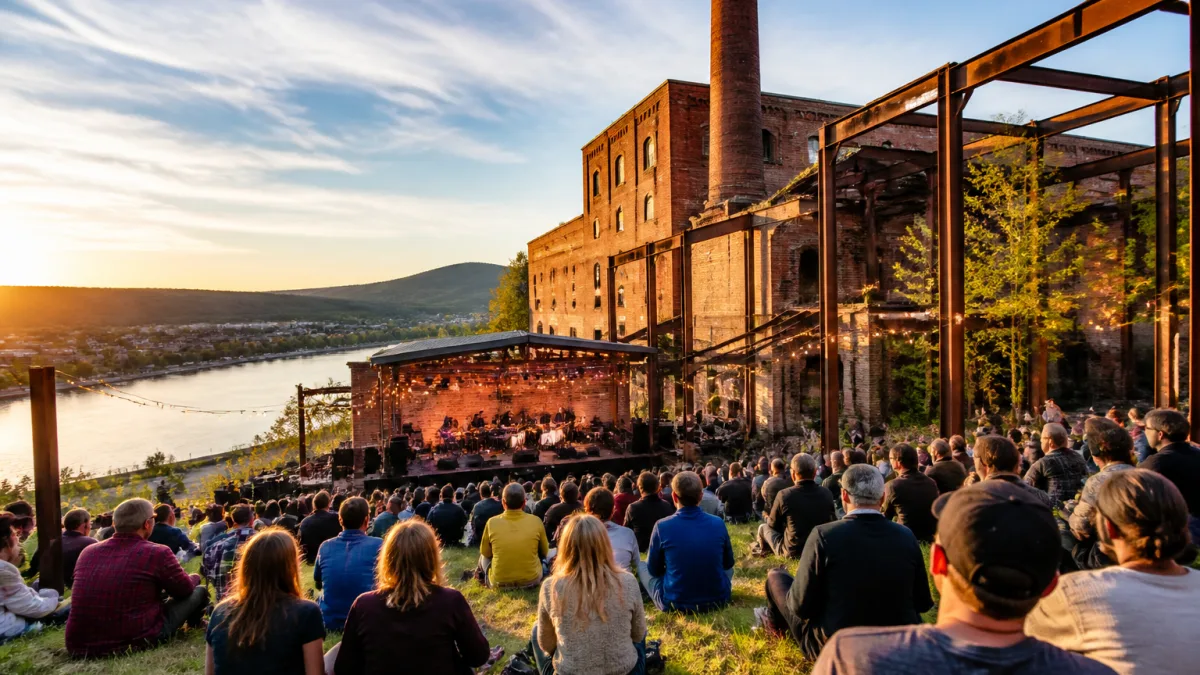
La Noce, a three-day music gathering in Chicoutimi, has carved out a distinct place in Saguenay’s cultural calendar by staging performances on the hillside remains of a late-19th-century paper mill. The setting at La Pulperie — a cultural and tourism centre near the Chicoutimi River — binds the event to the industrial roots of a city once known as Canada’s largest producer of mechanical pulp. The festival’s format is intimate by design, described as a backyard celebration that puts provincial talent at the forefront.
The site itself carries the weight of local history. The earliest surviving building dates to 1903, at a time when about 4,000 people lived in the area and roughly half were employed at the mill. Holding a contemporary music festival in that landscape underscores how Saguenay’s public assets — from preserved industrial infrastructure to cultural programming — are being reused to tell the region’s story in the present tense.
A compact event with a regional pull
Organizers frame La Noce as a deliberately scaled experience. Attendance is pegged at roughly 5,000, with audiences moving among outdoor platforms that ring the old facility’s slopes. For visitors, the location is reachable by an approximately six-hour drive from Montréal via forest-lined highways, a journey that reinforces the festival’s positioning: remote enough to stand apart, close enough to be accessible to touring artists and audiences across Québec.
“A sprawling backyard 'wedding party' of around 5000 people,” is how the festival’s atmosphere has been described, capturing its blend of informality and focus on Quebec’s music.
Co-founders Éric Harvey and Frédéric Poulin, longtime collaborators in the province’s music community, have rooted programming in their ties to Saguenay–Lac-Saint-Jean. Their connection to Chicoutimi — where many residents know La Pulperie from school outings — informs a curatorial approach that is as much about place as performance.
Public space, heritage and programming
La Noce’s footprint across the mill remains reflects a broader local shift: public amenities originally built for industry are now serving culture and tourism. In practical terms, that means the festival must work within a protected heritage site while ensuring safe circulation on sloped grounds and along routes that once moved pulp, not crowds. It also makes municipal coordination central to the event’s success, from site preparation to neighbourhood access during peak hours.
- The venue is embedded in Chicoutimi’s urban fabric, tying performances to nearby services and businesses.
- Heritage interpretation coexists with staging and sound, maintaining the site’s educational role even during live events.
- Scaled attendance aligns with the capacity of historic structures and surrounding streets.
Residents familiar with La Pulperie will recognize how its museum and tourism functions frame the experience for festivalgoers. The setting invites audiences to consider the continuum from pulp production to performance — and how civic stewardship keeps these spaces active.
Numbers that tell the story
| Detail | Figure/Fact |
|---|---|
| Festival duration | Three days |
| Approx. attendance | 5,000 people |
| Site’s earliest building | 1903 |
| Local population circa 1903 | ~4,000 residents |
| Share working at mill (historic) | About half |
| Drive from Montréal | ~6 hours |
Why it matters for Saguenay
La Noce is more than a weekend of concerts. Its location inside an emblematic industrial complex positions the city’s heritage as an active stage, not a static exhibit. For Saguenay residents, that means a public venue they visited as students is hosting a contemporary program that reflects the region’s identity. For visitors, the journey to Chicoutimi doubles as an introduction to the landscape that powered the city’s early growth.
The founders’ longstanding ties to the local scene — formed in Chicoutimi and sustained from Montréal — help ensure the event remains connected to community expectations and site realities. That balance, between conservation and activation, is central to how Saguenay leverages its assets. As a compact, place-based festival, La Noce continues to demonstrate how careful curation and a distinctive setting can carry an event on its own terms, while keeping the city’s story at the centre.