
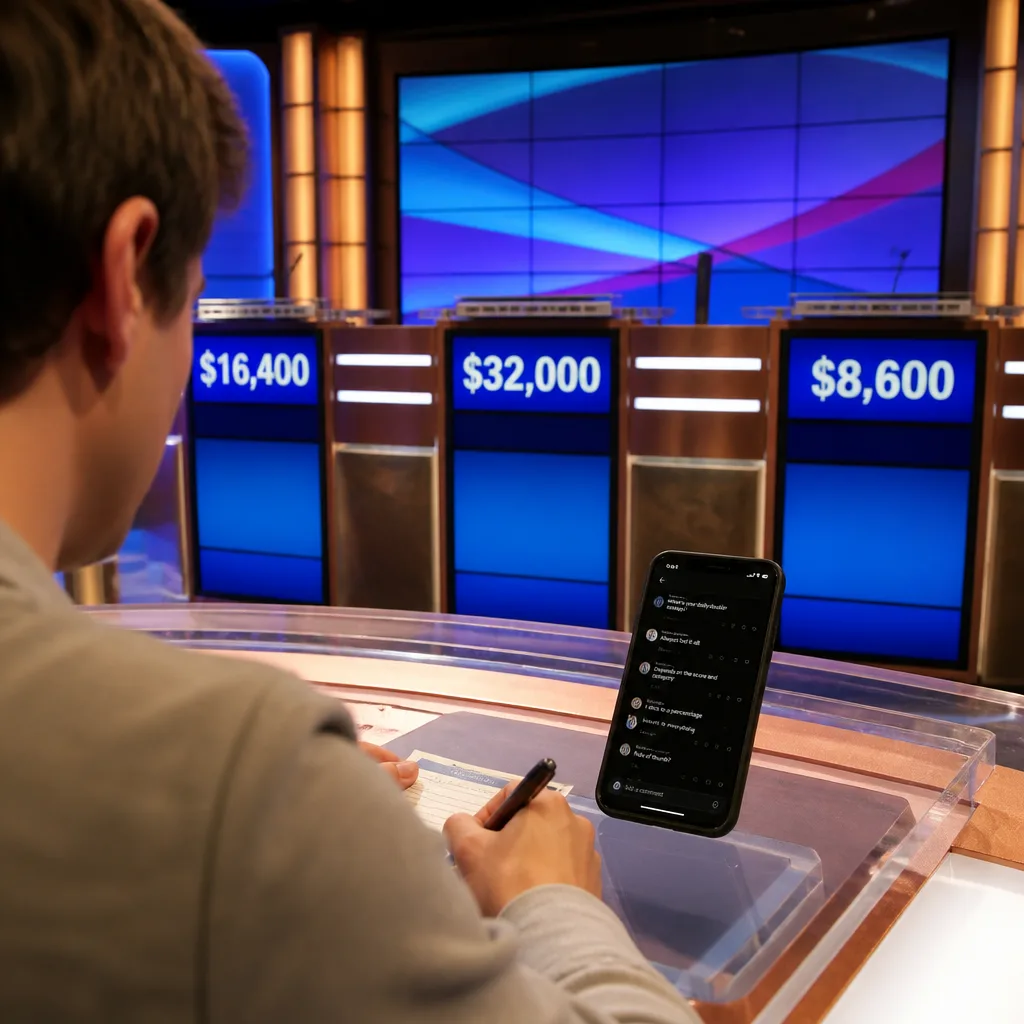
Grace Biermann, the librarian and writer who recently won an episode of Jeopardy!, has offered a fuller explanation of several aggressive wagers that shaped her victory — and prompted lively debate online.
How the game swung on large bets
Biermann finished the episode with $32,000 in winnings after a series of bold moves. Early in the game she encountered the first Daily Double with $3,400 on the board and risked $1,400, which she answered correctly to bring her to $4,800. Later, with $19,200 in play, she wagered $10,000 on a second Daily Double and again converted the clue, moving her to roughly $29,200. She closed the game by making a small Final Jeopardy wager of $2,000, ending with a final total of $32,000.
| Moment | Bank | Wager | Result |
|---|---|---|---|
| First Daily Double | $3,400 | $1,400 | Correct → $4,800 |
| Second (third in show) Daily Double | $19,200 | $10,000 | Correct → ~$29,200 |
| Final Jeopardy | ~$30,000 | $2,000 | Correct → $32,000 |
Public reaction and personal reflection
The size of Biermann’s midgame wager, in particular, drew attention because her nearest competitors held roughly $7,800 and $7,000. After the episode aired she posted on Reddit to put the decisions in context, acknowledging both surprise and second-guessing about the large midgame stake.
"I've seen a lot of people wondering about my wagering decisions (some more politely than others), and I wanted to give a little bit more context for them. (Sorry this is a few days late—it's been a pretty overwhelming week!),"
In that post she also reflected on broader patterns she had noticed while preparing for the show: that women sometimes appear less aggressive with wagers. She described feeling naturally anxious and cautious, and that part of her aim on the show was to challenge that tendency by making "big swings" and testing her confidence across the board.
What the moves reveal about strategy
Biermann’s account highlights several strategic considerations that inform wagering on quiz shows such as Jeopardy!:
- The value of seizing opportunities when only one player controls a Daily Double.
- How relative bankrolls of opponents shape risk-taking.
- The psychological element of gameplay — balancing confidence, anxiety and the desire to alter typical patterns.
Her explanations appear intended to demystify her choices rather than defend them; she admits one early bet could have been larger and describes the episode as an intense, reflective experience.
Viewers and fans often scrutinize wagering in high-profile quiz shows because a single large bet can decisively change outcomes. Biermann’s public breakdown of her approach adds a candid voice to that conversation, and reconnects the tactics on-screen with the personal calculations contestants bring to the buzzer.